


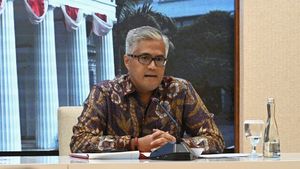
JAKARTA - Saudi Arabian Health Minister Fahad Al-Jalajel confirmed on Monday that so far there have been no public health problems during the Hajj season, saying the public health situation remains stable.
"We are pleased to announce that no cases of an epidemic have been detected so far and there is no risk of an outbreak of the disease. The health and safety of the congregation remains our top priority," Minister of Health Al-Jalajel said in an official statement, quoted from Arab News May 27.
He further said the Kingdom of Saudi Arabia was proactively preparing to ensure safe Hajj for everyone, with the Ministry of Health continuing to monitor the health situation strictly.
Saudi Arabia's thorough readiness has been guided by the direction of King Salman bin Abdulaziz Al Saud and Crown Prince Mohammed bin Salman, and is made possible by close cooperation in all public, private and non-governmental sectors, the ministry said.
Saudi Arabia began preparations for Hajj a few months earlier, assessing global health risks for diseases such as yellow fever, polio and meningitis.
This effort was followed by the implementation of strict health entry requirements and the introduction of new "health capabilities" criteria to ensure that pilgrims were in a medically healthy condition to carry out worship safely, the ministry added.
Minister of Health Al-Jalajel thanked all countries for their cooperation and compliance with these guidelines.
"Our story with the hajj has been going on for a long time, but every year we write a new chapter, with better readiness, more in-depth awareness and smarter technology," said Minister of Health Al-Jalajel.
The ministry said the health team had been placed at 14 entry points by land, air, and sea to provide medical services as soon as the first flight under the Makkah Route Initiative arrived.
The ministry has also launched many campaigns to increase public health awareness in multilanguage through media, field involvement, and international medical missions.
In addition, health infrastructure in holy places is significantly increased. Bed capacity has increased by 60 percent compared to last year.
SEE ALSO:



A new 200-bed emergency hospital was recently inaugurated in Mina, while three field hospitals with a total of more than 1,200 beds were deployed in collaboration with the Ministry of Defense, Domestic and National Guard.
This year also witnessed the involvement of the highest private sector in Hajj health care, with three major private hospitals operating in holy places.
To ensure a rapid emergency response, 11 medical evacuation aircraft, 900 ambulances, and 71 new emergency points have been activated, with more than 7,500 paramedics on the ground.
State-of-the-art digital solutions are being deployed, including smart monitoring devices for high-risk pilgrims connected to the Virtual Seha Hospital and telemedicine services for long-distance consultations. More than 50,000 health workers and technical professionals are behind this effort.
The English, Chinese, Japanese, Arabic, and French versions are automatically generated by the AI. So there may still be inaccuracies in translating, please always see Indonesian as our main language. (system supported by DigitalSiber.id)


