

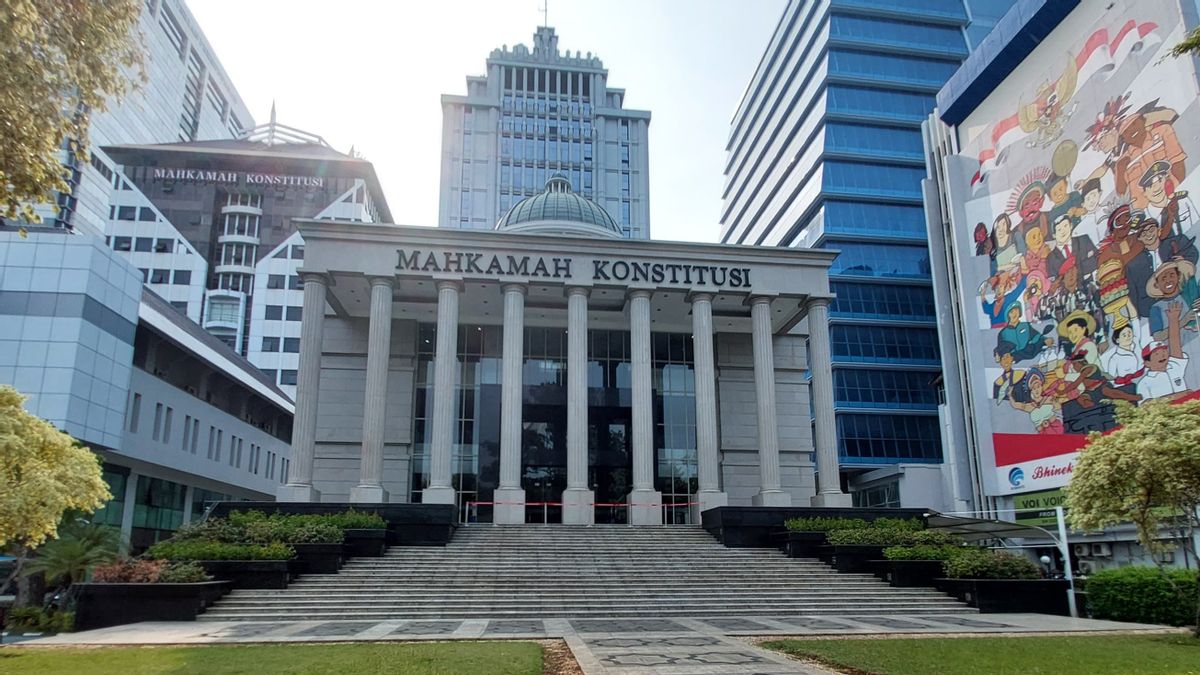


PEKANBARU - Professor of the Defense University (IDU), Colonel Sus Prof. Dr. Drs Mhd. Halkis MH submitted a judicial review to the Constitutional Court (MK) against Law Number 34 of 2004 concerning the Indonesian National Army (UU TNI).
"The judicial review of the TNI Law was submitted because it was considered against the constitution and curbed the rights of soldiers as citizens," said Mhd Halkis in his statement quoted by Antara, Sunday, March 16.
Mhd Halkis submitted a judicial review of the TNI Law through his attorneys, Izmi Waldani and Bagas Al Kautsar, with registration number 41/PAN.ONLINE/2025.
According to Halkis, who is also an active officer, Article 2 letter d of the TNI Law defines professional soldiers as trained, educated soldiers, well equipped, not practical politics, not doing business, and guaranteed welfare.
This definition is considered inappropriate logically because it uses a negative approach, does not explain the definition of a professional soldier positively, but only mentions what should not be done. As a result, misunderstandings arise in understanding military professionalism.
"The professional army must be interpreted as a soldier who carries out state duties in a neutral, competency-based manner, and has rights in the economic aspect and public office," he said.
Article 39 paragraph (3) of the TNI Law prohibits soldiers from doing business. This rule is considered contrary to Article 27 paragraph (2) of the 1945 Constitution which guarantees the right of every citizen to get a decent job and livelihood.
In the United States and Germany, soldiers are allowed to have businesses with clear monitoring mechanisms. Halkis questioned why in Indonesia soldiers are prohibited from doing business, while guaranteeing welfare for them is inadequate.
"Privates are also experiencing economic inequality due to this ban, especially post-retirement. If the ban remains in effect, the state is obliged to provide sufficient economic guarantees for soldiers while on duty and after full duty," he said.
In addition, Article 47 paragraph (2) of the TNI Law restricts civil office for active soldiers to only seven agencies, such as the Coordinating Ministry for Political, Legal and Security Affairs, BIN, Lemhannas, and BNN. This rule is considered not in line with the principles of meritocracy and is contrary to Article 28D paragraph (3) of the 1945 Constitution, which guarantees citizens' rights to the same opportunity in government.
"Many civilian positions require technocratic expertise from TNI soldiers, such as at the Ministry of Education or the Ministry of Foreign Affairs, but this rule limits opportunities for those who have competence outside the seven agencies," he said.
If the Constitutional Court grants this request, several major changes can occur, such as the concept of military professionalism which is clearer and based on constitutional principles and justice. The economic rights of soldiers are also more flexible with strict supervision, or the state is obliged to provide better welfare.
SEE ALSO:
-
 | BERITA
Prabowo Beri Hormat ke Mentan Amran Berhasil Jalankan Program Swasembada Pangan
16 Maret 2025, 00:15 -
 | EKONOMI
Menteri PKP Sebut Desain Rumah Lippo Group Cocok Untuk Hunian Subsidi
16 Maret 2025, 01:16

TNI soldiers can also get wider career opportunities, including occupying civilian positions based on their competence.
"Reformation of the TNI Law through the Constitutional Court's decision is believed to be the basis for revising the TNI Law so that it is more in accordance with the demands of the times, as well as an important precedent for constitutional reform in Indonesia," said Halkis.
The English, Chinese, Japanese, Arabic, and French versions are automatically generated by the AI. So there may still be inaccuracies in translating, please always see Indonesian as our main language. (system supported by DigitalSiber.id)
Most Popular Tags
#Prabowo Subianto #donald trump #Febrie Adriansyah #8791 #giias 2026Popular


