

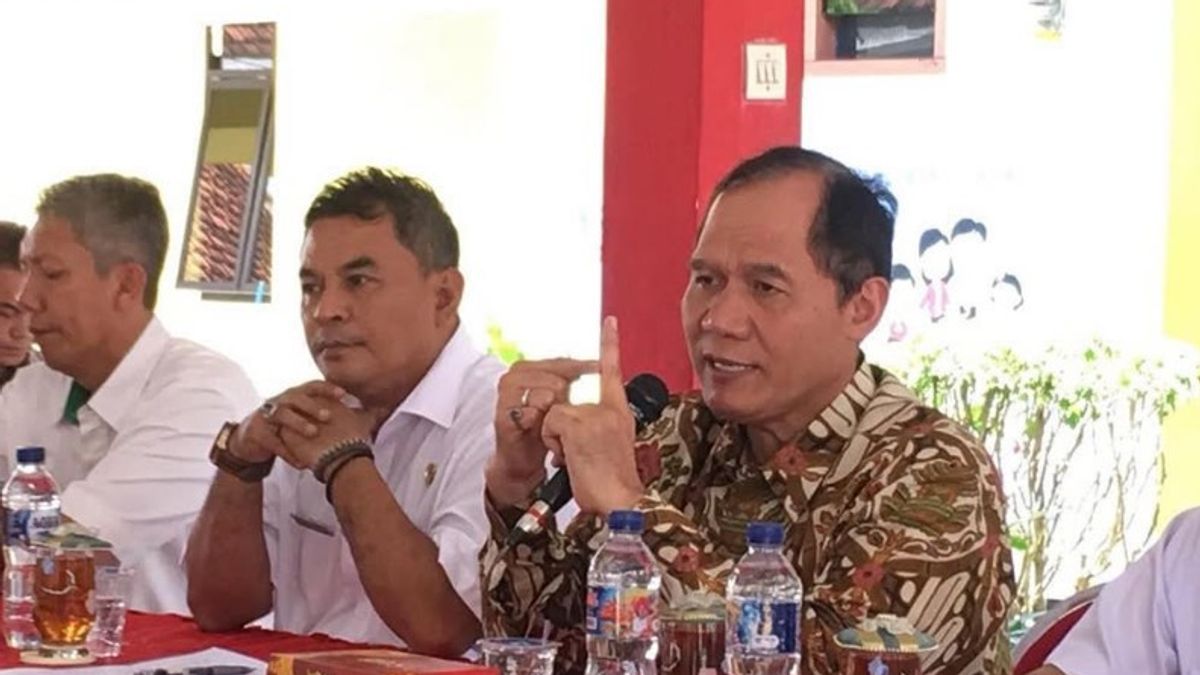


Member of Commission VII of the House of Representatives, Bambang Haryo Soekartono, supports President Prabowo Subianto's plan to revive the textile SOEs to meet the basic needs of the community. The plan will be completed with the preparation of a roadmap for strengthening the textile industry with preparations for funds of around 6 billion US dollars.
According to Bambang, the roadmap plan to increase export value from 4 billion US dollars to 40 billion US dollars in 10 years is reasonable. He assessed that the target could be achieved by the government if there were innovations that could dominate global competition.
"This can be done, if the government is serious about doing it. This means that the garment industry built by the government must be accompanied by high innovation, so that it can compete in the global arena," said Bambang Haryo, Saturday, January 17.
Moreover, said Bambang, if the Nusantara garment industry uses its raw materials which also come from Indonesia itself, then the national textile industry will strengthen.
"Cotton is provided, and the upstream industry, which is currently imported from China at around 60-90 percent, can also be drastically reduced. This is expected to continue, supported by private industries, which are full of innovations," he said.
Bambang also hopes that there will be greater support for the ekraf industry which will allow unique products to emerge, and be able to attract the interest of foreign consumers.
"Support from the government, whose budget is very small now. We really hope that this ekraf can be increased, so that this will bring specific and special industries, which have no match in the world. So that it is able to attract foreign consumers," he said.
In addition, he added, the Government can also encourage the public to use domestic products. As has been promoted by Maspion, that we must love domestic products.
"So those who rise, not only exports but also consumption in our country. People must use many domestic products, especially those produced by the garment industry built by the government," concluded Bambang.
Previously, Coordinating Minister for Economic Affairs Airlangga Hartarto, conveyed that the government would form a new state-owned enterprise (BUMN) specifically for the textile sector. The plan is a direction from President Prabowo Subianto during a meeting in Hambalang, Bogor, West Java on January 11.
The reason is that the textile and garment industry is considered to be the front line in facing the risk of US tariff policies. "It will form a new state-owned enterprise for textiles. It will not revive (old textile companies)," said Airlangga at the Indonesian Business Council (IBC) Business Outlook 2026 in Jakarta, reported by Antara.
From the results of the completed study, Airlangga said, the plan will be continued with the preparation of a roadmap for strengthening the textile and textile products (TPT) industry.
To support this policy, the Government has prepared funding of USD6 billion through BPI Danantara. The funds are directed towards the procurement of capital goods, the implementation of new technologies, to increasing exports in the textile sector.
"Therefore, a roadmap has been made on how to increase our exports from 4 billion (US dollars), to 40 billion (US dollars) in 10 years, and how to deepen the value chain rather than the textile industry," he said.
The English, Chinese, Japanese, Arabic, and French versions are automatically generated by the AI. So there may still be inaccuracies in translating, please always see Indonesian as our main language. (system supported by DigitalSiber.id)


