

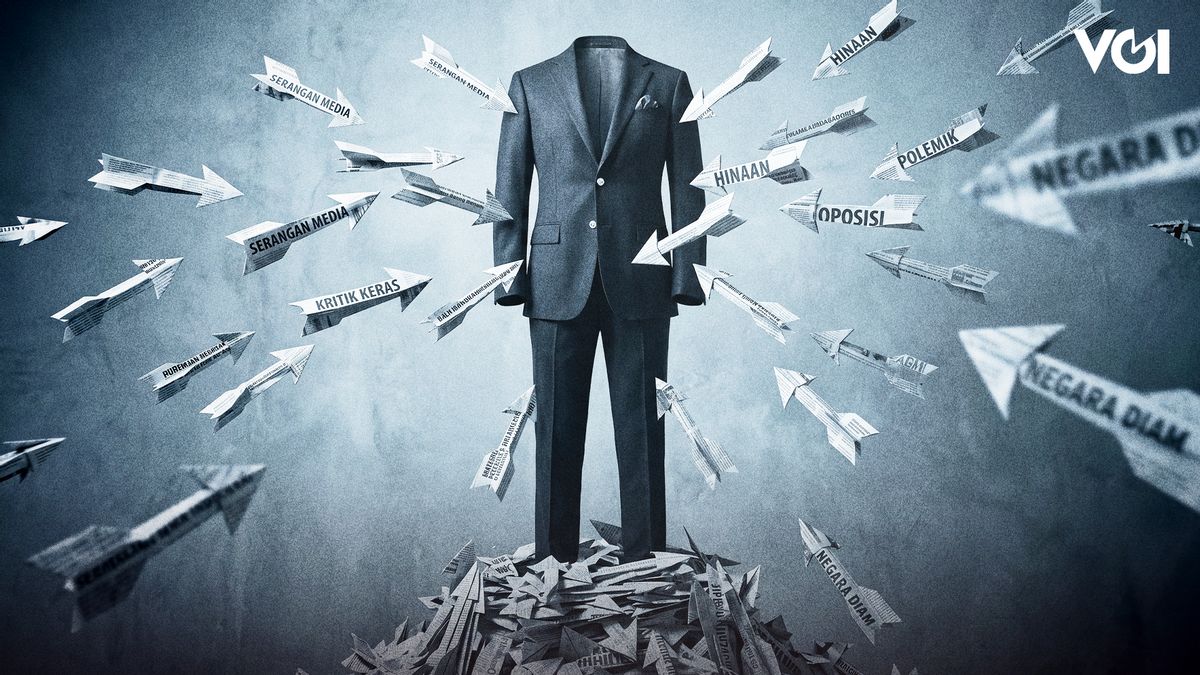
JAKARTA - In the midst of heavy criticism, verbal attacks, and waves of provocation on social media, one question arises that tickles: why does the country seem to choose to be silent when its leaders are publicly insulted?
This phenomenon is not as simple as it seems. It is at the intersection of law, mass psychology, and complex political communication strategies.
In terms of regulation, the state's approach actually has a clear legal basis. In Law Number 1 of 2023 concerning the Criminal Code, insulting the President is categorized as a complaint offense. This means that the legal process can only run if the President personally files a report.
In the perspective of political communication, public attention is a very valuable asset. Even, attention that is born from negative sentiments can produce significant effects.
Political communication observer Gun Gun Heryanto explained that in the digital era, the logic of communication has changed. "We live in an attention economy. The more crowded an issue is, the greater the reach and impact. Even harsh criticism can serve as a reinforcement of political existence," he explained.
This theory is in line with the concept of agenda-setting introduced by Maxwell McCombs, which states that the intensity of news coverage or public conversations determines what issues are considered important by the public.
In this context, attacks on leaders do not always lead to weakening. In fact, in many cases, it can trigger a sympathy effect.
This phenomenon is known as the rally around the flag effect, a concept explained by political scientist John Mueller. When a leader is perceived to be unfairly attacked, the public - especially the support base - tends to increase its solidarity and loyalty.
"Excessive or disproportionate attacks can actually strengthen the position of the party attacked. The public sees it as an injustice," said Burhanuddin Muhtadi.
Opinion Manipulation
On the other hand, modern political dynamics are also inseparable from the potential for disinformation and deliberate provocation. In the report Computational Propaganda, researchers from Oxford University revealed that manipulating public opinion often involves infiltrating narratives, including through actors who pretend to be part of a certain group.
This kind of strategy often ends in a boomerang effect. An inaccurate or exaggerated narrative actually damages the credibility of the party that spreads it.
The case of Ratna Sarumpaet is one example that is often referred to. Claims that are proven to be untrue in the case resulted in a decrease in public confidence in the group that raised him. In the realm of psychology, the way the public processes information also plays an important role.
The concept of cognitive priming explains how exposure to initial information can shape the way a person understands subsequent information.
Nobel Prize in Economics Daniel Kahneman explained that humans tend to use quick judgments based on initial perceptions, not in-depth analysis. In the context of politics, this makes public opinion easily formed by repetitive narratives.
Thus, the state's silence does not always mean weakness. In some cases, it actually becomes part of a strategy that allows public opinion to develop naturally.
Political observer Rocky Gerung said that a non-reactive attitude could be a form of communication in itself. "Silence does not mean defeat. Sometimes it is a way to show that the attack is not worth responding to," he said.
Ahead of the next political contest, this pattern becomes increasingly relevant. Emotion-based attacks, especially those not supported by data, have the potential to be counterproductive.
Burhanuddin Muhtadi added that Indonesian voters tend to be rational in the long run. "Narration that is not based on facts will lose its influence. It can even turn into sympathy for the party that is attacked," he said.
In the end, the phenomenon of "the more you insult, the more you love" is not just a slogan, but a reflection of complex social-political dynamics. It shows that in the digital age, public perception is not only shaped by facts, but also by the way facts are packaged, disseminated, and debated.
For the public, the challenge is to keep the mind clear in the midst of the torrent of information. Because, in the noise that is constantly produced, not everything that sounds loud really has a strong meaning.
The English, Chinese, Japanese, Arabic, and French versions are automatically generated by the AI. So there may still be inaccuracies in translating, please always see Indonesian as our main language. (system supported by DigitalSiber.id)


