

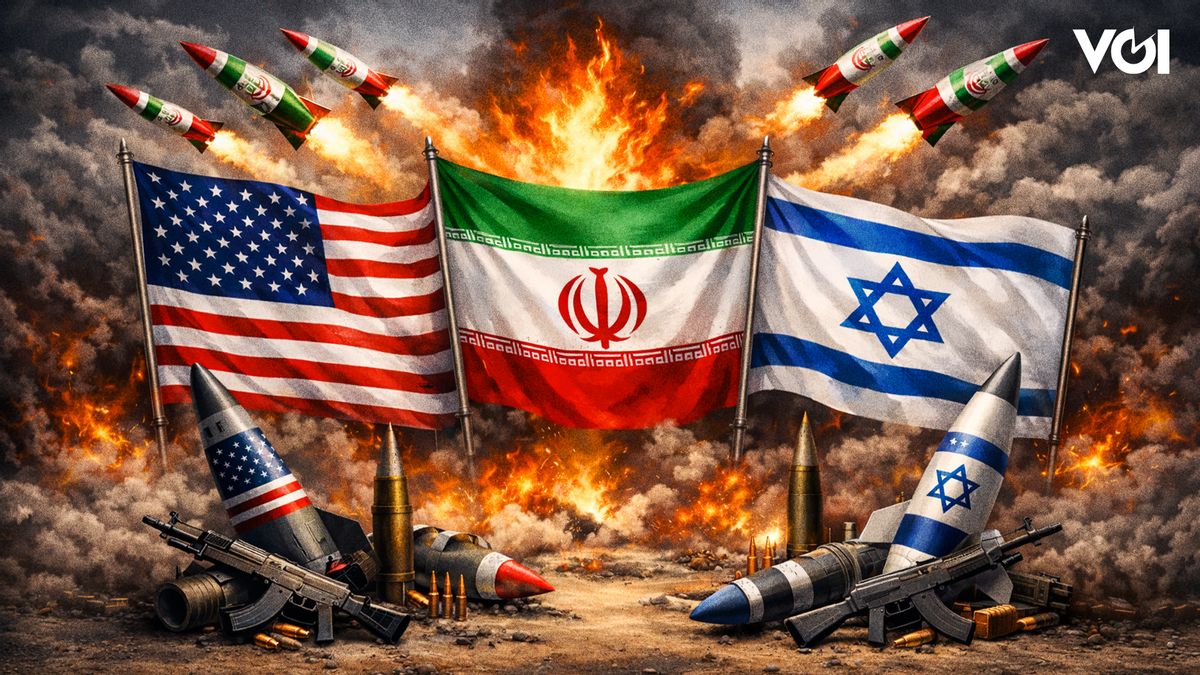
JAKARTA - The confrontation between Iran and Israel, which has been taking place in the shadows of intelligence, sabotage, and proxy conflicts, has now turned into a large-scale open war. At the end of February 2026, a series of air raids by the United States and Israel on strategic facilities in Iran triggered a harsh response from Tehran, making the situation more tense than before.
For years, tensions between Iran and Israel have been manifested more through cyber operations and proxy attacks in various points such as Lebanon, Iraq, and Syria. These attacks rarely result in the direct involvement of official forces, but involve militant groups or unofficial units in complex "shadow wars". However, since February 28, 2026, the US-Israeli joint attack has exceeded this pattern. The air raids launched by the two countries against several strategic locations in the Tehran region and Iranian military facilities are referred to as open military operations.
The attack turned out to be part of an operation with a different code name, and had resulted in the death of Iran's Supreme Leader, Ayatollah Ali Khamenei, in an attack planned by Israel with the support of US intelligence.
War Time Prediction
Benjamin Netanyahu stated that this conflict "may take time, but it will not last for years," confirming his belief that joint military operations can bring structural changes in Tehran without a prolonged war.
Quoted from the New York Post, senior researcher from the Institute for National Security Studies, Kobi Michael said the retaliatory missile attack from Iran indicates that this conflict has become a "biblical event" with long-term implications for Tehran's stability, because even if the regime survives, the impact will be huge.
The war between Iran - Israel which was initiated by the United States attack has sparked harsh criticism from various countries such as Turkey, Malaysia and Indonesia. The reason is that the war is considered a unilateral act without a mechanism for de-escalation through diplomacy. These countries ask the warring parties to respect international law.
Former Indonesian Foreign Minister and also founder of the Foreign Policy Community of Indonesia (FPCI), Dino Patti Djalal, estimates that the US and Israeli military attacks on Iran could potentially last longer than expected. The former Indonesian Ambassador to the United States said President Donald Trump is believed to have asked Indonesia not to interfere.
"I believe President Trump does not want Indonesia to interfere because his mood is blind to overthrow the Iranian government," said the former Indonesian Ambassador to the United States on his Instagram account @dinopattidjalal, Sunday (1/3).
Dino reasoned that the relationship between Indonesia and Iran was not very close in recent times. Dino highlighted that there was no interaction between President Prabowo Subianto and Iran, either through visits or meetings in a third country.
"Indonesia must dare to take a firm and realistic stance. Don't play the role of peacemaker. The attack by America and Israel on Iran is clearly contrary to President Prabowo Subianto's speech in his speech at the UN last year," he said.
The Human Dimension and the Risk of Escalation
The latest data shows that the conflict that has spread has affected victims in various countries, from Iran to the Gulf countries that are the target of retaliatory missiles and drones. The report notes hundreds of casualties and injuries in several countries as a result of this confrontation.
As an example of a world-shaking tragedy, an air strike hit a school in Hormozgan Province, Iran, killing dozens of students and causing serious injuries. This is a symbol of how the impact of failed wars is not limited to the military zone alone. California Governor Gavin Newsom also delivered a harsh criticism on Monday local time against Donald Trump.
"We have to reconcile why our bombs are used or Israeli bombs are used to kill children, young girls, in a school and what the imminent threat is; it hasn't been explained," Newsom said, quoted by Anadolu, Tuesday, March 3.
According to Newsom, Trump's policy on Iran is dangerous for US citizens and undermines US national security interests.
"We cut taxes for billionaires, we cut funding for behavior, cut funding for health care, cut food stamps to fund a war that no one wants and was never approved by Congress, increasing costs for everyone," he added.
Global Geopolitical and Economic Impact
This conflict is not only a bilateral problem. Iran-Israel tensions also disrupt global energy flows, especially through potential disruptions in the Strait of Hormuz - an important economic route for the world. Mohammad Faisal, Executive Director of CORE Indonesia, said an attack on Iran could trigger a spike in global oil prices, which has an impact on inflation, especially in energy-importing countries such as Indonesia.
In addition, this conflict has driven an increase in logistics costs due to disruptions in energy supply and uncertain market conditions, according to M Rizal Taufikurahman from the Institute for Development of Economics and Finance (Indef).
The English, Chinese, Japanese, Arabic, and French versions are automatically generated by the AI. So there may still be inaccuracies in translating, please always see Indonesian as our main language. (system supported by DigitalSiber.id)


