

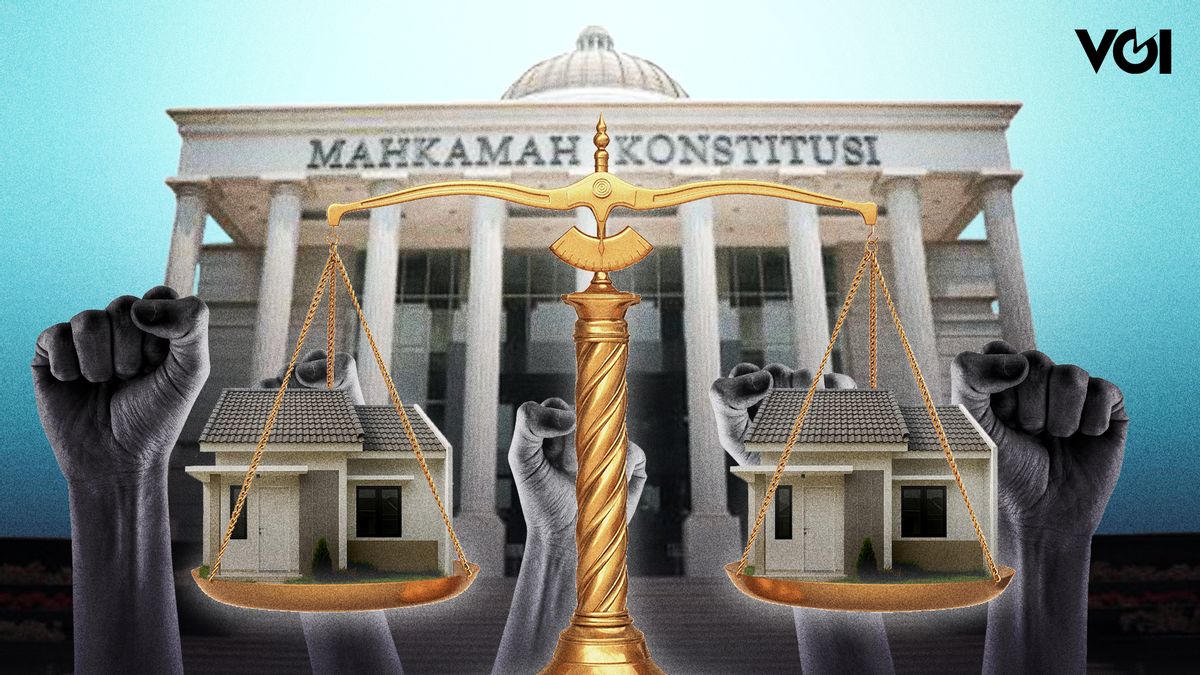
JAKARTA – The Constitutional Court has granted all petitions for judicial review of Law Number 4 of 2016 concerning Public Housing Savings (Tapera) filed by the All-Indonesian Trade Union Confederation (KSBSI).
In its ruling, Decision Number 96/PUU-XXII/2024, the Constitutional Court declared the Tapera Law unconstitutional because Article 7 paragraph (1), which states, "Every worker and self-employed person earning at least the minimum wage is required to participate," contradicts the 1945 Constitution.
"Granting the applicant's petition in its entirety. Declaring that Law Number 4 of 2016 concerning Public Housing Savings (State Gazette of the Republic of Indonesia Number 56 of 2016, Supplement to the State Gazette of the Republic of Indonesia Number 5863) contradicts the 1945 Constitution and has no binding legal force unless it is reorganized as mandated by Article 124 of Law Number 1 of 2011 concerning Housing and Residential Areas (State Gazette of the Republic of Indonesia Number 5188)," said Chief Justice Suhartoyo while reading the ruling on Monday, September 29.

"Declares that Law Number 4 of 2016 concerning Public Housing Savings (State Gazette of the Republic of Indonesia Number 5 of 2016, Supplement to the State Gazette of the Republic of Indonesia Number 5863) remains in effect and must be restructured within a maximum of two years from the issuance of the a quo decision," he continued.
The judicial review of the Tapera Law was filed by two labor groups and one worker, who objected to Article 7 paragraph (1). The plaintiffs argued that the phrase "mandatory" only increases the financial burden while providing no guarantee of housing.
In his deliberations, Constitutional Justice Saldi Isra outlined several reasons why the Tapera Law contradicts the 1945 Constitution. First, the Constitutional Court considered that Tapera shifted the meaning of savings, which is essentially voluntary, to a coercive debt. The use of the term "savings" cannot be separated from its general meaning in banking practices and the financial system. Savings are a form of deposit whose withdrawal is subject to conditions agreed upon between the community and the financial institution.
Thus, the elements of voluntariness and consent are crucial foundations in the legal framework and context of fund retention. Meanwhile, the concept of savings under Tapera is defined as savings made by participants periodically for a specified period of time, which can only be used for housing financing and/or returned along with the proceeds after participation ends.

"Based on these considerations, the use of the term savings in Tapera cannot necessarily be interpreted as a formal, coercive debt, like taxes. In this regard, the inclusion of the term savings in the Tapera program creates problems for affected parties, namely workers, because it is locked into an element of coercion and places the word "obligatory" as Tapera participants. Therefore, conceptually, it does not align with the true nature of savings, as it no longer involves free will," explained Saldi.
Second, the Constitutional Court considered that the obligation for workers to become Tapera participants to obtain housing has displaced the role of the state. In fact, the state is positioned as the primary responsibility for providing decent housing for its citizens. However, Article 7 paragraph (1) of the Tapera Law is inconsistent with that objective.
This norm requires every worker, including self-employed workers earning at least the minimum wage, to become a participant. The provisions of Article 7 paragraph (1) also align with the essence of Article 34 paragraph (1) of the 1945 Constitution, which essentially affirms the state's obligation to take full responsibility for vulnerable groups. Instead, it requires them to bear additional burdens in the form of savings which creates an element of coercion.
"The principle of state responsibility is emphasized in sectoral policies regarding housing, explicitly outlined in Law Number 1 of 2011, which affirms the state's role in guaranteeing the right of every citizen to occupy, enjoy, and/or own a decent home in a healthy, safe, harmonious, and sustainable environment," said Saldi.
"To realize this role, the state ensures the availability of long-term, sustainable, and affordable funds to meet housing and housing needs through a financing system in the form of mobilization and collection of funds," he added.
Third, the Constitutional Court assessed that the phrase "obligatory" in Article 7 paragraph (1) of the Tapera Law would burden workers, especially those who have been laid off, and/or employers whose businesses have had their business licenses revoked. This has the potential to degrade socio-economic life, further distancing the state from realizing the mandate of Article 34 paragraph 1 of the 1945 Constitution, impacting the economic well-being of workers and employers.

This is because if workers or employers violate Article 7 paragraph (1) and Article 9 paragraph (1) of the Tapera Law—which requires employers to register workers as participants—they will be subject to administrative sanctions. For example, business permit suspension or revocation. This, the Constitutional Court stated, is certainly burdensome for employers, especially in an unfavorable economic situation.
Fourth, the Constitutional Court considered that the existence of Tapera contradicts Law No. 1 of 2011 concerning Housing and Residential Areas. Under Law No. 1 of 2011, workers in the Low-Income Community (MBR) category can access home ownership, construction, and renovation services through various schemes, such as the Old Age Security (JHT).
It states that the JHT not only serves to guarantee welfare in old age but is also designed to be used for urgent needs during productive years. One such scheme is 30 percent for home ownership and 10 percent for other needs.
"JHT participants essentially already have access to savings and housing purchase facilities without the burden of additional contributions. For comparison, civil servants (ASN) can participate in the ASN Housing Program managed by PT Taspen's subsidiary, PT Taspen Property (Taspro). Meanwhile, Indonesian National Armed Forces (TNI) and Indonesian National Police (Polri) personnel can participate in the Yayasan Kesejahteraan Pendidikan dan Perumahan (Education and Housing Welfare Foundation) program or obtain housing down payment loans managed by PT Asabri," Saldi explained.
"Furthermore, each bank has its own mortgage scheme that can be voluntarily chosen by the public, even outside of these programs. Therefore, the Constitutional Court considers the mandatory and sanctioned Tapera program to be overlapping. Furthermore, the Constitutional Court believes that Tapera has the potential to create a double burden, especially for workers who already contribute to other existing social security schemes," he continued.

Fifth, the Constitutional Court considered that the provision of Article 7 paragraph 1, which requires workers to set aside their income for housing—which is relatively similar to the JHT scheme—creates program duplication, ultimately resulting in double contributions due to wage deductions.
"The mandatory deductions from Tapera clearly reduce the portion of wages that should be used to meet workers' daily needs. On the other hand, mandatory savings are enforced without distinguishing between workers who own or not. This uniform obligation for all workers creates disproportionate treatment," Saldi concluded.
Meanwhile, Yusuf Wibisono, Director of the Institute for Demographic and Poverty Studies (IDEAS), stated that complaints, objections, and even rejections from workers and small business owners are perfectly normal. This is because workers and employers are already burdened with numerous deductions for various reasons.
These include deductions for Article 21 Income Tax (PPh 21), health insurance contributions, employment insurance contributions (old-age security, death security, work accident security, and pension security), and reserves for severance pay. "These additional Tapera deductions will further burden workers and employers," he said.
Furthermore, the timing of this decision's implementation is also poor. Following the enactment of the Job Creation Law, wage increases were very low, even unable to keep up with inflation. As a result, people's purchasing power and welfare have declined over the past four years. The introduction of Tapera further depresses workers' already weak purchasing power.

"The government's management of public funds has been chaotic, resulting in low public trust. For example, a similar program previously implemented, the Civil Servant Housing Savings Advisory Board (Bapertarum), has had many Bapertarum participants struggle to access their savings after retirement. In recent years, the public has witnessed the uncovering of mega-corruption cases involving trillions in public funds at Jiwasraya, Asabri, and Taspen," Yusuf concluded.
He said the main reason the public persistently rejects Tapera is that not all workers experience the need for housing financing. The majority of the population, approximately 82 percent, already own their own homes. Only 18 percent of Indonesian families are homeless.
"Workers who already own homes naturally feel disadvantaged if they are required to pay long-term contributions, and they face uncertainty about the amount of funds they will receive in the future," he said.
The Ministry of Public Housing Spearheads Housing Provision for the People
Heru Pudyo Nugroho, Commissioner of the Tapera Development Authority (BP Tapera), stated that the government will immediately revise the Tapera Law following the Constitutional Court's ruling. The revision will be implemented by relevant ministries and institutions, including the Ministry of Housing and Settlement (PKP) and the Ministry of Finance (Kemenkeu). "Yes, we must carry out the revision immediately. Because we have two years to reform the construction of the Tapera Law," he added.
Heru further explained that the revision plan has also been submitted to Finance Minister Purbaya Yudhi Sadewa. In his explanation, Purbaya confirmed his agreement with the government's restructuring of the Tapera Law. As an initial step, the government will collaborate with academics and experts in drafting the revised points of the Tapera Law.

"We will also invite experts in the housing sector, financing schemes, and markets related to the securitization of the housing sector. We will invite them to participate in discussions to provide a more complete picture for the drafting of the academic paper on the revision of the Tapera Law," Heru explained.
On the other hand, national political communication and legal expert Tamil Selvan believes that if the government intends to provide affordable housing for the public, it should increase the subsidized housing program, which has real benefits, rather than creating new regulations that are detrimental. "Subsidized housing is very good and beneficial, and that should be increased, not forced through the Tapera Law," he continued.
According to him, the fundamental problem with housing availability is that the government lacks sovereignty in determining land prices in Indonesia and is unable to combat the property oligarchy that regulates land prices at will.
"Land prices are skyrocketing, and the state is powerless. Even when it comes to land acquisition for public purposes, it's difficult, because the oligarchy sets the prices. A solution must be found for this, so that the mandate of Article 28H can be properly delivered to all citizens. Once again, rights must not be turned into obligations that cause suffering for the people," Tamil emphasized.
Yusuf Wibisono added that if the government truly wants to provide adequate housing for the people, simply designing a financing scheme is not enough. There are at least five things that must be done.
First, restore the Ministry of Public Housing, a move already undertaken by President Prabowo Subianto. Since the merger of the Ministries of Public Works and Public Housing, public housing development has tended to be neglected, lagging behind the booming infrastructure development in the Jokowi era, where budget allocations for housing development have often been minimal, including for public housing subsidies, which are only around 250,000 units per year.

Second, a commitment to land provision and eliminating high costs in public housing construction, especially in urban areas where land is already limited. Third, a commitment to minimizing production costs and selling prices for public housing must be accompanied by a commitment to increasing public purchasing power. This can be achieved through, for example, implementing subsidy policies, VAT exemptions, and facilitating access to bank financing.
Fourth, revitalizing state-owned enterprises (SOEs) to accelerate public housing development, particularly Perumnas (National Housing Corporation), as well as PLN (State Electricity Company) and PDAM (Regional Water Company) to ensure electricity and clean water supplies. At the same time, support from private developers is needed, especially through mandatory low-cost housing development. Finally, promoting banking efficiency and reducing mortgage interest rates at national banks.
Yusuf revealed that mortgage interest rates in Indonesia are currently still very high compared to other countries in the region. While mortgage interest rates in Singapore are only around 3 percent, in Malaysia 5 percent, in Thailand 6 percent, and in Indonesia around 10 percent.
"With high mortgage interest rates, which are generally floating, mortgage borrowers are burdened not only with very high costs but also with high risk if interest rates increase in the future. This very expensive and high-risk mortgage is one of the main causes of the high backlog," he said.
The English, Chinese, Japanese, Arabic, and French versions are automatically generated by the AI. So there may still be inaccuracies in translating, please always see Indonesian as our main language. (system supported by DigitalSiber.id)


