

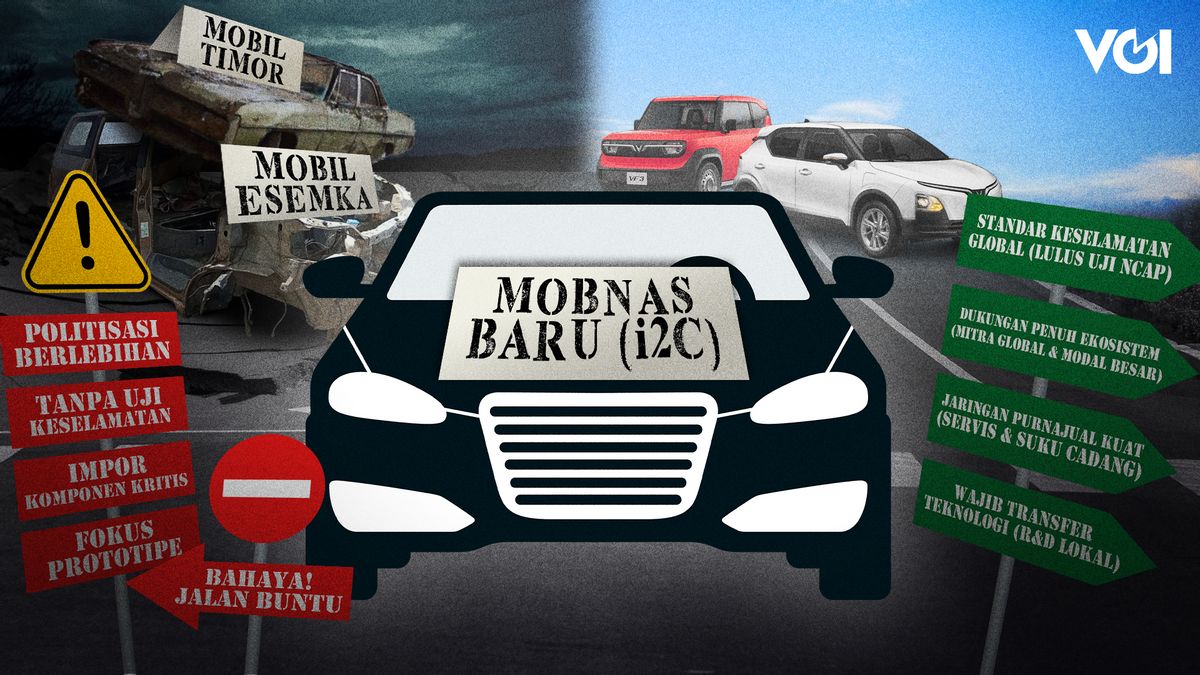
JAKARTA – That old ambition is rekindling. Yes, Indonesia's dream of having a national car, or "mobnas," is now being woven back into life by the Ministry of Industry. The agency, led by Agus Gumiwang Kartasasmita, is currently developing a plan to develop the "mobnas" (national car) in accordance with President Prabowo Subianto's orders.
Agus even stated that the "mobnas" program only needs to be implemented, with all aspects already prepared, including the branding and companies expected to be involved. "The industry is ready; I've already spoken with the companies." "The brand is already there, and I've met with the company," he added on Friday, October 24th.
Furthermore, he has officially proposed to the National Development Planning Agency (Bappenas) that the national car program be included in the National Strategic Projects (PSN). According to Agus, being designated as a PSN will accelerate the implementation of national car manufacturing in Indonesia. "And with PSN status, all matters related to preparation, implementation, and even commissioning should be expedited, in line with the President's expectations," he continued.
Regarding the national car concept, Agus explained that some components of the car may not be entirely manufactured domestically. However, he ensured that the domestic content standard (TKDN) would be implemented as a requirement for the national car project, considering that no industrial sector has components sourced entirely domestically.
While commendable, the Prabowo administration should reflect on the previous national car program, which ended disastrously. In the 1970s, domestically produced cars emerged, becoming the precursors to the national car. At that time, at least three products labeled "national cars" were introduced: the Morina, Sena, and the Toyota Kijang.
Unfortunately, these three national cars did not last long because they were only designed as basic vehicles. The government had already issued regulations prohibiting the import of completely built-up (CBU) vehicles with the aim of developing the domestic automotive industry. The Sena and Morina were not very popular, while the Toyota Kijang was quite popular. was considered before eventually sinking. In fact, the Kijang was planned to be the official government vehicle at the time.
Entering the 1990s, the development of the national car project was tarnished by nepotism. Initially, in 1993, the government established the Maleo national car project, managed by PT IPTN. The Maleo car was designed by B.J. Habibie, a 1,200-1,300 cc sedan with a target of over 80 percent local components. However, the project was overtaken by the Timor national car project, led by President Soeharto's son, Hutomo Mandala Putra, also known as Tommy Soeharto.

Soeharto had already issued Presidential Instruction Number 2 of 1996 concerning the Development of the National Car Industry. Through Presidential Decree Number 42/1996, the government decided to fund PT Timor Putra Nasional, also known as PT TPN, to pioneer the national car industry. PT TPN was also permitted to import complete cars from South Korea without import duties.
Unfortunately, Tommy Soeharto's project was shelved after PT Timor was sued by Japan, the United States, and the European Union at the World Trade Organization (WTO). PT TPN imported 1995 KIA Sephia cars and simply "labeled" them as Timor S15. Two years later, with the fall of the Soeharto regime, production of Timor cars ceased.
In the reform era, several local automotive manufacturers attempted to create locally-made cars. At least in the 2000s, several local car brands emerged, such as the Tawon, Arina, and Komodo. Finally, a car created by students at a vocational school in Surakarta, Central Java, emerged. This car became known as the Esemka. Although initially touted as a breakthrough and garnered widespread support, its production remains unclear to this day.

Initially, the Esemka was touted as the national car, following the soaring popularity of the then-Mayor of Solo, Joko Widodo (Jokowi). Jokowi introduced the Esemka while still serving as Mayor of Solo and continuing through his presidency. From 2005 to 2012, Jokowi used an Esemka SUV, the Rajawali, as his official car.
However, Esemka is now being dragged into court for allegedly failing to fulfill its mass production promise. Last April, Esemka was sued by Aufaa Luqman, a resident of Ngoresan, RT01 RW02, Jebres Village, Jebres District, Solo, Central Java. He claimed he suffered losses because he was unable to purchase an Esemka car as promised. He also filed a lawsuit for breach of contract against Jokowi and the 13th Vice President, Ma'ruf Amin.
These past failures have not dampened President Prabowo Subianto's hopes of revving up the national car program. He stated that Indonesia could launch its own car within the next three years. The president also admitted that he had prepared the budget and land for domestic car production. "I have allocated the funds, and we have prepared the land for the factories. The team is working now. We can now produce Indonesian-made jeeps (Maung)," the president concluded.
President Prabowo's ambition to realize a national car was evident when a government-affiliated company showcased an electric SUV prototype at an automotive exhibition last July. The Indonesian Military Technology (TMI), a company under the Ministry of Defense (Kemenhan) foundation, introduced a battery-powered national car (EV) project called the i2C, or Indigenous Indonesian Car, which translates to "native Indonesian car," and is said to embody the president's vision and ambition.
TMI President and CEO Harsusanto stated that Indonesia has never had an independent automotive industry. Therefore, in line with the president's vision, the i2C car project will be realized. This inaugural project resulted in a battery-powered electric SUV concept, which has been presented in a 1:1 scale clay model. This is said to provide a concrete illustration of the design direction that will be further developed.
The car's design itself is inspired by iconic elements such as the Garuda bird and batik motifs representing regional artistic identity. These motifs are then integrated into the vehicle concept to create a distinctive and contemporary visual experience. Harsusanto himself stated that the project is targeted to enter mass production by 2028 at the latest.
Consequently, TMI's target aligns with Prabowo's ambition to build a national car industry within three years. Furthermore, TMI stated that the name i2C could be changed at Prabowo's direction.
National Car Production Is Not Easy
Producing a national car that is acceptable to the Indonesian public is certainly no easy task. History has shown that no national car design has been able to endure long-term on Indonesian roads. So, what factors keep the national car dream buried? Celios researcher Nailul Huda said that industry unpreparedness, inconsistent policies, and political ambitions outweighing a well-thought-out business strategy make the national car program difficult to realize.

He explained that the lack of a manufacturing ecosystem strong enough to support independent national car production, coupled with unclear and frequently changing industrial policies, has made investors and industry players hesitant to get involved. Huda cautioned that the ambition to build a national car should not become a routine every time a president changes.
He cited the example of Jokowi's dream of making the Esemka a national car when he first became president. In fact, this car was already used as an official vehicle when he was still Mayor of Solo. "Even now, it seems the spirit of the national car is revitalized after the Maung, manufactured by Pindad, was intended to become the national car after being an official car," he said.
He believes there's nothing wrong with the government's enthusiasm for creating a national car. After all, the existence of a national car is expected to boost the economy. However, cooperation with the private sector is currently unclear, due to the existence of a technology transfer scheme. Huda stated that Proton's success as Malaysia's national car is inextricably linked to the transfer of imported technology. Only after this technology transfer was Malaysia able to create its own local car brand.
He emphasized that a guarantee of technology transfer is mandatory if the government intends to independently develop a national car. Otherwise, the private sector will profit because its products are labeled national cars, but are actually made abroad. In fact, the main components may even be imported. "Therefore, I believe technology transfer should be a strong foundation for developing a national car through private sector cooperation," Huda added.
Automotive observer Bebin Djuana stated that the Prabowo administration should learn from the failures of previous national car projects. Moreover, to face global competition, quality and innovation are key. He believes the ambition to build a national car requires the support of a globally operating industry, and the government is required to be consistent, as developing a national car cannot simply be a five-year agenda.
Furthermore, developing a national car will not be easy because people already have their favorite brands. Therefore, the government must carefully consider the available options, whether to acquire existing cars or produce a new brand. "This project also requires support from all levels of government because the vision of building a national car is, again, no easy matter. In my opinion, it is not important at this time to force ourselves to have a national vehicle," he added.
Meanwhile, ITB automotive expert Yannes Martinus Pasaribu stated that strict discipline and time-based control, with targets on quality and speed of production, are key to ensuring the national car program under President Prabowo avoids the same fate as Esemka. He explained that the Prabowo-era national car program must involve real technology transfer through global partnerships that also involve local engineers in research and development of its core technology.
"Implement realistic, phased TKDN (National Level of Utilization) through joint ventures and technology transfer—not rebadging—focusing on the frame, body, suspension, powertrain, and ECU. Then, strengthen quality and safety. Here, the national car must have the courage to participate in UNECE/NCAP homologation, conduct transparent, thousands-kilometer durability tests exposed to major media outlets, and ensure warranties and spare parts are available through all national parts distribution networks," he explained.
For the record, UNECE, or the United Nations Economic Commission for Europe, is the regulatory body that develops global vehicle safety standards. NCAP, meanwhile, refers to the New Car Assessment Program, a system of independent organizations that conduct crash tests and assess cars based on those standards to provide information to consumers.

Equally important is ensuring after-sales service, from workshop networks and technician training to spare parts logistics, to maintaining competitive pricing and total cost of ownership. "Essentially, we must avoid outdated strategies such as over-promising prototypes, excessive politicization, and reliance on critical imports without a concrete, realistic, and achievable substitution plan," Yannes emphasized.
According to him, all of these factors require strong support from Danantara as a financing engine. Furthermore, various government agencies need to be involved regarding fiscal incentives, regulations for local roadmaps and batteries, as well as testing infrastructure and industrial parks.
Apart from all that, Yannes believes President Prabowo's ambition to develop a national car industry within the next three years is quite reasonable. He cited the success of VinFast, a Vietnamese car brand that has produced world-class products within three to four years.
This is due to VinFast's support from the Vietnamese government to create an industrial ecosystem. "Regarding Prabowo's three-year target, we can learn from VinFast's success in Vietnam, which can produce world-class products within three to four years if supported by substantial capital expenditure (CAPEX), strong global partners, and government orchestration through various supportive policies," Yannes concluded.
The English, Chinese, Japanese, Arabic, and French versions are automatically generated by the AI. So there may still be inaccuracies in translating, please always see Indonesian as our main language. (system supported by DigitalSiber.id)


