

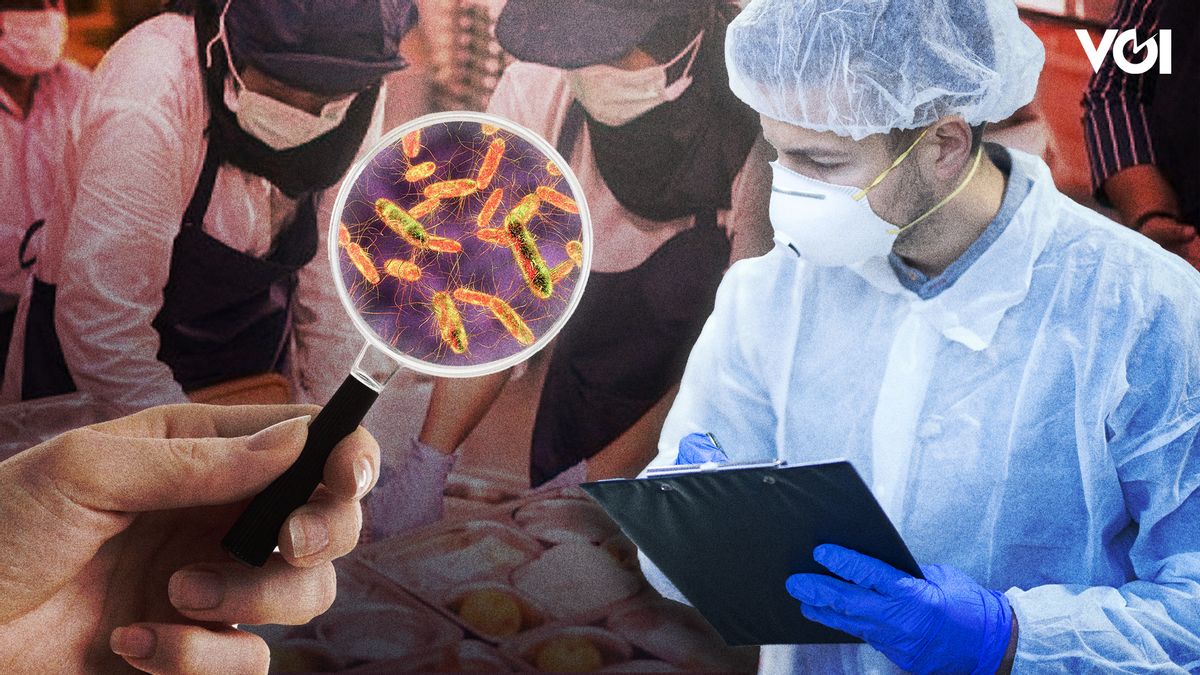
JAKARTA Without feeling, it has been eight months since the Free Nutrition Food (MBG) program began. During that time, President Prabowo Subianto's flagship program drew cases of poisoning spread across various regions in Indonesia.
Based on a report from the Head of the National Nutrition Agency (BGN), Dadan Hindayana to President Prabowo Subianto, the number of extraordinary incidents (KLB) that occurred during the implementation of the MBG program was in the period from January 6 to July 31, 2025, 2,391 SPPG was formed with 24 incidents. Meanwhile, on August 1 to September 27, 2025, 7,244 SPPG increased with 47 incidents.
"Data shows that many cases have been experienced by new SPPGs because human resources still need flying hours," he said after the KLB Management Coordination Meeting at the MBG Priority Program at the Ministry of Health, Sunday, September 28, 2025.
Former director of the infectious disease WHO Southeast Asia, Tjandra Yoga Aditama, revealed a number of problems that have the potential to cause food in the MBG program to trigger mass poisoning. In general, WHO says there are at least five things that can be detected in the laboratory to assess food poisoning.
According to him, when referring to the results of the MBG sample examination lab at the Regional Health Laboratory in West Java, there are at least two causes of food poisoning. First, the discovery of bacteria, the majority of which are Salmonella in MBG food samples. Tjandra said, according to WHO, Salmonela bacterial contamination was linked to high protein foods such as meat, poultry and eggs.
Second, it was also found that the majority of bacteria were in the form of Bacillus cereus. He said, when referring to data from the NSW Food Authority Australia, the Bacillus cereus which can cause food poisoning is linked, among others, to improper rice storage.
Apart from these findings, Tjandra said food poisoning was triggered by at least five things, based on a WHO study. These five problems, he said, could actually also be detected in the laboratory to assess the trigger for food poisoning. And good if these five things are also examined in our laboratory in connection with food poisoning associated with MBG," he added.
The first problem, which triggers widespread food poisoning, was the discovery of Salmonela, Campylobacter and Escherichia coli in food samples for poisoned victims. In addition, Listeria and Vibrio cholerae can also be found.
Second, is a virus called WHO of the Norovirus type and Hepatitis A virus. Third, it is caused by the presence of parasites such as tramatoda worms and bandworms such as Ekinokokus maenia Taenia. The fourth cause that usually triggers food poisoning is prion, although the case is rare. Prion is an infection ingredient consisting of protein, for example Bovine spongiform encephalopathy (BSE).
The fifth cause, which needs to be anticipated is the possibility of contamination of chemicals in eating. For chemicals, WHO divides them into three parts, namely heavy metals such as lead, cadmium, and mercury; persistent organic pollutants ("Persistent organic pollutants - POPs") such as diocsin and polychlorinated biphenyls -PCBs; as well as various other forms of toxine are myco mitigation, marine bio mitigations, cynaogenic glycosides, aflata tidak andochraploy.
"The various potentials that are called WHO should be our consideration, although of course it does not mean that the current food poisoning related to MBG is caused by these five things. This general WHO explanation is conveyed only as part of our vigilance," explained Tjandra.
The Importance Of SLHS Education And Certification And HACCP
Lecturer of Nutrition Science at Muhammadiyah University Surakarta, Pramudya Kurnia, encouraged the government to immediately evaluate the implementation of the MBG. The evaluation needs to be carried out by involving the Health Office in all regions in Indonesia. The government must strengthen education to parties involved in the MBG supply chain. If possible, the Health Service is present at the SPPG (Government Service Unit) to evaluate, then provide recommendations," he said.
He argues that the lack of supervision of mass food system management is also the culprit of MBG poisoning cases. Therefore, the government must immediately take quick steps by auditing raw materials and vendors, providing training and certification of kitchen staff, and implementing standardization of production and distribution processes. Hignity and food safety training must be carried out. Also the application of checklists of food raw materials and must pay attention to the expiration date of raw materials," he added.
Pramudya said that microbiological contamination can occur during the production process of the MBG menu, starting from the time the food ingredients are harvested, distributed to the MBG kitchen, until it is served to students. The pollution can be found in all products, especially animal products such as chicken, beef, and fish. "Animated products are sensitive foodstuffs because they have high water and protein content, so they become ideal places for microorganisms to grow," he continued.
In addition, MBG poisoning can also be caused by chemical contamination such as pesticide contamination in vegetables and fruits. Chemical pollution can also occur due to the use of additional ingredients in improper foods, such as the use of artificial spices that exceed the dose.
The processing of food ingredients into MBG menus that are not in accordance with procedures also risks reducing the quality of the food produced. This discrepancy includes the use of non-sterile cooking utensils, inadequate eating utensils, polluted water, and careless storage of food ingredients, "explained Pramudya.
Various causes of poisoning in the MBG program which is considered to lead to the Nutrition Fulfillment Service Unit (SPPG) of the MBG kitchen manager which ultimately led the government to temporarily close the problematic SPPG. In the aftermath of the MBG poisoning case in a number of areas, the government decided to temporarily close the problematic SPPG while waiting for the results of the evaluation and investigation," said the Coordinating Minister for Food, Zulkifli Hasan.
He explained that a number of things were evaluated regarding the SPPG, namely the disciplinary factor, quality, and cook's abilities. Zulhas also emphasized that all other SPPGs will also be evaluated regarding the discipline, quality, and ability of the cook. Evaluation is not only in places that occur (poison), but throughout the SPPG," he added.
Although he has not mentioned the number of closed SPPGs, Zulhas ensures that the evaluation is focused on the discipline of the cook and the quality of food processing. The government also requires sterilization of eating utensils and repair of sanitation channels, ranging from clean water to waste disposal. All SPPGs are required to have a Sanitation Higiene Laik Certificate (SLHS). Without that, the kitchen cannot operate," he said.
Based on data from the Presidential Staff Office (KSP), of the 8,549 MBG kitchens throughout Indonesia, only 34 kitchens have pocketed SLHS. This means that thousands of other kitchens are still vulnerable and do not meet sanitation standards. In fact, SLHS is an official certificate from the health office that guarantees the cleanliness of the kitchen, cooking utensils, and food safety. Without it, food has the potential to carry disease and mass poisoning.
Deputy Head of BGN, Nanik S Deyang admitted, the problem at SPPG is related to the lack of understanding of new SPPG nutritionists against the food safety standards Hazard Analysis Critical Control Point (HACCP). This is because BGN is experiencing limited experienced nutritionists so that most new graduates are finally recruited to fill the needs of thousands of MBG kitchens in various regions.
"I announce, please nutritionists throughout Indonesia register at the MBG kitchens, because we lack. If possible, the experienced ones, but the stock has run out, schools have been absorbed," he said.
Nanik stated that his party did not turn a blind eye to the limited experience of the recruited personnel. However, BGN will still provide opportunities for the younger generation to get involved. "Young people are now smart. With social media and training, they are quickly educated. If something goes wrong, let's fix it together," he added.
Despite being faced with limited human resources, Nanik emphasized that BGN strives to maintain a balance between quantity and quality. We want quality, but the need in the field is also very large. Therefore, recruitment continues while we improve supply and strict kitchen verification," he said.
"Currently there are around 100 verifiers who have been deployed to oversee the operational operations of the MBG kitchen. If necessary, the number will be increased so that supervision is more optimal," continued Nanik.
The steps taken by the Coordinating Ministry for Food, including BGN, are certainly in line with President Prabowo Subianto's instructions asking that every SPPG have a trained chef. In fact, the president asked the SPPG to be equipped with a rapid test kit to check the quality of the food, have a food route sterilization tool, install water filters to CCTV directly connected to the center. President Prabowo hopes that these steps can strengthen the quality of service and ensure that the national nutrition fulfillment program runs more safely and trustedly.
The English, Chinese, Japanese, Arabic, and French versions are automatically generated by the AI. So there may still be inaccuracies in translating, please always see Indonesian as our main language. (system supported by DigitalSiber.id)


