

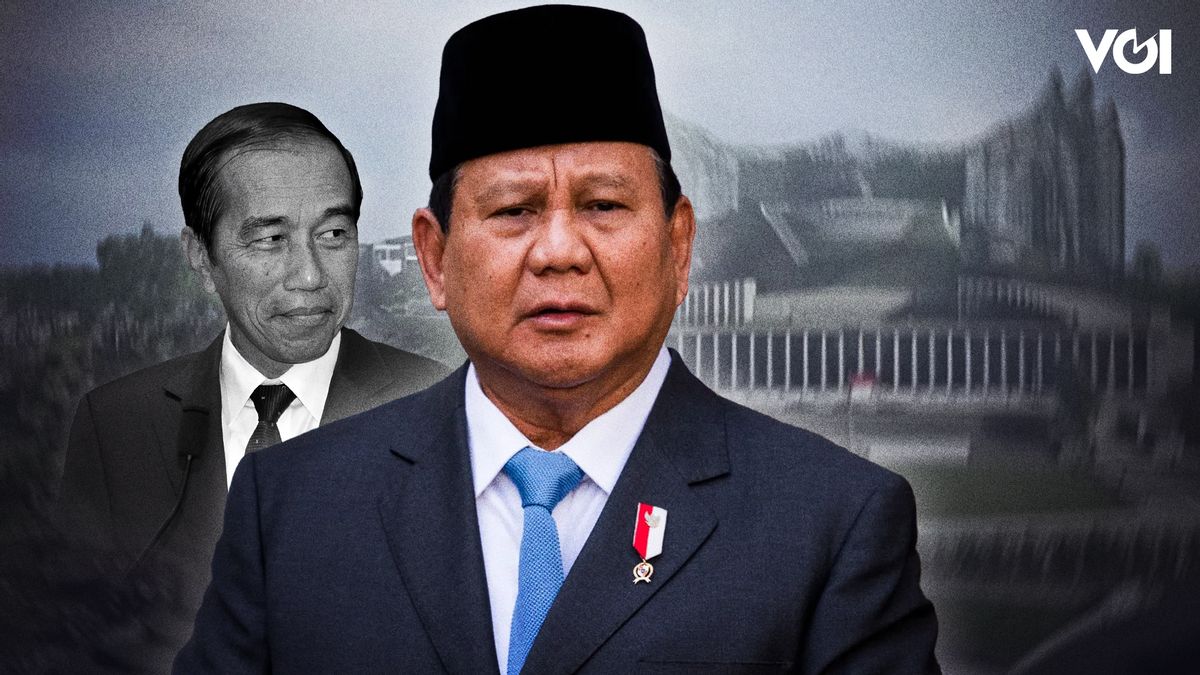
JAKARTA - Speculation whether or not to own a new palace in Panajam Paser, East Kalimantan has been answered. The speculation emerged with various comments in the media, following the change of Jokowi's regime and being replaced by a new government President Prabowo Subianto. So, what about certainty about continuing IKN which is often questioned by a number of parties, including the certainty of investors in the State Capital (IKN) who from the start invested their capital?
For Prabowo, continuing IKN is a dilemmatic choice. Stopping the project means revoking the big legacy of its predecessor as well as causing political turmoil. But continuing, he must face the risk of popularity if the people feel the direct impact of the country's budget is getting tighter. Many cause economic difficulties.
The Head of the IKN Authority, Basuki Hadi Mulyono, who is also a former PUPR, reminded that the delay in IKN development followed the rejection by the Council's Budget Agency for the additional funds he asked for related to a number of IKN projects. But recently that statement changed, the latest developments after a meeting with the president.
The President's Rp 48.8 trillion has agreed to be allocated in IKN to solve several things. First, to complete the legislative, judicial, and supporting ecosystem complexes and open access to IKN in the planning area (WP) 2, "Basuki told reporters.
Certainty about the continuation of the IKN after the President signed Presidential Decree number 79 concerning IKN. Presidential Decree No. 79 of 2025, is actually about the Inauguration of the Government's Work Plan in 2025. In the Presidential Decree, it contains arrangements for the declaration of IKN as a political city in 2028. Among them are met with various certain conditions-
The requirements for IKN to become a political city in 2028 include, among others, assessing the completeness of the Trias Politica. Namely, it must have, among others; Government Areas (KIPP) which have an area of 800-850 ha, must have been built to a minimum of 20 percent, office building construction has been completed by 20 percent, affordable housing has been completed by 20 percent, while the employee transfer process has reached 7000 - 4100 ASN, targeted and connectivity has reached around 0.74 percent. Meanwhile, according to Basuki, road construction has reached more than 88 percent and only leaves 20 kilometers. The construction of the legislative, judicial areas will begin at the end of October.
The DPR and DPD buildings will be built on the west side. According to Basuki, the Department of Health, Bank Indonesia and the State Intelligence Agency are also scheduled to fill the tower at the location first. Meanwhile, the Constitutional Court and Judicial Buildings are planned to begin at the end of next October.
Prabowo's government seems to have made a choice not to be labeled as a person who forgets how to lose his skin, and takes the option to continue building IKN even though many observers criticize him. "This is Pak Prabowo's statesmanship which affirms his commitment to continuing Pak Jokowi's programs," said Hendri Satrio in an official press release received on Saturday.
This situation is increasingly complicated when the discourse on cutting subsidies and social programs strengthens, giving the impression that the people must sacrifice for the sake of a magnificent project whose benefits have not been clearly felt by the people.
On the one hand, the IKN project since the Jokowi era was positioned as a symbol of Indonesia's transformation towards developed countries: equitable development outside Java, a new economic growth center, and a symbol of the nation's new identity. But on the other hand, its sustainability during the time when the state fiscal was burdened (the state budget deficit widened, debt increased, energy subsidies swelled, and urgent needs for the education and health sector) caused strong criticism. Investment promises vs the slumped state budget reality.
Since the era of President Joko Widodo, the government has promised that most IKN funding will be supported by private and foreign investment. In fact, until now the portion of the APBN still dominates. Until now, the investment commitment that has been predicted to have not been realized according to promise. "If the state budget continues to support this project, this project is at risk of becoming a long-term fiscal burden," said Vid Adrison, senior economist at Iluni FEB University of Indonesia in his notes on the 2025 State Budget.
People's Critical Voices
From the House of Representatives to civil society groups, criticism is getting sharper. Many think that the development of IKN is just a 'lightlight project' that ignores the basic needs of the people. For example, education, health, and employment are more urgent. "How can the government increase the burden of fiscalism with giant projects in the midst of the people's situation?" said the former Coordinating Minister for Political, Legal and Security Affairs, Mahfud MD during an event at the Constitutional Court, last November.
The sustainability of the National Strategic Project, Prabowo tries to maintain the sustainable policies of the previous government. Geopolitical & symbol of the state, IKN is considered important as a symbol of politics and a new, more modern center of government. Foreign investment, the government hopes that IKN will become a magnet of international investment, although until now the realization is still far from the target.
Budget constraints, the 2025 State Budget is predicted to be more stringent because of the need for subsidies and debt financing. The lack of private investment, until now most of the IKN costs are still supported by the state budget, although the government is aggressively claiming investor interest. Public priority, many parties think that funds should be focused on people's problems: education, health, food, and employment.
Political & Social Risk
Public criticism, the public can assess that the government is more concerned with lighthouse projects than the basic needs of the people. It is this moral burden that must now be borne by the government, continuing the project. Long-term fiscal burden, If private investment remains minimal, the state budget will continue to be forced to bear the costs of IKN development. The government also faces a potential new gap. Instead of getting closer to equitable distribution, however, new inequality could emerge, between project areas and other areas, which the project has not touched.
The middle road delays the construction of IKN infrastructure which has not yet been urgent. prioritizing core government facilities, while commercial development is fully handed over to investors. Open a more transparent cooperation scheme with the private sector/assing so that the burden on the state budget does not get heavier.
Prabowo's decision to continue the development of IKN in the midst of budget difficulties shows a political stance on sustainability but also contains the risk of popularity. If the government fails to convince the public about the direct benefits of IKN and fails to attract real investment, this project can be considered a big fiscal burden that sacrifices the needs of the people in other sectors.
The English, Chinese, Japanese, Arabic, and French versions are automatically generated by the AI. So there may still be inaccuracies in translating, please always see Indonesian as our main language. (system supported by DigitalSiber.id)


