

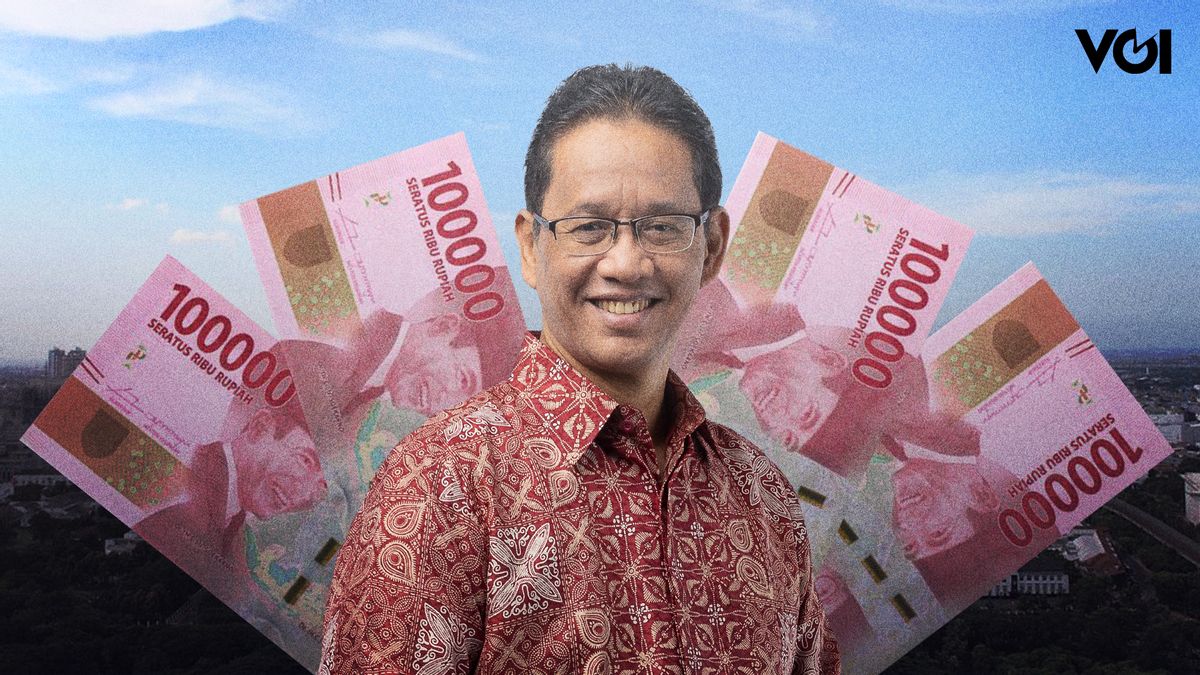
JAKARTA Purbaya Yudhi Sadive officially serves as finance minister replacing Sri Mulyani Indrawati after being inaugurated by President Prabowo Subianto on Monday 8 September. The two figures are said to have differences in schools or styles in managing state fiscal policies.
The 7th President of the Republic of Indonesia, Joko Widodo (Jokowi), who claimed to know him closely, also commented on the figure of Purbaya. According to him, the figure of the former chairman of the LPS Board of Commissioners is the right person to occupy the position of minister of finance.
"Good. I know Pak Purbaya very well. However, the school or how to manage state finances is different from Mrs. Sri Mulyani," he said.
The difference in the style of Purbaya and Sri Mulyani in managing the fiscal of this country is indeed natural. Not only his experience, the educational backgrounds of these two figures are also in the spotlight, because they form a way for them to make different decisions but both affect the national economy.
Purbaya studied undergraduate education in ITB's Electronic Engineering, then earned a Master and Doctorate of Economic Sciences at Purdue University, United States. This combination of techniques and economics makes him known as analytic, happy to rely on data, and thorough in every fiscal policy and investment taken.
Meanwhile, Sri Mulyani Indrawati studied economically at the University of Indonesia and then continued her Master and Doctor at the University of Illinois, United States. Her expertise in macroeconomics and public policy provides her with strategic capabilities, which help her direct Indonesia's economy through complex fiscal and monetary policies.
Although there are different educational paths, both of them have a strong vision to stabilize and encourage Indonesia's economic growth. Purbaya emphasized more data analysis and investment efficiency, while Sri Mulyani highlighted the macroeconomic strategy and mature public policy.
The difference in Sri Mulyani and Purbaya's style was acknowledged by the UGM economist, Sekar Utami Setiastuti, who revealed that Sri Mulyani and Purbaya had a different style in managing Indonesia's finances. During Sri Mulyani's leadership, the direction of Indonesia's financial management was indeed more towards conservative distance.
A conservative financial Stance is a cautious approach in financial management that prioritizes preventing losses, acknowledgment of losses and costs early, as well as delaying recognition of profits and assets, in order to protect the company's net asset value from overstaying or overstatement.
Sri Mulyani's style is not entirely bad because she is more careful in managing state finances so that there are no excessive deficits and inflation. During her tenure, Sri Mulyani has a careful fiscal distance such as maintaining a realistic deficit, focusing on priority programs, maintaining fiscal stability and carrying out reforms in the admission system," explained Sekar.
Finance Minister Purbaya Yudhi Sadive gave a thumbs up after attending a working meeting with Commission XI of the DPR at the Parliament Complex, Senayan, Jakarta, Thursday (11/9/2025). (ANTARA/Dhemas Reviyanto/bar)
"It's okay"
"It's okay"
"It's okay"
"It's okay"
He revealed that Sri Mulyani took a cautious stance in managing it because of the current uncertain global conditions. So that if the world economy is shaken again like during the Covid-19 pandemic, Indonesia still has a stimulus to recover itself. This financial management style can also maintain fiscal credibility, maintain fundamentals, maintain market confidence, and keep the rupiah stable.
"Because this is needed to maintain fiscal fundamentals and credibility, in order to maintain market confidence, so that the rupiah is stable, inflation is more maintained and there is no spike in deficits that create a fiscal crisis," he added.
On the other hand, Purbaya's financial management style is indeed much more expressive, as can be seen from its plan to withdraw Rp200 trillion from Bank Indonesia to make the economy rotate. However, this policy must be carried out carefully to prevent uncontrolled inflation. Sekar assessed that the money must be channeled to productive sectors such as infrastructure, new and renewable energy, manufacturing, or the digital economy.
"The money will not have an impact if it is channeled to consumption or to large corporations. Because it is feared that credit will be stuck in the financial management. So you must also be careful because of the effect on banking and inflation," he said.
Purbaya's Promise Not To Overhaul Fiscal Policy
The same thing was stated by the INDEF Senior economist, Aviliani. According to him, Sri Mulyani is more likely to be careful at work. He gave an example, before issuing bonds, Sri Mulyani will think hard to prevent the bonds issued from selling and ending with rising interest rates.
Meanwhile, Purbaya tries with the existing data to make a bolder decision. "If you look at the statement, he's not a foreigner (investor), isn't it really stupid, the important thing is that he already has data," added Aviliani.
Apart from the difference in style in state financial management, the Deputy Chairperson of the Chamber of Commerce and Industry, Saleh Husin, hopes that there will be consistency in the direction of fiscal policy and the sustainability of the ongoing program, so that the business world does not face excessive uncertainty.
He revealed that industry players expect fiscal policies that side with growth. "We from the industrial world hope that there will be more pro-growth fiscal policies by encouraging incentives for the processing industry, either through tax breaks, more affordable financing, or investment stimulus. In addition, harmonization of tariffs and import duties also needs to be arranged so that the domestic industry is more competitive," he added.
Purbaya himself promised not to overhaul the fiscal policy that had been carried out by his predecessor, Sri Mulyani Indrawati. He emphasized that he would further optimize the existing system and speed up running machines.
"We will optimize the existing system. Usually, if the ugliness of the new leader, the old one is torn apart, make it new again, because I want to make a new milestone. I will not be like that, "he said.
Purbaya believes it will not take long to adapt to become a minister of Finance, because he already has adequate experience related to fiscals. He said, during the 2020 and 2021 COVID-19 crises, he was beside President Jokowi to help formulate the right fiscal policy.
In addition, he also helped the 6th President Susilo Bambang Yudhoyono (SBY) in 2008, and was appointed Deputy III for Strategic Issue Management at the Presidential Staff Office (KSP) in the Jokowi era. "So if you say I don't have a fiscal experience, that's a big mistake," he said.
Purbaya stated that the Ministry of Finance will focus on making fiscal policies that have optimal driving force for the economy. Because fiscal must be maintained in order to stay healthy while spending so that the economy continues to run. I see government spending in the last two quarters is quite slow and has a negative impact on the economy. Therefore, it is necessary to make a healthy fiscal policy without disturbing the financial system with optimal spending," he said
The English, Chinese, Japanese, Arabic, and French versions are automatically generated by the AI. So there may still be inaccuracies in translating, please always see Indonesian as our main language. (system supported by DigitalSiber.id)


