

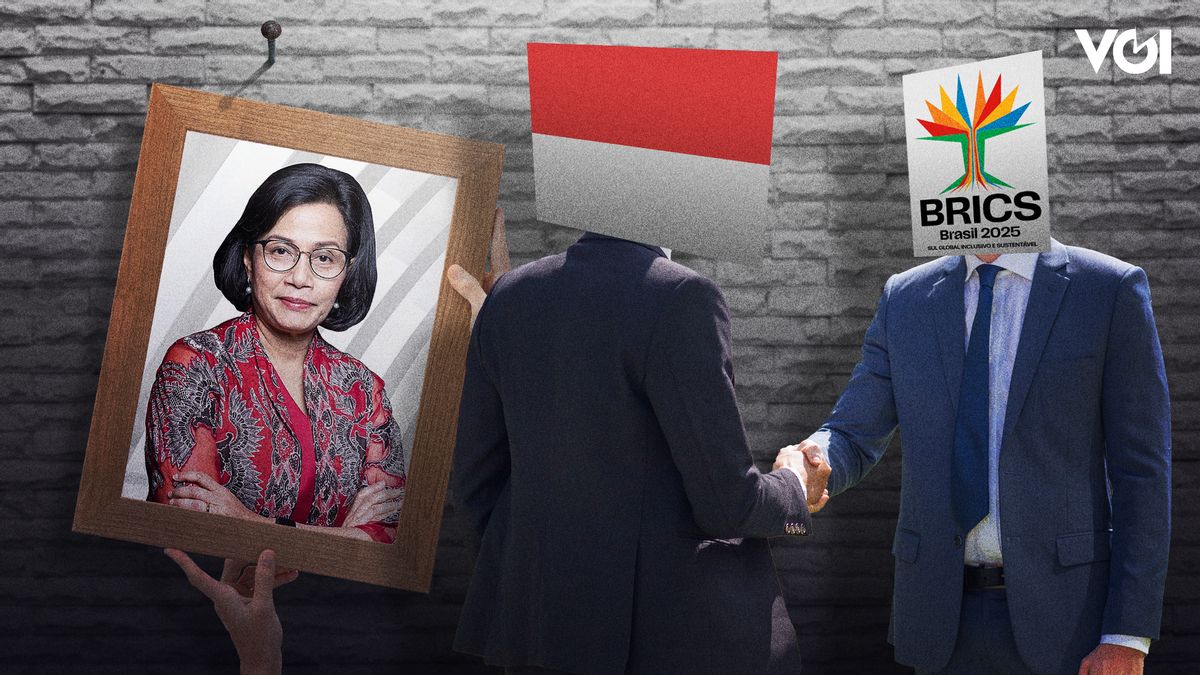
JAKARTA President Prabowo Subianto carried out a reshuffle volume two in the ranks of the Red and White Cabinet. The most surprising decision by the public is of course the change of economic minister from Sri Mulyani Indrawati to Purbaya Yudhi Sadive.
Economic observer, Tubagus Raditya Indrajaya, has his own views regarding the removal of Sri Mulyani. According to him, Sri Mulyani stepped down not because of the corruption, not because she failed to maintain fiscal, especially not because of the 'corruption' state budget. But precisely because it is too disciplined, too IMF, too World Bank may even be too American.
At the same time, President Prabowo returned from Beijing with a thin smile and a strong chest. Although he didn't say much, the president, like an old tiger who returned from China's giant jungle and Russian snow forest, brought more than just diplomatic souvenirs. Yes, Prabowo seems to be carrying a signal of shifting the world axis.
So far, Indonesia's position in the global economy, similar to VIP guests at the IMF party, has been praised, praised, but still ordered to wash dishes. Sri Mulyani is the ambassador of pride for the party. With a 3 percent deficit jargon, tax ratio, and 'confident investor', she maintains the image of Indonesia in the eyes of the West," said Raditya, who is familiarly called Kang Didit.
Unfortunately, the party' is now quiet as the world changes. America is having a debt fever, Europe is wide, and the IMF is losing its prestige in Southern countries. On the other hand, BRICS grew with confidence, as can be seen from Yuan, Ruble, Rupees, and even Real Brazil, starting to speak a new language, namely collaboration without colonialization.
Prabowo saw that and had made a choice. No ruler replaces ministers as heavy as Sri Mulyani for no big reason. The public only sees a reshuffle. But insiders know that this is a "fiscal reset" that requires strategic support from the two giants of the world, China and Russia," he explained.
In Kang Didit's analysis, when meeting with Xi Jinping and Vladimir Putin, Prabowo could signal that his government wants to change the way to manage the economy with priority to spend money on the people.
We cannot continue to be constrained by Washington rules. Will you support me? And their answer may be simple, please. We are ready to help. But first remove the gate guard of the IMF,'' approximately an imaginary dialogue between Prabowo, Xi Jinping and Putin in Kang Didit's view.
Differences In Prabowo And Sri Mulyani Ideology
He considered that the removal of Sri Mulyani was not a personal issue but a sign of shifting Indonesia's economic ideology from austerity to sovereign spending, from a strict deficit to massive investment, from West to East. Therefore, the 8 percent economic growth target is no longer a slogan. Cheap credit from China flows heavily for food, energy, and industry. The new oligarchy may be born, but not from Harvard Club, but from Beijing cadre schools and Vladivostok (NewPoros) steel factories.
We are not hating Sri Mulyani. We are just reading the changing times. Anyone who understands the history of knowing, there are times when economists such as Soemitro Djojohadikusumo (P Prabowo's father) think about the same thing, namely independence," he said.
"Now history is spinning. Prabowo seems to want to complete the old idea, not just with theory, but with concrete actions. And the first action is to remove the symbol of the old fiscal regime, Sri Mulyani. So, welcome to Indonesia version 2025. A place where geopolitical determining fiscal, and bilateral meetings can replace the finance minister," continued Kang Didit.
Economic observer Ichsanuddin Noorsy considers the removal of Sri Mulyani not something surprising when the Indonesian economic situation continues to be in the spotlight, especially with the increasing deficit in the state budget and the decline in tax revenue. The reason is, this condition is not only a matter of deficits, but also related to how the state budget is managed to trigger economic growth.
"The state budget should be a trigger for economic growth by ensuring the distribution and proper budget allocation. However, if the state budget fails to carry out this function, then wealth will only rotate among certain elites without having a broad impact on the economy," he said.
He saw that there have been seeds of mismatch between Sri Mulyani and Prabowo since the 'audition' of ministerial candidates at Prabowo's residence, especially regarding fiscal policy. One of the main issues in the spotlight is the idea of forming Internal Revenue Services (IRS), which does not receive full support.
At that time, as soon as he left Prabowo's house in Kertanegara, Sri Mulyani immediately stated that there was no state recipient body. That shows he doesn't accept the idea of establishing Internal Revenue Services," he explained.
INDEF economist, Ariyo Irhamna also said that ideological differences were the main reasons behind changing the position of minister of finance. So far, Sri Mulyani is considered to tend to focus more on market mechanisms and minimize the role of the government. Meanwhile, President Prabowo wants the active role of the government through fiscal instruments, financing, and strengthening State-Owned Enterprises (BUMN).
"This change of finance minister is a consistent step to ensure fiscal policy is in line with the inclusive and sovereign national development vision as expected by President Prabowo Subianto's government," he said.
The English, Chinese, Japanese, Arabic, and French versions are automatically generated by the AI. So there may still be inaccuracies in translating, please always see Indonesian as our main language. (system supported by DigitalSiber.id)


