

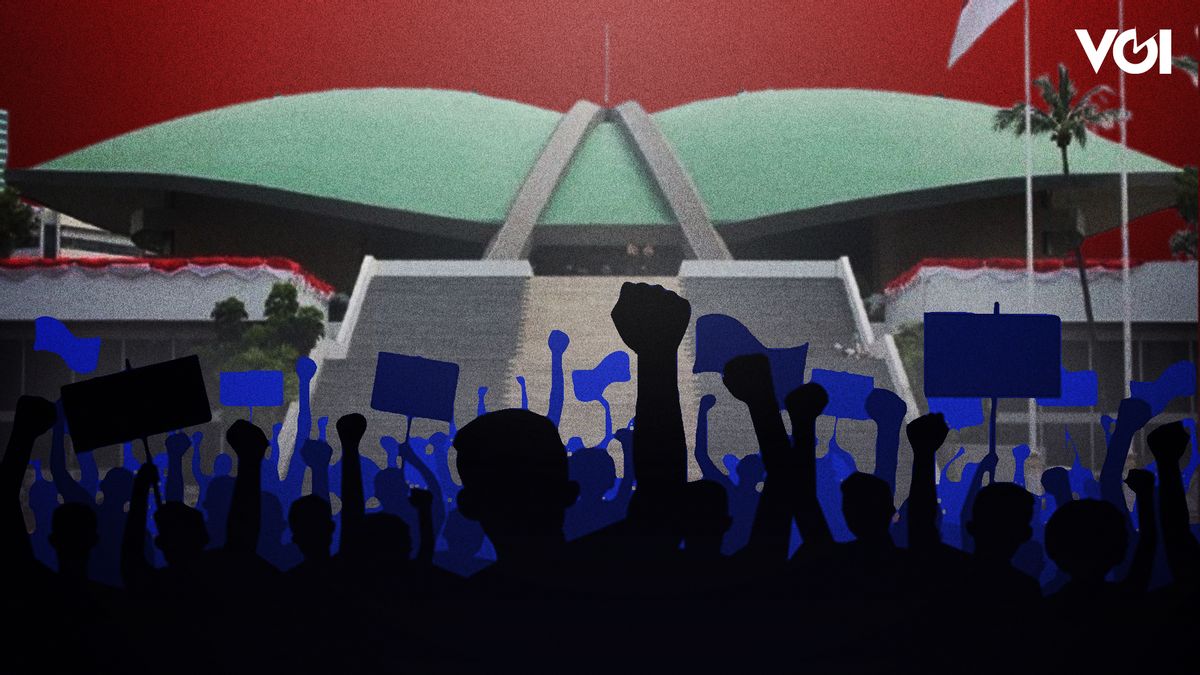
The call to disband the House of Representatives (DPR) of the Republic of Indonesia had echoed during the demonstrations in the last few days. The reason is none other than the various benefits received, statements that seem to have no empathy for the people and a luxurious lifestyle (hedon and flexing/wealth show).
The emergence of public anger towards members of the Indonesian House of Representatives which led to demands for the dissolution of the legislative body was caused by the decline in the quality of the people's representatives. BRIN political researcher Aisah Putri Budiatri assessed that ongoing demonstrations showed that the quality of current parliamentarians was declining and did not show character as statesmen and representations of the people responsible.
"From yesterday's public action, we are increasingly seeing the quality of our parliamentarians who do not seem to show their character as statesmen and representatives of the people who are responsible," he said, Sunday, August 25, 2025.
Although there are several DPR RI leaders who have issued public statements, including apologies and promises to improve themselves, this step is considered still not enough. This is because it seems normative without any concrete steps that are being taken by the DPR, especially related to public demands.
Aisah also highlighted the behavior of some DPR members who were said to be contrary to the expectations of the community. Instead of showing empathy and responsiveness, there is actually an attitude that demeans the public. In fact, it does not appear that there is a quick response from members of the DPR to discuss the demands of the community.
"In the midst of the mass action, we also do not see that there are members of the council who discuss directly the response to discuss the demands of the people, on the contrary they actually avoid it. In fact, there are rumors that members of the DPR will make visits abroad with some agendas being carried out containing elements of 'walks' without an important agenda. It's very sad," he added.
Aisah emphasized that public disappointment was exacerbated by the attitude of the DPR which did not take serious action against the inappropriate behavior of a number of its members. He gave an example, the absence of an ethics trial from the MKD for the behavior of DPR members who were 'jogging' or when their members called the people stupid.
The series of events made the DPR seem to show a real face that is far from the expectations of the people. He reminded that if there were no concrete steps taken by the DPR, public disappointment could lead to a more massive wave of action.
"In recent times, it has been clear how the DPR shows its real face which is far from public expectations. If there are no changes and concrete steps from the DPR institution and its members, then I think disappointment will increase and action will be even more massive," concluded Aisah.
UI Political Psychology Expert Hamdi Muluk said that the DPR is currently a reflection of the very basic political practice, namely who gets what, when, and how. This situation is the fruit of the low quality and competence of the people in it and the absence of a large design in the government.
According to him, politics is only a commodity, not a life call. Therefore, being a member of the DPR is more of a job to get the maximum economic benefits, not to fight for a certain value. Finally, many members of the DPR have experienced alienation with the people they represent. They no longer connect with the people. The political behavior of DPR members becomes a foreign thing for the people," he added.
He considered that there were still many members of the House of Representatives whose quality was mediocre, so they seemed deaf and blind to people's criticism. Mental media also ultimately showed the change in the attitude of DPR members to become hedonists.
DPR Is Difficult To Disband But Can Be Reformed
So, can the demands for the disbandment of the DPR RI be carried out? A lecturer at the State Department of Law, Faculty of Law UGM, Faiz Rahman, said that the constitutional dissolution of the DPR is almost impossible. As a state institution that is stated in the status and authority of the 1945 Constitution, the mechanism for dissolution of the DPR that can be carried out is through amendments or amendments to the constitution by explicitly mentioning these provisions.
"Constitutionally, it is actually impossible to dissolve the DPR. The only way is to first amend the 1945 Constitution which is the constitutional basis for the DPR's institutional institutions and include provisions related to the dissolution of the DPR," he explained.
Unfortunately, the possibility to dissolve the DPR through amendments to the 1945 Constitution is very difficult, considering that the authority to amend is in the hands of the MPR. MPR itself consists of members of the DPR and members of the DPD. If there are proposals for disbandment of institutions, it means that they (members of the DPR) will decide whether the proposed article is acceptable or not. In addition, with the current regression of democracy in Indonesia, changes in the Constitution can actually be used for other interests whose impact is more destructive to democracy and the state of law," said Faiz.
In Indonesian history, there were two presidents who almost dissolved the DPR RI, namely President Soekarno and Abdurrahman Wahid (Gus Dur). Bung Karno dissolved the DPR as a result of the 1955 General Election and replaced it with the DPR Gotong Royong (DPRGR) on March 5, 1960. Based on Presidential Regulation (Perpres) Number 3 of 1960, on March 5, 1960, the president dissolved the DPR because the DPR only approved the APBN of Rp36 billion out of a total submission of Rp44 billion. In addition, the DPR is also considered to have failed to produce a new constitution to replace the Temporary Constitution (UUDS).
Meanwhile, Gus Dur, once frozen the DPR and MPR through the announcement of the President of the Republic of Indonesia on July 23, 2001. This declaration was issued because the MPR wanted to remove Gus Dur from his presidential position through the Special Session. However, the MPR and the DPR continued to carry out their functions which led to Gus Dur's impeachment at the Special Session and inaugurated Megawati Soekarnoputri as president.
However, the historical record, said Faiz, will be difficult to repeat. This is because it is possible that the dissolution of the DPR will be hampered by Article 7C of the 1945 Constitution which explicitly confirms that the president cannot dissolve the DPR. In addition, Soekarno and Gus Dur's decision at that time was basically illegal legally, but influenced by power and political situation.
He explained that if the DPR could be dissolved, there would be a vacancy of institutions that could form a law. This situation will create new chaos in Indonesia's sustainability, including if the authority is returned to the president.
"I see that people are tired of seeing the current conditions. So I think the call to disband the DPR is more an expression of public disappointment and anger towards institutions that should represent their voices, but what is being done is actually oppressing them," said Faiz.
He stated, instead of disbanding the DPR, the thing that can be done and called for is institutional reform of the DPR. For example, political parties replace their problematic members. One thing that can be done is through the mechanism for replacing DPR members who are problematic by political parties. However, this is actually difficult, because if we look at it, the problem is that those who play an important role in political parties," he added.
As an alternative solution, public awareness is needed when carrying out the election by choosing representatives of the people who truly represent the voice of the people. Ideally, the electoral mechanism is a space to ensure that those who are elected are people who really listen to the voice of the people. Thus, we need to record problematic people and we will no longer choose in the next election. However, with the current democratic situation, it seems quite difficult. So it is a bit dilemma," said Faiz.
He also reminded members of the DPR and the government to fix communication and empathy for the public. Making policies that openly benefit his side and not showing empathy to the community during difficult economic situations is one of the things that needs to be improved.
"I think the public communication of council members is an issue in itself, which often even worsens the problems that exist. As representatives of the people, they should not make policies that are nirempati to the people, let alone make inappropriate words. These things then make the community even more furious," concluded Faiz.
The English, Chinese, Japanese, Arabic, and French versions are automatically generated by the AI. So there may still be inaccuracies in translating, please always see Indonesian as our main language. (system supported by DigitalSiber.id)


