

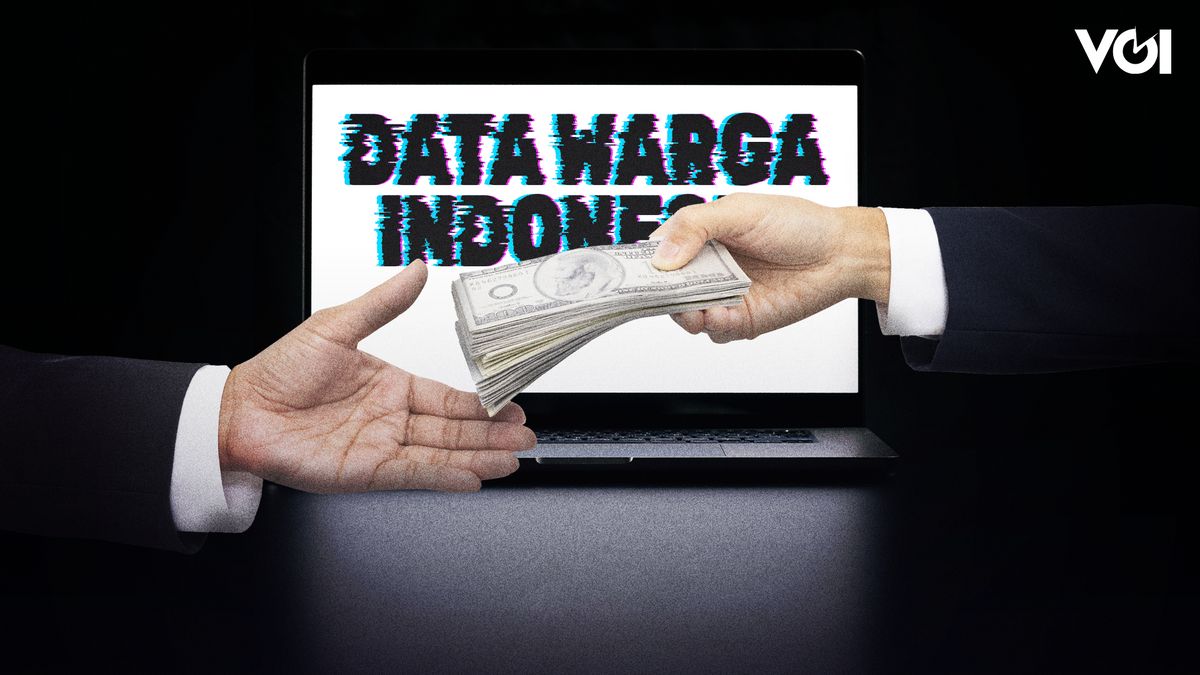
JAKARTA - The trade agreement between Indonesia and the United States is not merely viewed as a trade agreement, especially since the clauses in the agreement include a barter or exchange of personal data.
The Indonesian government is obligated to hand over its citizens' data in order to obtain a reduction in tariffs imposed by the superpower, from 32 percent to 19 percent.
The trade agreement, which involved the exchange of Indonesian citizens' personal data, has sparked a long-running controversy. It appears the government acted rashly. By exchanging the agreement for the handover of its citizens' personal data,
This has led to various assessments. America is seen as profiting greatly, while we risk data that could be shared. Meanwhile, we are limited to a 19 percent tariff on exports of products such as textiles, footwear, and agricultural products. Meanwhile, the US can export personal data submitted by the Indonesian government to the US. This is seen as an imbalance. Many groups have both opposed and advocated for the agreement's cancellation.
Criticism of the trade agreement has come from civil society. Imparsial Director, Ardi Manto Adiputra, said that citizens' personal data should not be used as the object of trade or economic agreements between countries. "Personal data sovereignty is part of national sovereignty. President Prabowo is potentially handing it over to foreign parties."
Shaid Iqbal, Chairman of the Indonesian Labor Federation, expressed similar criticism. According to Iqbal, his organization objected to the transfer of labor data to US jurisdiction. He also threatened to organize large-scale demonstrations to protest the move.
Speaker of the House of Representatives (DPR), Puan Maharani, reminded the government to heed the provisions of the Personal Data Protection (PDP) Law in implementing the trade agreement between the Indonesian and US governments. "The government must be able to protect the personal data of Indonesian citizens in accordance with the Personal Data Protection Law," Puan stated at the DPR Complex in Jakarta on Thursday, July 24, 2024.
She emphasized, "The government must be able to protect the personal data of Indonesian citizens in accordance with the Personal Data Protection Law," Puan added.
Responding to the results of the Framework for the United States-Indonesia Agreement on Reciprocal Trade, obtained from the whitehouse.gov website. The trade agreement consists of 12 points. One of the main issues is the 19 percent tariff on Indonesian goods exported to the United States.
In the world of diplomacy and international trade, not all agreements are transparent. Some occur quietly, without much public scrutiny, even on sensitive matters that directly affect the interests of the public. One issue that has recently emerged is the alleged exchange of personal data of Indonesian citizens within the framework of a trade agreement with the United States. If true, this is a high-risk move and could have serious implications for data sovereignty and public security.
This issue arose following rumors that one form of "compensation" or concession offered by Indonesia in the trade agreement with the US was limited—or even open—access to its citizens' personal data for the benefit of corporations or foreign intelligence agencies. This form of exchange is not always explicitly stated in the agreement document but can be hidden through clauses on digital, cloud, AI, or cybersecurity cooperation.
According to Cybersecurity Expert Persada Pratama, the critical response from some members of the public to this agreement should not be seen as a rejection of international cooperation, but rather as encouragement for the government to be more serious about improving data protection infrastructure and establishing technical regulations that guaranteeing transparency, accountability, and data security.
"The government needs to demonstrate that data transfer abroad will not be carried out haphazardly and remains under the control of Indonesian law, as stated in the official statement from the Ministry of Communication and Informatics," he added. "But that alone is not enough. We need to strengthen the national digital security system, conduct rigorous technology audits, and participate in public oversight so that public data does not become a commodity sold cheaply in the name of digital economic progress," he told Voi on Sunday, July 28.
The United States is known to place a high premium on global data access, whether for the benefit of the digital economy, security surveillance, or technological dominance. If Indonesia is not careful, citizens' personal data could become a "commodity" in unequal trade relations, especially in the absence of legal protection and robust cyber infrastructure.
Public Alarm and Diplomatic Ethics Needed
Digital sovereignty is threatened. When citizens' data is controlled by foreign parties, Indonesia loses control of its own digital space. This is not only an economic issue, but also concerns national defense.

We face issues beyond the lack of transparency and weak regulations. We know that the creation of the Data Protection Law has not been fully implemented. The Data Protection Task Force, which is under the National Cyber Agency, has not yet been fully implemented, leading to high public concern about data leaks.
There are issues that will be faced if data is released to other parties. According to Wahyudi Djafar, Executive Director of Catalish Policy Work, data subjects must have full control over their data, regardless of the country in which it is transferred. Data protection clauses must be clarified by the sending citizen and the standards that will be applied.
We know that the US lacks comprehensive and adequate protection. Although there are laws regarding insurance and taxes, these laws comprehensively cover all protections, but they do not provide protection equivalent to that for consumers or workers, only in certain countries.
Data subjects should have full control over their data, regardless of where and in which country. Data protection clauses must be clarified by the sending citizen and the standards that will be applied in the event of a data problem. "If a lawsuit arises, which institution can we report it to?" said Wahyudi.
The English, Chinese, Japanese, Arabic, and French versions are automatically generated by the AI. So there may still be inaccuracies in translating, please always see Indonesian as our main language. (system supported by DigitalSiber.id)


