

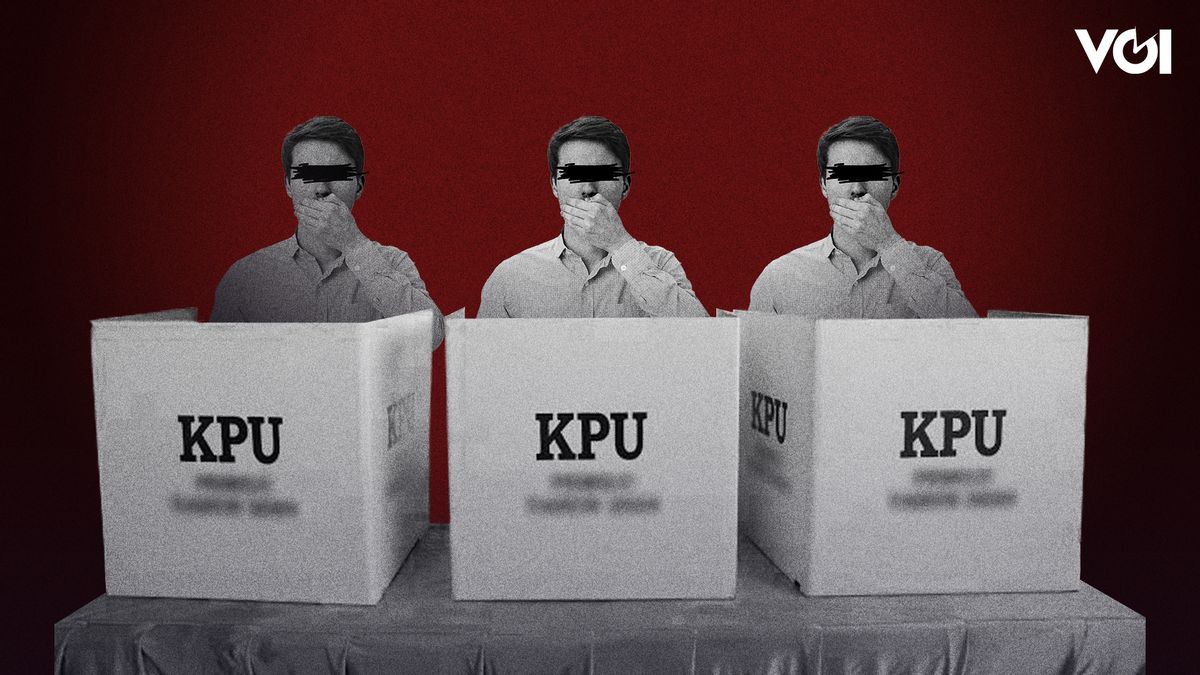
JAKARTA - The Constitutional Court (MK) through Decision Number 135/PUU-XXII/2024 officially decided that the separation between Legislative Elections and Presidential Elections is constitutional. This decision opens the way for the holding of elections separately in the future, different from the simultaneous models that have been implemented so far. Although considered a constitutional step, this decision reaps pros and cons, especially because it is considered to have the potential to threaten national unity and test the quality of Indonesian democracy.
The submission of a judicial review was originally submitted by the Needdem (Community for Elections and Democracy), a observer Foundation on elections and democracy. The submission of a judicial review is intended to assess the inefficient of holding simultaneous elections. From the issue of inefficiency.
According to the researcher, Needdem, Heroic Pratama, indeed a matter of simultaneousness, has a potential problem with the presidential system being accommodated by multi-partys facing its own challenges, the effectiveness of voting, with one person's legislative election capital, must look at a number of names. even though we can see once. Are people required to know and be close to that number of candidates, the efficiency of budget management, the effect of working facts on workloads up to 20 hours.
Taufik Basari from the Nasdem party stated that the decision had become a dilemma and had a constitutional crisis. Where it is not implemented also contains problems. It is also carried out in violation of the constitution. Missing the interim replacement of members of the DPR. it doesn't talk about Consensuality. "I agree technically that our election has many problems, but that's not a matter of consensus", but constitutional violations have no legitimacy.
If the DPR is extended to its term of office there is no legitimacy, article 22 paragraph 2, in the decision of the choice. The Constitutional Court's decision Troubled so that it must be found a solution, so that it is not deadlocked. Agree that yesterday's election was problematic, fetic and tiring. there are many problems of the role of money, collapse, but don't let the release be separated between national and regional elections. And the problem of constitutional violation. The decision returns to the author of the law,
The decision of the Constitutional Court (MK) Number 135/PUU-XXII/2024 concerning the separation of national and regional elections has created a wave of discussions regarding its implications for national unity and the quality of democracy in Indonesia. This decision, which ordered the separation of national and regional election schedules with a interval of 2-2.5 years, not only changed the landscape, but also brought serious challenges to social cohesion and public participation. What are the gaps if they do not carry out these decisions are binding and final and reluctant to implement them.
A number of leaders of the Nasdem General Chair, Surya Paloh, tasted the decision as unconstitutional and accused other parties of influence. They accuse unconstitutional. Especially among the DPR
Threats to National Unity
This Constitutional Court decision has the potential to create political fragmentation that could threaten national unity through several mechanisms: Synchronization of central-regional policies: Election separation can result in local governments with different political affiliations from the central government, which has the potential to hinder the implementation of national strategic policies. As stated in a discussion in FH UGM, this situation can create political tensions between levels of government.
Continuous political polarization: with the increasing frequency of elections (from once in five years to twice in the same period), society will constantly be in a political atmosphere that can deepen differences and reduce space for national consensus.
Potential political elite conflicts: This decision has sparked heated debate among political elites, with the House of Representatives openly voicing rejection of the Constitutional Court's decision. Polarization between state institutions like this can seep into society and divide national unity.
In addition, it is a gamble on the quality of democracy. The quality of Indonesian democracy is at stake through several crucial aspects. Democratic fatigue: Increased election frequency risks causing political saturation among voters. Hurriyah from the University of Indonesia revealed that the Constitutional Court's decision actually considered public saturation as voters, but ironically the solution offered increased the frequency of elections.
The decline in voter participation: empirical data from various countries shows an inverse relationship between the electoral frequency and the level of participation. Voters who are faced with too many elections tend to experience "democracy fatigue" and choose not to participate. This phenomenon is very risky for Indonesia, which is already facing the challenges of political participation.
Harassment of the principle of the trias of politics: Constitutional Law Expert Universitas Airlangga Dr. Rusdianto Sesung views this decision as a form of "offside" of the Constitutional Court because it has entered the legislative domain by creating new norms. Not just testing the constitutionality of a law. This creates a dangerous precedent for the balance of power.
Consistency of jurisprudence: This decision contradicts the previous Constitutional Court Decision (No. 14/PUU-XI/2013) which requires simultaneous elections. This inconsistency raises legal uncertainty and questions about the predictability of Indonesia's democratic legal framework.
The increasing frequency of elections due to separation of schedules has serious consequences. Economic burden: More frequent election implementation means greater budget spending, both from the APBN/APBD and political parties. Observers expect this to be a waste.
Organizers' fatigue: Although separation is aimed at reducing the workload of election organizers, increasing frequency can actually cause chronic fatigue among KPPS officers and other election organizers. It can be seen that in the 2004 elections it took a lot of victims
Transactional politics: A longer time gap between national and regional elections can actually strengthen the practice of polarase and political transactions among party elites, instead of improving the quality of political recruitment as expected.
Facing the complexity of the impact of this decision, several strategic steps need to be considered, improvement of regulations: It is necessary to immediately formulate a new Election Law that provides legal certainty and accommodates transitional needs without sacrificing constitutional principles.
The public needs to be prepared through massive political literacy to understand changes in the electoral system and keep participation high even though the election frequency increases.
Strengthening party institutions, political parties must use time lags to carry out better internal consolidation and regeneration, not actually stuck in transactional politics. Strict supervision of implementation: Civil society needs to strictly monitor the implementation process of this decision to prevent abuse of power during the transition period.
The Constitutional Court's decision No. 135/PUU-XXII/2024 is ultimately a major experiment against Indonesia's democratic resilience. Its success is very dependent on the ability of all stakeholders to maintain a balance between the efficiency of election administration, the quality of public participation, and the integrity of national unity. The biggest challenge is to ensure that this election separation does not actually backfire which weakens the joints of democracy that have been built hard after reform.
The English, Chinese, Japanese, Arabic, and French versions are automatically generated by the AI. So there may still be inaccuracies in translating, please always see Indonesian as our main language. (system supported by DigitalSiber.id)


