

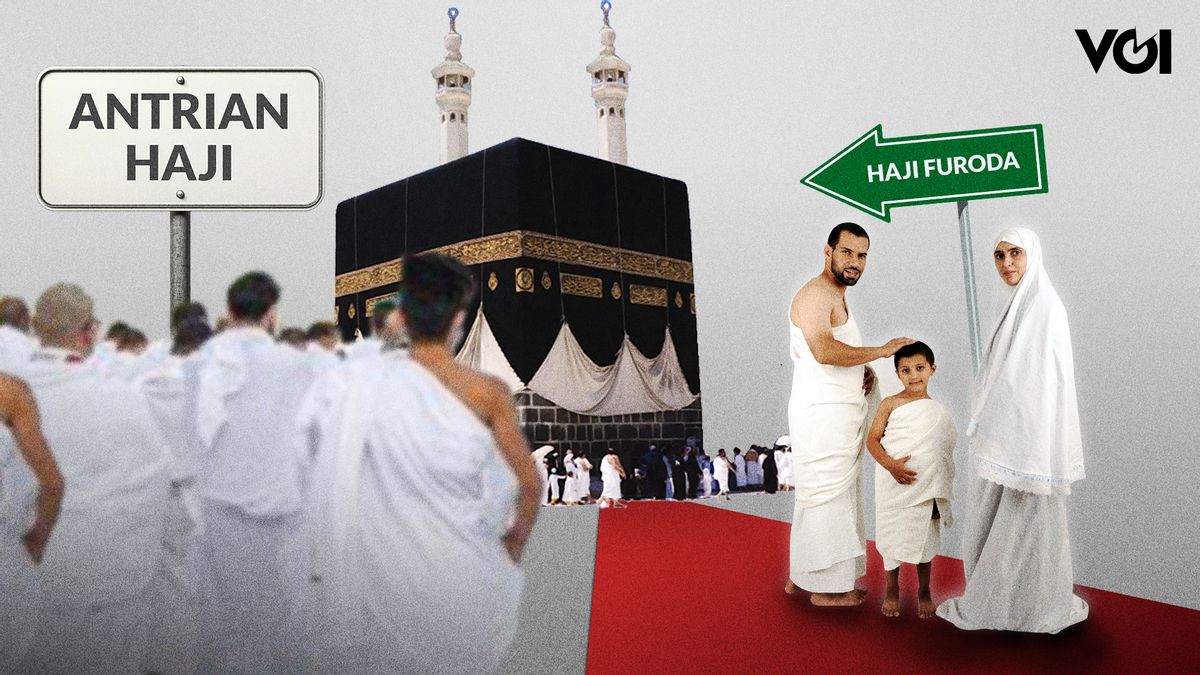
Haji Furoda, also called Haji Mujamalah, was born from the practice of the kingdom of Saudi Arabia which gave special invitations to individuals, figures, or institutions to carry out Hajj without going through the country's regular quota. This is an alternative for pilgrims who want to immediately perform the pilgrimage without having to wait long queues in regular Hajj.
As we know, the queue for Indonesian Hajj candidates currently reaches 5.4 million, which means the waiting time can reach 25-30 years. With the total population of Indonesian Muslims reaching 270 million people, the queue shows that the hajj quota given by the Saudi Arabian government is not sufficient to meet all Indonesian hajj requests.
Every Muslim certainly longs to perform the fifth Muslim pilgrimage, which is only required once in a lifetime for those who can afford it. However, the length of the regular hajj queue in Indonesia, which can reach 10 to 30 years in several areas, gives birth to various alternative routes. One of them is Haji Furoda "hajj routes without queuing up with direct invitation visas from the Saudi Arabian government (visa mujamalah).
On the one hand, Haji Furoda is a quick solution for those who want to go to the Holy Land without waiting for decades. But on the other hand, this route raises a big question: is this worship still purely a spiritual call, or has it shifted to an exclusive commodity that can only be accessed by a handful of elites?
Furoda Hajj Phenomenon: Fast, Expensive, And Exclusive
In contrast to regular Hajj managed by the Ministry of Religion and following the official quota from the Kingdom of Saudi Arabia, Haji Furoda entered through a special route. The cost is also not kidding around USD 18,000 to USD 30,000 (around Rp. 300-450 million), depending on the facilities and the operator's agent (PIHK). This price is far above the regular Hajj (around Rp. 50-60 million) and special ONH Plus (Rp. 150-200 million) hajj.
With such a high price, Haji Furoda is like a symbol of status. He is no longer just a way of worship, but part of a high-end spiritual lifestyle.
DOCUMENTATION/ANTARA/Andika Wahyu/Spt
"It's okay"
"It's okay"
"It's okay"
"It's okay"
But unfortunately for this year the Saudi Arabian government did not issue a furoda Hajj visa without explanation until the deadline for service. As a result, for now many Indonesian pilgrims, this non-quade route of Hajj failed to leave for the Holy Land. The Ministry of Religion (Kemenag) noted that more than 1,000 furoda pilgrims this year canceled their departure because their visas had not been issued.
Secretary General of Amphuri (The Muslim Association of Hajj and Umrah Organizers of the Republic of Indonesia), Zakia Zakaria Anshari, said that many of its members lost hundreds of millions of rupiah due to not issuing the visa, the loss came from several types of expenses that had already been issued by the organizer's agent, for example for booking hotels, plane tickets and so on. That was experienced by agents in various ways. According to Zaki, who also has an agency, his party did not lose too much even though he had collected the pilgrims who would depart, because his party had not yet booked a number of congregational facilities, when it was not confirmed that the Hajj visa was obtained.
He hopes that the agents of the furoda hajj organizers will still be accommodated because they are an alternative pilgrimage in addition to regular Hajj and plus. "I am sure that even though this visa is not issued, next year it will be issued again, according to him, the Saudi Arabian government is currently making arrangements for safe Hajj," he said in a dialogue to make it clear, a few days ago.
Privatization of worship and commodification of piety, critical questions also arise: Does Furoda's path open space for the privatization of the pilgrimage, where the rich can buy direct access to Baitullah, while the poor are stuck in long lines?
This phenomenon leads to a commodification of piety when worship, which is supposed to be a spiritual call, turns into an economic transaction. Not a few instant hajj organizers highlight the luxury of services, such as five-star hotels, direct flights, exclusive rituals, to the assistance of celebrity clerics. The value of worship, which should be full of simplicity and equality, is slowly replaced by global attributes.
Risk, Legality, And Inequality
Although it is legally valid internationally, Haji Furoda is still in the gray zone in the context of Indonesian regulations. The government, through the Ministry of Religion, does not have direct power over the mujamalah visa because it is not part of the official quota of the Republic of Indonesia. As a result, there are many cases where prospective pilgrims fail to leave or even are stranded at the airport because of problematic visas.
Ironically, inequality is also increasingly felt. In one country where the majority of the population is Muslim, the existence of two regular and instant hajj systems creates a religious gap. Those who have money can 'cut queues', while others have to wait decades, even though their intentions and sincerity are equally strong.
Hajj is a pilgrimage full of spiritual meaning: sacrifice, patience, and unification of all Muslims regardless of status. However, with the emergence of instantal routes such as Haji Furoda, we need to reflect: is the intention of Hajj still as pure as before? Are we hajj because of Allah, or because we want to be fast, comfortable, and prestige?
Chairman of the Indonesian Hajj Brotherhood Association (IPHI), Dr. Ir. H. Erman Suparno, MBA, M.Si, one of the figures who saw the furode hajj, undermined justice. Because, those who do the duet can immediately leave without waiting in line, while those who can't afford it have to wait long. "This is not fair," he told Voi, some time ago.
It is not wrong to choose the Furoda route, as long as it is legal, safe, and intended to be sincere. But the community also needs to be more critical, so as not to be trapped in the spirit of pilgrimage which emphasizes the social aspect rather than being spiritual. Due to the existence of elite services and more comfortable facilities.
Haji Furoda opens up opportunities for worship faster for those who can afford, but also opens up debates about the justice of access and ethics of religious commercialization. In the midst of the rise of instant hajj businesses, it is important for all of us to maintain that spiritual, simplicity, and sincerity values remain the center of this holy journey.
The English, Chinese, Japanese, Arabic, and French versions are automatically generated by the AI. So there may still be inaccuracies in translating, please always see Indonesian as our main language. (system supported by DigitalSiber.id)


