

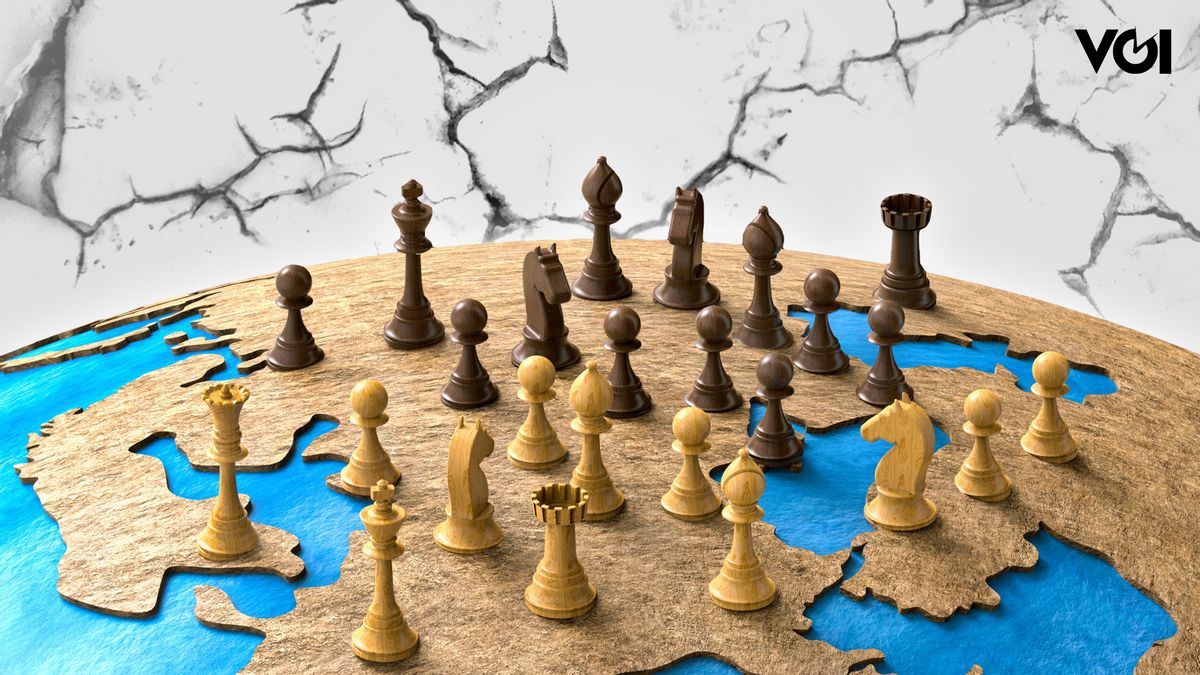
JAKARTA - The risk of geopolitical tensions results in various political and economic uncertainty caused by conflict, policy changes, and diplomatic relations between countries. World history records that some geopolitical tensions sometimes lead to military conflicts. Some investors, such as Bridgewater's Ray Dalio conglomerate, explain this subject more deeply. The following is the geopolitical risks that include:
War and Conflict: Military action and territorial disputes can disrupt global supply chains and affect commodity prices, as well as freight forwarding costs. The period can also support aerospace & defense stocks, which may benefit directly from conflicts and rising capital expenditures across the defense sector.
The Trade War: Tariffs and trade barriers can affect international trade, affect export-dependent industries and global economic growth. History shows that this kind of thing has happened many times, since ancient times, the Napoleonic war to date. In general, global markets and traders do not like external boundaries, such as regulations that disrupt trade.
Political instability: Government changes, political unrest, and regulatory changes can create uncertainty for businesses and investors. In addition, a significant shift, called a "big change" in global economic partnerships, could affect the market.
Sanctions: Economic sanctions imposed by one country on another can limit access to markets and resources. For example, these sanctions can affect high technology such as semiconductors or AI and companies (and their suppliers) behind them.
Europe Increases Defense
This geopolitical instability raises concerns for countries in the European Union and raises proposals from the European Commission (EC) to strengthen its defense sector to provide military assistance to Ukraine. The plan includes defense loans worth 150 billion to member states, loosening regulations to encourage countries to spend more on defense, and using part of the EU's budget for defense investment.
Reporting from Forbes, the proposal comes at a critical time, given the ongoing Russia-Ukraine War and tense relations with the United States.
Many major European militaries, including Britain, France, Germany, and Poland, have made significant cross-sections since the end of the Cold War. Europe is concerned about Russia's aggression in the future, they again need heavy weaponry and artillery, which has played a dominant role in the Russo-Ukrainian War. Please note, countries in Europe have very little equipment and war equipment. (table possession of weapons and war equipment)
The decline in the number of armored vehicles from 1992 to 2022 was significant but not as severe as the decline in the number of tanks and howitzers. Indeed, France and Germany have cut their tank counts and howitzers by about a tenth of their number in 1992. Meanwhile, the UK and Poland had only a third of their number in 1992. Overall, these four countries had 1,936 tanks and 834 howitzers by 2022. In comparison, according to Oryxspioenkop, so far in the war, Russia has lost 3,786 tanks and 1,347 howitzers and remains effective in fighting.
In 2024, global defense spending reached US$ 2.46 trillion, an increase from US$ 2.24 trillion in the previous year. This increase reflects the commitment of countries around the world to strengthen their defense capabilities amid increasingly complex geopolitical situations.
Based on data from the International Institute of Strategic Studies, the United States (US) became the country with the world's highest defense budget of US$968 billion or around Rp. 15,875 trillion or Rp. 15.87 quadrillion (exchange rate of Rp. 16,400/US$). The second rank is occupied by China with a defense budget of US$235 billion. And the third-ranked occupied by Russia has the third largest defense budget in the world, amounting to US$146 billion, or 6% of its total national income.
How Trump Raises Dollars And Weakens Currency In Asia
Developed markets can become more unstable and sensitive to geopolitical risks because of their dependence on foreign investment and export markets. The traditional US dollar is 'assembled', which has historically experienced higher inflows during the conflict period, puts pressure on the emerging country's market currency. In addition, conflicts have the potential to disrupt global trade, which has an impact on exports from economies developing to old economies'. The weakened Wall Street sentiment can lead to significant, sometimes even panicked reactions, reactions in emerging markets.
Early March 2025, the United States (US) Special Envoy, Steve Witkoff, submitted a proposal for an extension of the ceasefire to the Israeli government and Hamas leaders. Unfortunately the proposal was rejected by the Hamas leader on March 18, 2025. This sparked a new war with Israel carrying out attacks on Palestine and Lebanon.
Israeli military airstrikes on Sunday (23/3) reportedly killed 634 Palestinians, including Hamas leader, Salah al-Bardawil. As a result, market participants returned to hunt for the US dollar, so the US dollar index soared, which was at the level of 104.12 earlier this week.
Based on VOI searches earlier this week, several Asian currencies were observed to weaken, including Japan's Yen (-0.33%), Ringgit Malaysia (-0.27%), Baht Thailand (-0.24%), Won South Korea (-0.21%), Taiwanese Dollars (-0.12%), Yuan Renminbi (-0.11%), Yuan offshore (-0.09%), Peso Philippines (-0.04%), Singapore dollars (-0.04%), and Hong Kong Dollars (1%. And weak rupiah also occurred as the pressure experienced by the Composite Stock Price Index (IHSG) on the Indonesia Stock Exchange (IDX).
The trading of the combined stock price index on Monday (24/3) also weakened at the level of 6,224. Meanwhile, in the debt securities market, the price pressure of state bonds also continued after last week's high selling flow.
Strategic Geopolitical Position
Indonesia has very strategic geopolitics in global interaction. In addition to its position between the two oceans and the two continents, it clearly shows the nation's opportunities to take on a big role that can be played on the international stage. And most importantly, this country also has a wealth of nature (SDA) which is again abundant, which is needed by all countries in the world. For example, one of them is Palm Oil which is very much needed by all countries in Europe.
Not only that, Indonesia's position is on strategic routes, such as the Malacca Strait, the Sunda Strait, and the Lombok Strait, which are the main global trade routes. Control of this route makes Indonesia have high bargaining power in terms of trade and maritime security.
On this basis, the government plays a major role in regulating the industry and can affect the economy when making decisions about trade, law and policy agreements. So how is the best way to manage the geopolitical position of this strategic country to gain profits and reduce dependence on other countries? The keyword is only one, diversified.
Diversification, in the context of business and investment, is a strategy to expand or spread activities, products, assets, or investments to reduce the risk of dependence and increase profit opportunities. In an atmosphere of tension and international geopolitical instability as a result of the Russia-Ukraine, Israel-Lebanon-Palestinian war, diversified focus on precious metals, food commodities, defense and energy.
Canadian-born entrepreneur 1870, Arthur W Cutten in his autobiography "The Story of a Speculator," wrote about the impact of war on future wheat. "In times of war, wheat is not only a commodity but also an important resource for countries. Futures of wheat fluctuations in the Chicago Board of Trade (CBOT) reflect the urgency and uncertainty of that period, as demand to feed soldiers and populations increases dramatically, pushing prices to unpredictable heights. The conclusion from Cutten's writing states need to focus on food security amid geopolitical instabilities.
President's Response To The Fall Of The JCI
Presiden Prabowo Subianto memastikan kondisi pangan nasional tetap terkendali menjelang Lebaran 2025. Prabowo menilai dengan stabilnya pangan nasional, itu lebih penting dari naik turunnya saham yang terjadi saat ini.
"Pangan is the most important. Share prices may go up and down, food is safe, the country is safe," Prabowo said in a cabinet meeting at the Jakarta Palace, Friday, March 21, as reported by Antara.
Prabowo also said that this controlled food price should not be considered normal. Moreover, Indonesia is the fourth largest country in the world. The President realized that over the years concerns about food security and dependence on imports have always been an important issue. However, this year food production is considered very good, and food prices are still under control.
"In the month of fasting and before Eid, our food is safe, our food conditions are quite under control," said Prabowo.
The English, Chinese, Japanese, Arabic, and French versions are automatically generated by the AI. So there may still be inaccuracies in translating, please always see Indonesian as our main language. (system supported by DigitalSiber.id)


