

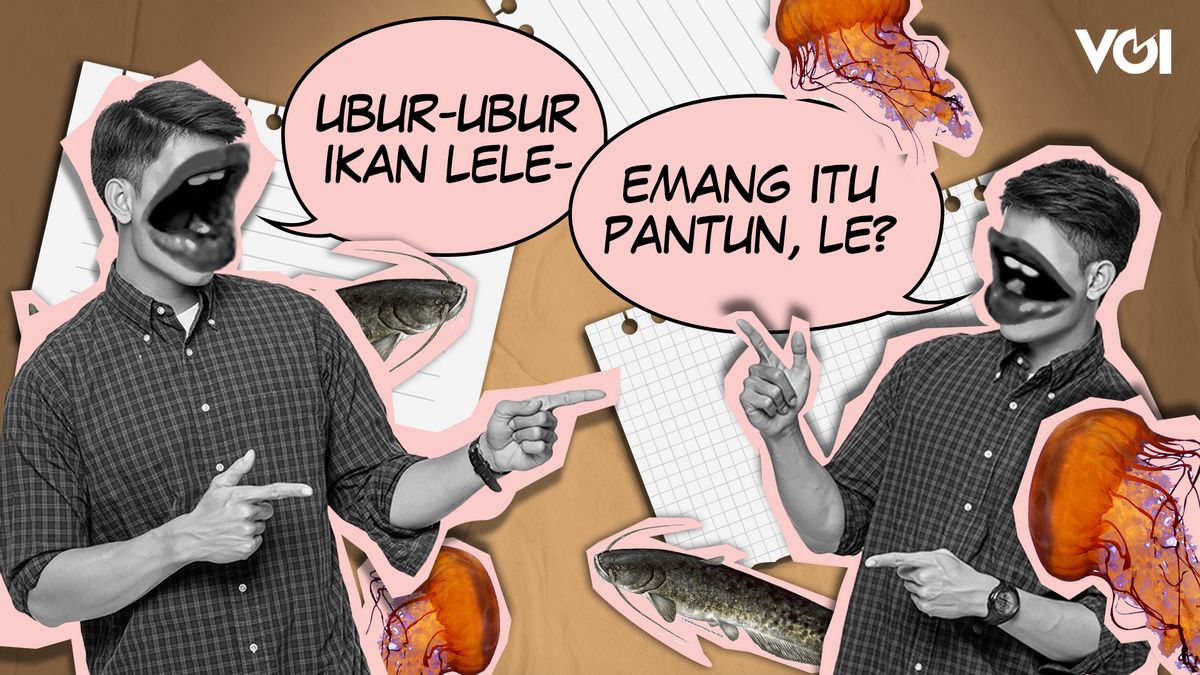
JAKARTA - The term "fish cult" has recently gone viral on various Indonesian social media platforms. This expression often appears in simple rhymes that are inserted with a humorous element and ends with the word "le" so that it has the theme "fish."
Several examples of rhymes that are popular on social media:
- Sour-buru catfish, sudah bekerja, le.- Ubur-burur catfish, yang lain menikah aku masih selenggal, le.- Ubur-burur catfish, jangan lupa makan siara, le.- Ubur-burur catfish, pinjem a hundred, le.
Can this be called a rhyme? Structurally, pantuns have a-b-a-b or a-a-a, while catfish's "fertilities" are more inclined as viral expressions that rely on RUMa's similarities. Rima is the sound that appears at the end of the poetry to beautify and illustrate her feelings of writing.
The viral term originated from a video of a man being ticketed by the police. Instead of panicking, he actually threw a funny rhyme while laughing: "Flowfish fertilizers, ticketed, le." The video uploaded by the TikTok account @wtf.daily11 immediately caught the attention of netizens and was watched more than 6.4 million times. After going viral, many netizens made similar rhymes, making a "fish cult" phenomenon in cyberspace.
However, not many people know that this expression comes from the song "Lale Fishbur" sung by rapper Ecko Show in 2018. The song contains criticism of the entertainment world in satirical style. One of the lyrics reads:
"Furf, catfish. So it went viral, so I became a meme. I'm a rapper, but I'm cool. Lose fame to catfish." Now, the term "fish cult" is not just a song lyrics, but part of a digital culture that continues to develop on social media.
Between Poems And Pantuns
Indonesia is rich in culture with various ethnicity, language, and tradition. One form of literature that still exists today is pantun. Pantun is part of the oral culture that is spread across various regions with different names. In Javanese it is called a parikan, in Sundanese it is called a paparikan, and in Batak it is called umpasa. Even though it has a different name, the structure remains the same.
The word "pantun" comes from Minangkabau, "leader", which means guide. Since the beginning, the rhymes have been neatly arranged to make it easy to hear and easy to understand. Initially, the rhyme was only spoken verbally, but over time it was recorded to keep it sustainable.
Pantuns have typical characteristics:
- Each verse consists of four lines.- Each row consists of 8-12 catalysts.- Pola RUMa A-B-A-B, A-A-A-A, or A-A-B-B.- Divided into two parts: cross-section and content.
Sampiran is the first two rows that serve as introductions and build RUMa. The contents are found in the last two rows, containing the main message, such as advice, satire, or expression of feelings.
As part of the Malay culture, rhymes have an important role in society. In the past, rhymes were used in daily conversations and were still used on various occasions, such as traditional speeches, trade, and expression of feelings.
The rhymes are also divided into several types based on their functions, including:
- Pantun adat-Pantun tua- Pantun muda- Pantun suka- Pantun kekerahan
Pantun is not bound by age, gender, or social status. He is a means of communication that connects various levels of society, from officials to the common people. Apart from being a form of literature, pantun also contains the values of life rooted in religious teachings and local wisdom.
Through rhymes, noble values are inherited. Even a joke or satire still contains a moral message. Therefore, maintaining and developing a rhyme means helping to maintain the nation's cultural heritage.
Jose Rizal Manua Responds To The Viral 'Lale Fish Fertile': Cannot Be Called Pantun
Penyair Jose Rizal Manua menanggapi viralnya "buat-buri catfish" di media sosial. Menurutnya, phrase tersebut belum bisa disebut pantun karena tidak memiliki struktur lengkap. Puntun harus punya sampiran dan pendiri. Misalnya pantun lama tentang cinta dan kecintai, ujarnya.
He also gave an example:
"Wherever the punai floats, from the rice fields come down to the river. Where does love come from, from the eyes come down to the heart."
In this rhyme, the first two rows as a cross-section, while the last two rows are filled. While the catfish "fertilizer" is more like a joke without a cross-section. If there is a continuation according to the pantun pattern, then it can be called a rhyme," he added.
Jose Rizal also emphasized that pantun is part of the rich culture of the archipelago. At the end of the talks, the VOI team "forced" Jose Rijal to create a rhyme in the style of "fish catfish cult". Here are the results:
"Eat catfish, be careful to fall, le."
The English, Chinese, Japanese, Arabic, and French versions are automatically generated by the AI. So there may still be inaccuracies in translating, please always see Indonesian as our main language. (system supported by DigitalSiber.id)


