

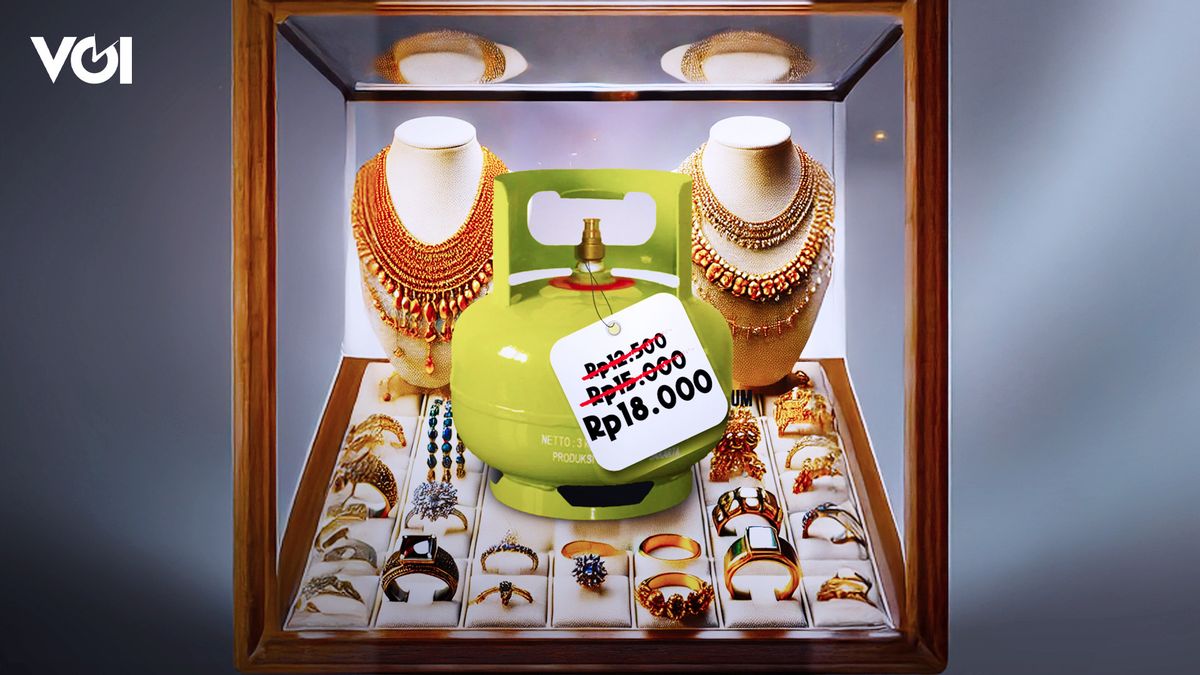
JAKARTA Strong protests and rejection emerged from the public after the Ministry of Energy and Mineral Resources announced a policy of banning the sale of 3 kg LPG gas aka melon gas at the retail level, early February. Thus, people who want to buy melon gas must visit the base or agent officially registered with Pertamina. Meanwhile, retailers must increase their status to a base if they want to keep selling melon gas.
The government reasoned that the arrangement for the sale of 3 kg LPG gas or melon gas was intended so that the subsidies given were really right on target. "Everything we have to tidy up, yes, this 3 kg LPG has subsidies there from the government. So, we hope that what is called subsidies, we want them to be accepted by those who are entitled to do that. So it's not to complicate (who are entitled), no. But we just want to tidy up everything so that the subsidies are much more targeted," explained the Minister of State Secretary, Prasetyo, Saturday, February 1, 2025.
The Minister of Energy and Mineral Resources Bahlil Lahadalia also conveyed the same thing which stated that the government was improving the governance of the provision of 3 kg LPG. The reason is, there are many reports if there are retailers who increase the price of 3 kg LPG.
"Oh like this, if you say LPG is rare, no. Elpiji is still all there, but now it is regulated, so that no person can increase the price of LPG by 3 kg," he said.
The price of LPG is more than Rp. 4,000, a maximum of Rp. 5,000, Rp. 6,000. However, if someone raises it, it means that we have to manage it, indeed now the retailer is still managed properly. So what? Don't raise the price you want," he continued.
He also reminded the public not to buy 3 kg LPG in large quantities at once. Because, if it is for household consumption needs, there must be a 3 kg LPG limit in each house. But, if one household has bought up to 30 tubes, 40 tubes, it means there is another purpose, "added Bahlil.
He contacted people who complained about the rare 3 kg LPG were those who bought a lot at once. According to him, if it is only for household consumption needs, the stock of 3 kg LPG gas is still safe. In fact, the government guarantees that the 3 kg LPG stock ahead of Ramadan 2025 remains safe. "There is no reduction in subsidies. The LPG subsidy remains IDR 87 trillion, nothing has been reduced in the slightest," he said.
Public strong protests then made the policy only valid for the duration of corn. February 4, the Daily Chairperson of the Gerindra Party DPP, Sufmi Dasco Ahmad, stated that the policy was revoked under direct instructions from President Prabowo Subianto. He even said that the ban was not President Prabowo's policy, but the policy of the Minister of Energy and Mineral Resources, Bahlil Lahadalia.
"The president has instructed ESDM to reactivate existing retailers to sell as usual," said Dasco at the Senayan Parliament Complex, Jakarta, Tuesday, February 4, 2025.
Even though its policy has been revoked, Bahlil Lahadalia still plans to organize the melon gas distribution system, one of the plans is to increase retailer status to a sub base. This step aims to make the distribution of melon gas more controlled and not experience an unreasonable price increase. Through this change, retailers who want to keep selling 3 kg LPG gas will have to follow the new regulations that will be implemented by the government," he added.
Policies That Do Not Solve Elpiji Gas Problems
Meanwhile, member of the Indonesian Ombudsman for Economic Substance, Yeka Hendra Fatika, assessed that the government's policy to prohibit retailers from selling melon gas did not solve the problem of subsidy distribution that had been happening so far. So if that's the cause, it's supervision. If it's like now, in my opinion, what is the disease, what is the cure, it doesn't connect," he said.
Minister of Energy and Mineral Resources (ESDM), Bahlil Lahadalia. (Photo: Doc. Antara)
"It's okay"
"It's okay"
"It's okay"
"It's okay"
He shared his experience of overseeing the distribution of melon gas for two years. Based on his findings, misappropriation of prices from HET was not only carried out by retailers, but had started since Pertamina's official base.
According to Yeka, with strict supervision from the central and regional governments, the LPG margin fee policy alone is enough to make agents and retailers not increase prices. There is no room to increase the price at will. At the retail level, per kilogram of the margin fee is around Rp800, meaning the profit is already Rp2,400," he added.
He emphasized that removing retailers from the supply chain of melon gas would not touch the root of the problem. He suggested that the government should tighten supervision, especially at the regional level. "That must be addressed first, strengthened supervision first. Do not immediately carry out a new policy pattern without being prepared for prior mitigation," Yeka said.
Director of the Center for Public Policy Studies (Puskepi) Sofyano Zakaria believes that the government should first fix Presidential Regulation Number 104 of 2007 concerning Provision, Distribution, and Determination of 3 Kilogram Tubes LPG Prices.
This is because the definition of household groups and micro-enterprises as recipients of melon gas in the regulation is still gray. This definition ultimately provides space for poor and rich families, as well as micro, small and reluctant businesses to use melon gas.
"Therefore, the main thing that should be addressed by the government is to revise Presidential Decree 104 of 2007, especially regarding who users are entitled to and also their supervision in the field," said Sofyano.
Bahlil Lahadaila Becomes A Victim Of Melon Gas Policy Politics
On the other hand, the Executive Director of PPI, Adi Prayitno revealed, there are four narratives of big issues that are quite interesting related to the ban on retailers selling melon gas which was later revised by President Prabowo Subianto. He highlighted Sufmi Dasco Ahmad's statement that the retail traders' policies that should not sell melon gas were not policies from President Prabowo.
"You can imagine, it means that the Ministry of Human Resources in this context maneuvers extremally making one real self-made policy without communicating with the President. Even though we know that there is no such thing as a ministerial vision and mission, what exists is the president's vision and mission," he said.
Second, the public certainly assumes, if it is true that the policy did not come from Prabowo, it means that it is very possible that there will be other voices or whispers that the Ministry of Energy and Mineral Resources has heard. Because we know that so far there has been a discourse about the twin sun in the Red and White Cabinet. The policy of the Minister of Energy and Mineral Resources as confirming this, that it is not impossible that external parties outside the palace are those who actually provide input on the policy of banning the sale of melon gas by retailers," explained Adi.
Third, continued Adi, it may also be that the Minister of Energy and Mineral Resources Bahlil Lahadilia was politically blamed so that public anger does not directly target the heart of government power, namely President Prabowo Subianto. Therefore, it is not surprising when there is a statement saying that the prohibition of retail traders from selling melon gas is not Prabowo's policy.
"That means what, this is a minister figure who is then very worthy of being presented politically. There are ministers who are very worthy of questioning and being questioned in this context, when people are angry when people criticize, it is enough that the Ministry of Energy and Mineral Resources is targeted, not getting to the president. Whereas previously we knew, the palace also spoke in support of 100 percent as a form of efficiency so that gas subsidies can be right on target," he explained.
Fourth, this case is history considering that the first time a president canceled the ministerial policy in its short term. This is because this policy was only announced and took effect on February 1, then on February 4 was revoked on the instructions of the president. Therefore, Adi asked that if in the future there are policies that come into direct contact with the people, they are not enforced in a hurry before conducting in-depth studies so as not to cause controversy and public anger. "It's enough that the people have difficulty in their lives, don't add policies that actually make it more difficult and eventually cause people's anger," he said.
An interesting statement was made by comic Pandji Pragiwaksono, who has recently often highlighted the political situation in the country. According to him, the polemic about the policy of banning the sale of melon gas by retailers such as the classic Indonesian political drama performance, namely the strategy of poison politics and bidders.
"This (policy) riot certainly made Pak Prabowo attacked by the public. This is like a classic political strategy of poison and bidders in the world of Indonesian politics. The political strategy of poison and bidders, throw up issues that make people uneasy, come in me with the bidder of the poison, and I will be a hero," he said in his personal broadcast.
The English, Chinese, Japanese, Arabic, and French versions are automatically generated by the AI. So there may still be inaccuracies in translating, please always see Indonesian as our main language. (system supported by DigitalSiber.id)


