

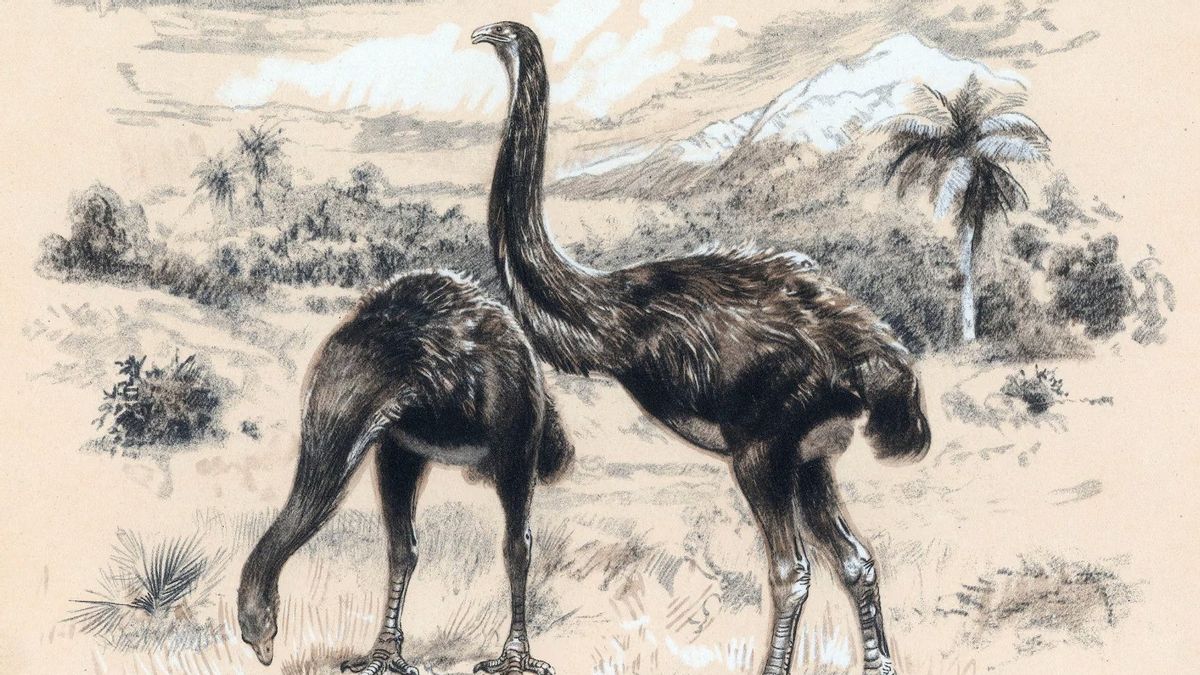


JAKARTA - The moa bird has been extinct for about 600 years. But biotech company Colossal Biosciences now claims to have taken the first steps to bring it back: an artificial egg shell.
Reported by The Guardian, quoted Friday, May 22, the system has been used to hatch chickens. Colossal hopes that the technology can eventually be scaled up to hatch birds the size of moas.
Moa is a giant bird from New Zealand that can't fly. It can be more than 3 meters tall. It weighs more than 200 kilograms. Its eggs are larger than any other bird's eggs that are still alive today.
This project falls under the field of de-extinction, which is an effort to revive extinct species with the help of genetic and reproductive technology.
"We have created a new shell-free culture system that is fully scalable and biologically accurate," said Colossal Biology Head Prof Andrew Pask.
However, this claim has not impressed all scientists. Because, the announcement was only conveyed through a press release. Details of the scientific data are still limited.
Colossal has previously sparked controversy by claiming to revive the dire wolf, a wolf relative that has gone extinct, as well as its ambition to bring back woolly mammoths.
Technically, chicks can already be hatched from artificial eggs. However, their life rate is still limited. One of the problems is the oxygen supply.
Colossal says its new system uses a silicon membrane. The membrane is claimed to be able to channel oxygen at the same rate as a chicken egg shell.
"It sounds impressive, but it will sound that way because it's a press release," said Dr Louise Johnson, an evolutionary geneticist from the University of Reading.
"I look forward to more details when they are published. However, until there is a peer-reviewed paper, my expert commentary on this is the same as commenting on a YouTube ad," he said.
The challenge of moa eggs is much more complicated than chicken. Moa eggs are estimated to be 80 times larger than chicken eggs and about eight times larger than emu eggs. That size makes no living bird today that could be a surrogate parent.
Another problem is with DNA. Over time, DNA is damaged and broken. Therefore, it is considered impossible to completely reconstruct the moa genome.
In the case of the dire wolf, Colossal altered 20 genes in gray wolves to make it look more like a dire wolf. But that's still far from a complete genetic replication.
Ethical questions also arise. Carles Lalueza-Fox, Director of the Barcelona Museum of Natural Sciences and a DNA recovery specialist, questions the ultimate goal of this kind of project.
"It's fair to ask whether it's ecologically reasonable to redesign some modern birds to superficially resemble moas, and what sort of fate such animals would face," he said.
He also questioned whether the engineered animals would later be released on New Zealand's South Island.
According to Lalueza-Fox, projects such as mammoths, dire wolves, and now moas show a mixture of scientific progress and publicity that can be misleading. He assessed that such claims should be read in the context of the business interests of private companies.
The English, Chinese, Japanese, Arabic, and French versions are automatically generated by the AI. So there may still be inaccuracies in translating, please always see Indonesian as our main language. (system supported by DigitalSiber.id)
Popular


