


JAKARTA - Taylor Swift has taken a new legal step to protect her voice and image from the misuse of artificial intelligence (AI) technology, amid the rise of deepfake cases targeting public figures.
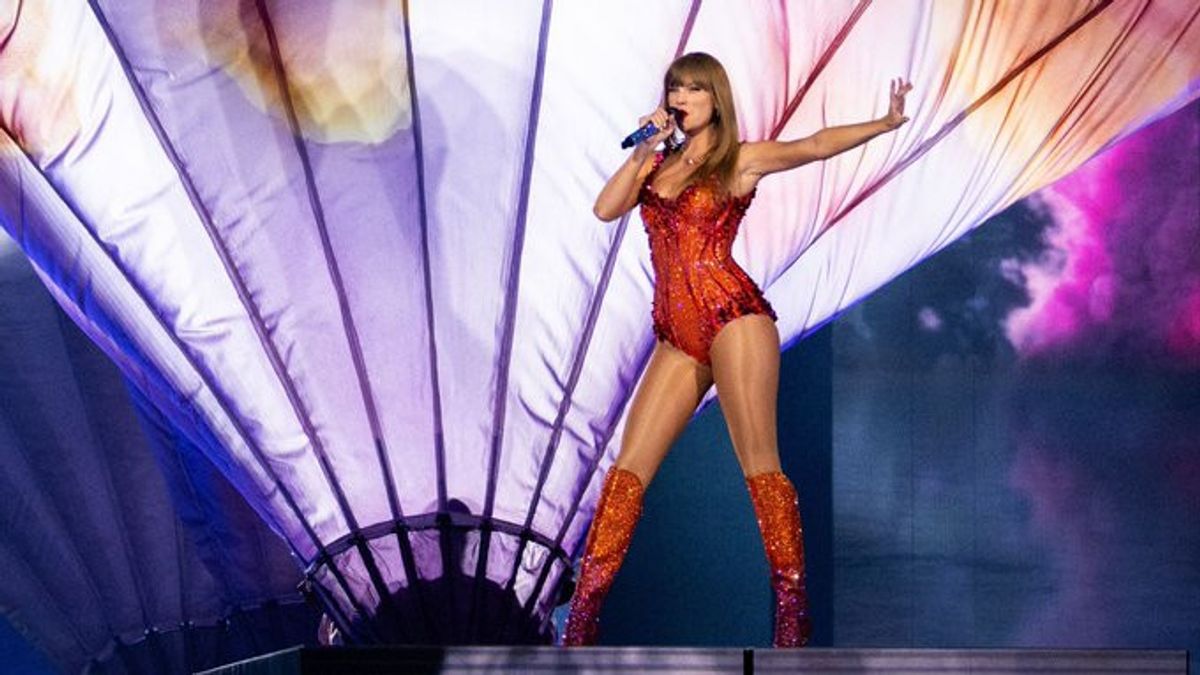
The global pop singer on Friday, April 24, filed several new trademark applications that include two audio clips of her voice, as well as one visual image of herself performing on stage.
The move is seen as a legal strategy to deal with the threat of generative AI, which is now increasingly able to realistically imitate a person's voice, face, and gestures.
In one of the voice recordings filed as trademarks, Swift is heard promoting her latest album titled "The Life of a Showgirl" on digital music platforms. Another recording contains a similar promotional message with a different intonation.
Not only that, he also registered a picture of himself performing in a typical sparkling costume while playing a pink guitar - a visual icon that has long been attached to his stage identity.
New Legal StrategyTaylor Swift's move comes after a number of other celebrities have begun to take similar paths to protect their identities from unauthorized digital replicas.
In January 2026, actor Matthew McConaughey became one of the first high-profile figures to file a series of trademarks on images, videos, and audio of himself to counter the threat of AI-based deepfakes.
Legal experts assess that this type of move has the potential to become a new trend among top artists, especially since traditional regulations such as copyright have not been able to fully close the legal loopholes that arise as a result of AI technology.
Trademark lawyer Josh Gerben, who first reported Taylor Swift's filing, called the attempt to trademark a celebrity's vocal likeness an approach that has not been widely tested in court.
"Historically, singers have relied on copyright law to protect their musical recordings. However, AI technology now allows people to create new content that mimics the voice of an artist without copying the original recording. This creates a legal loophole that can be filled by trademarks," wrote Gerben.
He added that by registering certain phrases associated with her voice, Swift could potentially challenge not only identical reproductions, but also "substantially confusing" imitations, which is an important standard in trademark law.
During her career, Taylor Swift has registered hundreds of trademarks, ranging from names, lyrics, to merchandise products. However, this is said to be the first time she has pursued protection in the form of a sound mark or sound mark.
Cases of identity abuse by Taylor Swift by AI are not new. In recent years, there have been fake clips showing her promoting household products, sexually suggestive deepfakes that went viral on social media, to manipulated photos used for political purposes.
This phenomenon shows how generative AI technology is evolving faster than existing legal protection systems.
Several other public figures have also voiced similar concerns, including Scarlett Johansson, Tom Hanks, and Bryan Cranston, who have accused AI technology of using their likeness without permission.
On the other hand, digital platforms are starting to move. Last week, YouTube announced a partnership with a number of talent agencies to open access to deepfake detection tools to celebrities and creators so that they can more easily request the removal of false content.
Taylor Swift's case marks a new chapter in the battle between the entertainment industry and AI technology. If previously artists protected their works, now they are starting to protect their own identities - because in the AI era, even voices can be forged, and images can be replicated in just a few seconds.
Follow VOI Whatsapp Channel
The English, Chinese, Japanese, Arabic, and French versions are automatically generated by the AI. So there may still be inaccuracies in translating, please always see Indonesian as our main language. (system supported by DigitalSiber.id)
Popular


