
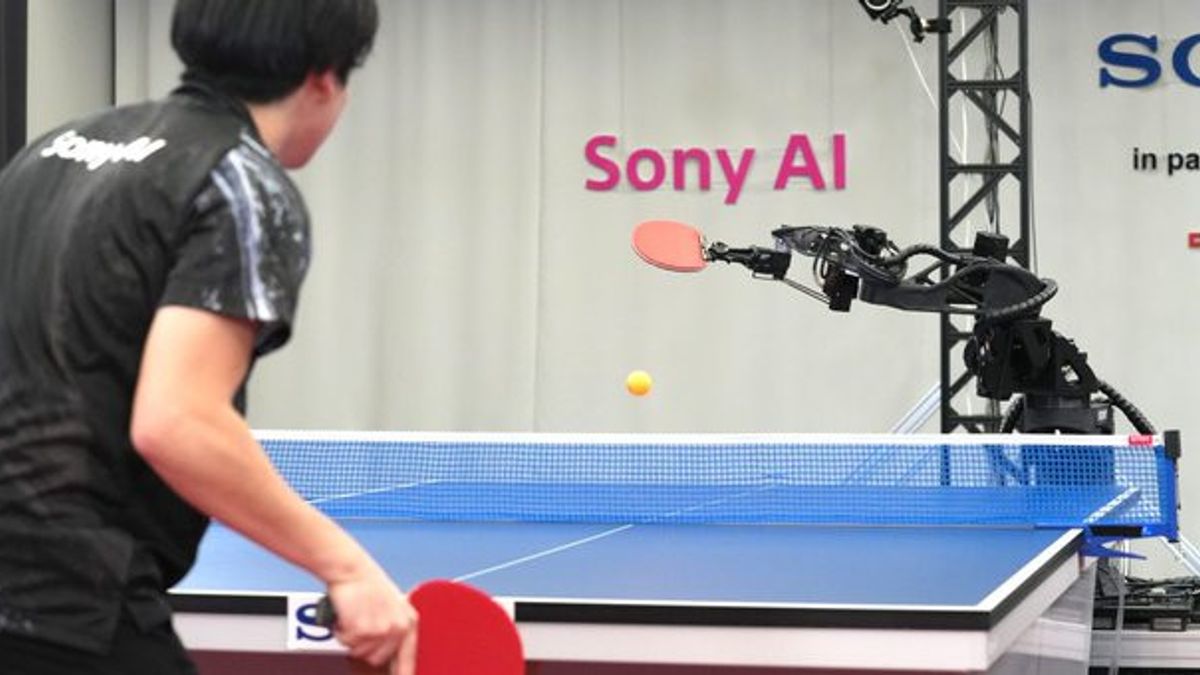


JAKARTA - An autonomous table tennis robot named Ace has scored a new milestone in the world of artificial intelligence after being able to compete and even beat top human players in official matches.
Developed by Sony's AI research division, Ace is the first robot to achieve the performance of an expert player in a competitive physical sport - an area that has been much more difficult for AI to conquer than the digital world.
Unlike games such as chess or Go that have long been dominated by AI, table tennis presents an extreme challenge: decisions must be made in milliseconds, the ball moves with complex spin, and the interaction takes place in real time in a physical space.
"Ace shows that AI systems are now capable of handling fast and high-precision interactions in dynamic environments," said Peter Dürr, project leader of Ace and director of Sony AI Zurich.
In a study published in the journal Nature, Ace reportedly won three out of five matches against elite players in April 2025, as well as losing to professional players. However, his performance continued to improve - until he was finally able to beat professional players in late 2025 and early 2026.
The technology behind Ace is key. The robot uses nine synchronized cameras and three vision systems to track the ball with high accuracy - even in conditions researchers call "blur for the human eye". This system is combined with AI-based control and a robotic platform with eight joints, allowing precise and flexible movement.
As a result, Ace is not only fast, but also difficult to predict. Professional player Mayuka Taira admitted that it was difficult to face the robot because it did not show emotions or patterns of play that were easy to read.
"It's hard to know his weakness because his reaction can't be predicted," he said.
Meanwhile, elite player Rui Takenaka believes strategy remains the key to defeating Ace, especially by utilizing simple serves that provoke a response that is easier to attack.
However, researchers emphasized that Ace still has limitations. Unlike humans who adapt quickly to opponents, this robot is still in the development stage to improve the ability to read the game strategy more deeply.
Outside of sports, this achievement opens up wider opportunities. The technology used by Ace has the potential to be applied to the manufacturing sector, services, to safety systems that require fast and high-precision responses.
This development also comes amid a surge in global robot innovation. In recent days, robots have even reportedly outpaced human runners in a half marathon in Beijing - showing a significant acceleration in the machines' capabilities in the real world.
Follow VOI Whatsapp Channel
The English, Chinese, Japanese, Arabic, and French versions are automatically generated by the AI. So there may still be inaccuracies in translating, please always see Indonesian as our main language. (system supported by DigitalSiber.id)
Most Popular Tags
#Prabowo Subianto #donald trump #2026 World Cup #Febrie Adriansyah #8791Popular


