
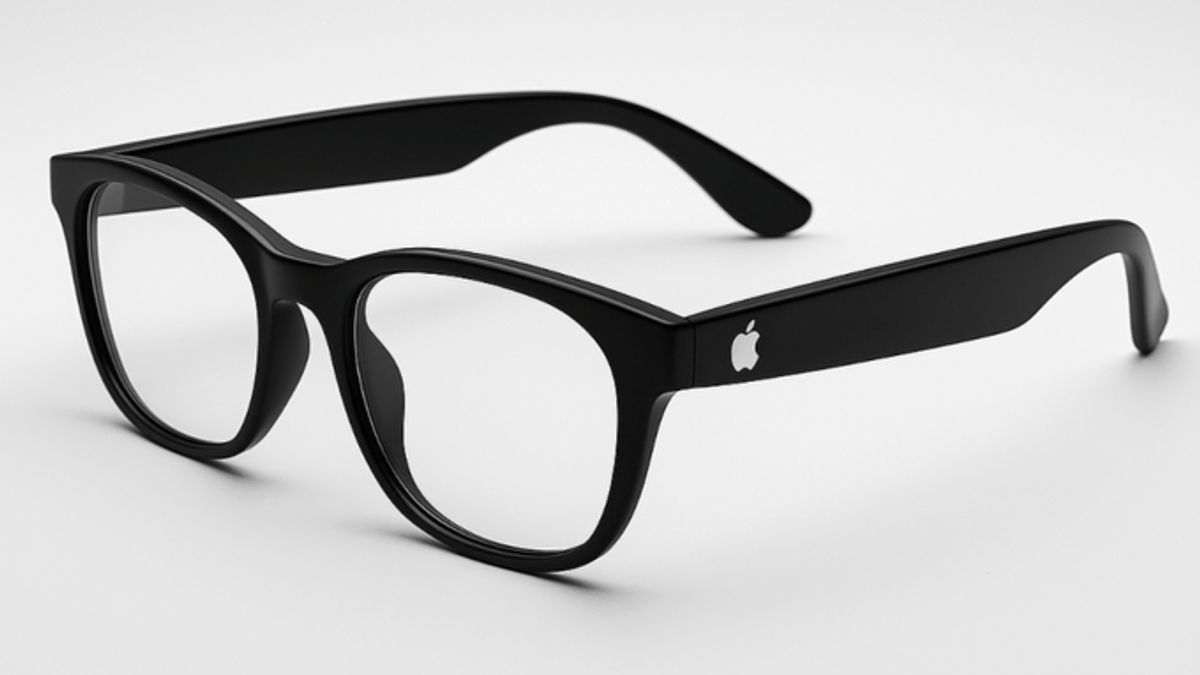


JAKARTA - The wearable industry is heating up again, this time through the smart glasses battle. Apple is reportedly preparing to launch its first smart glasses by the end of 2026, marking the company's serious move into the increasingly competitive AI-based device sector.
According to a Bloomberg report citing analyst Mark Gurman, Apple is targeting a debut of this product during the holiday season, a timing that is clearly not a coincidence - because consumer device demand usually peaks in that period.
But interestingly, Apple's approach seems different from initial expectations. Instead of presenting augmented reality (AR) with a built-in screen, Apple's first generation of smart glasses is expected to have no display at all.
Instead, the device will rely on cameras, audio, and integration with Siri to deliver a context-based experience. In other words, these glasses are positioned more as an "extension" of the iPhone, not its replacement.
This strategy reflects the reality of current technology. Adding a screen to smart glasses still carries major compromises - from weight, battery consumption, to production costs. To date, no company has really managed to balance all these factors on a mass scale.
Apple seems to be taking a realistic path: first, present a product that can actually be worn every day, then develop its capabilities over time - similar to the evolution of the Apple Watch and AirPods in the early days.
On the other hand, Meta has already entered the market through a collaboration with Ray-Ban smart glasses. This product managed to attract public attention and proved that the category has potential, even though it has not yet become the main need of users.
This means that the market is still wide open. Apple did not come as a "late player", but as a candidate who could redefine the category.
Apple's smart glasses are expected to rely heavily on AI-based voice interaction and context understanding. The embedded camera will help recognize the surrounding environment, while Siri becomes the main link between the user and information.
The problem is, Siri's own development has experienced a number of delays. If this digital assistant is able to evolve into a smarter and more contextual, Apple smart glasses could be a revolutionary device. If not, the risk is clear: this product will only feel like a collection of features that are already on the iPhone and AirPods.
Apple is also not betting on a single device. Reports say the company is developing a variety of AI-based wearables, including AirPods with cameras and pendant-shaped devices. This approach shows that Apple is experimenting to find the most natural form of AI interaction in everyday life.
In other words, smart glasses are just one of the entrances.
Apple's short-term goal seems simple: get to market first, build an ecosystem, then perfect the technology behind the scenes. In an industry still looking for this kind of shape, the strategy can be more effective than just being the first.
Follow VOI Whatsapp Channel
The English, Chinese, Japanese, Arabic, and French versions are automatically generated by the AI. So there may still be inaccuracies in translating, please always see Indonesian as our main language. (system supported by DigitalSiber.id)


