
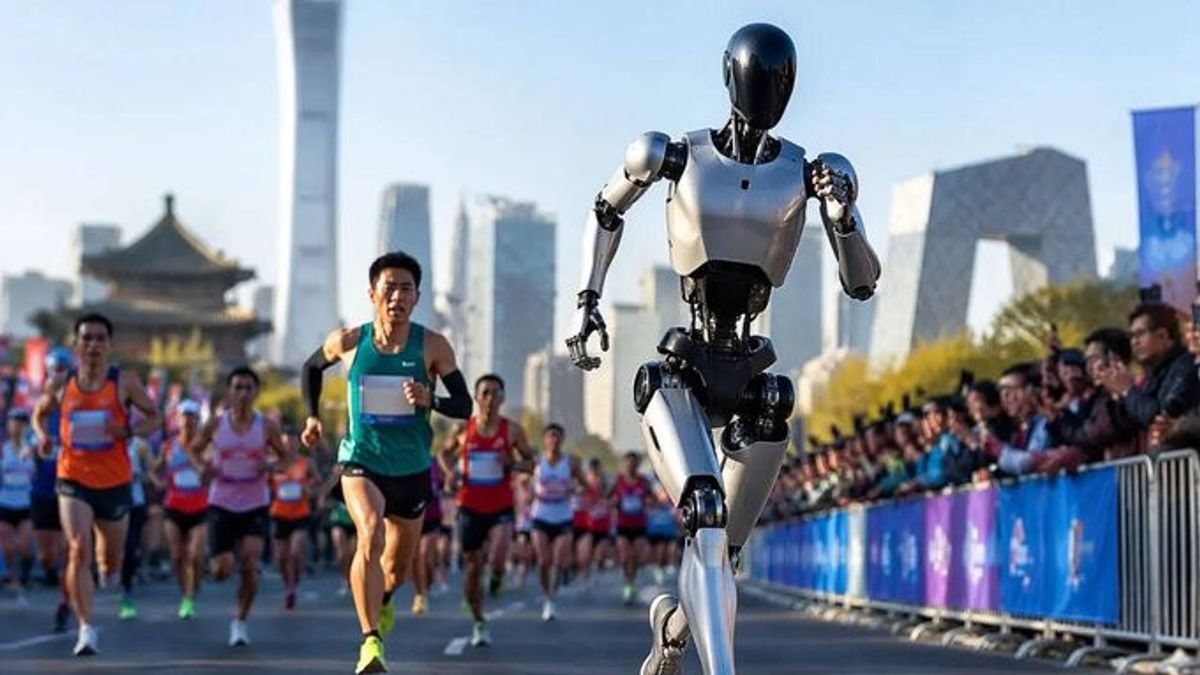


JAKARTA - Dozens of humanoid robots made in China have stolen the world's attention after recording extraordinary performance in the half marathon in Beijing, Sunday, April 19. In the 21-kilometer race, some robots were even able to outperform professional human runners. This marks a significant acceleration in the development of robotics technology.
The event, held at Beijing E-Town, is a stage for the latest capabilities of the humanoid robot sector, as well as reaffirming China's ambition to lead the future industry based on artificial intelligence.
Robot Faster than Human World Record
The winning robot was developed by technology company Honor, which managed to record a time of 50 minutes 26 seconds. This record surpassed the world record for human half marathon previously held by Jacob Kiplimo.
Not just one, the top three positions are all filled by robots from the Honor team, all of which are able to navigate autonomously without remote control.
This performance contrasts with the previous edition in 2025, where many robots failed to finish and the best times were still far behind human runners.
Real Visible Technological Progress
This year, the number of participants jumped drastically from around 20 teams to more than 100 teams. Almost half of the robots managed to complete the track with autonomous navigation capabilities, a major leap from the previous year.
The robots are designed to resemble the anatomy of human runners, including the use of 90-95 cm long legs and a liquid cooling system adapted from smartphone technology.
"Running faster may not seem very important, but it allows for the transfer of technology to other aspects such as the reliability of structures and cooling systems," said one of the team's engineers.
Not Just a Race, But a Test of the Future
Although it looks like a technology entertainment event, experts assess that the capabilities shown by this robot have broad implications - from the manufacturing industry to high-risk jobs.
However, there are still major challenges. Current humanoid robots are not considered to be able to match human flexibility, environmental perception, and agility in complex real-world tasks.
The Chinese government is aggressively pushing the development of humanoid robots through various policies, ranging from subsidies to the development of industrial infrastructure.
Events like this are also part of a major strategy to strengthen technological dominance, including those that have been featured in national events such as the CCTV New Year's gala.
In the public eye, this development is not just a technical advance, but a glimpse of the future. A student of engineering who watched the race called the robot's performance "very impressive" given that AI technology is still relatively new.
Meanwhile, young people are starting to be inspired. A student even admitted that he wanted to pursue robotics after seeing the robot's ability on the track.
Although large-scale commercialization is still in its early stages, this trend shows a clear direction: humanoid robots will play an important role in various sectors.
Follow VOI Whatsapp Channel
The English, Chinese, Japanese, Arabic, and French versions are automatically generated by the AI. So there may still be inaccuracies in translating, please always see Indonesian as our main language. (system supported by DigitalSiber.id)


