

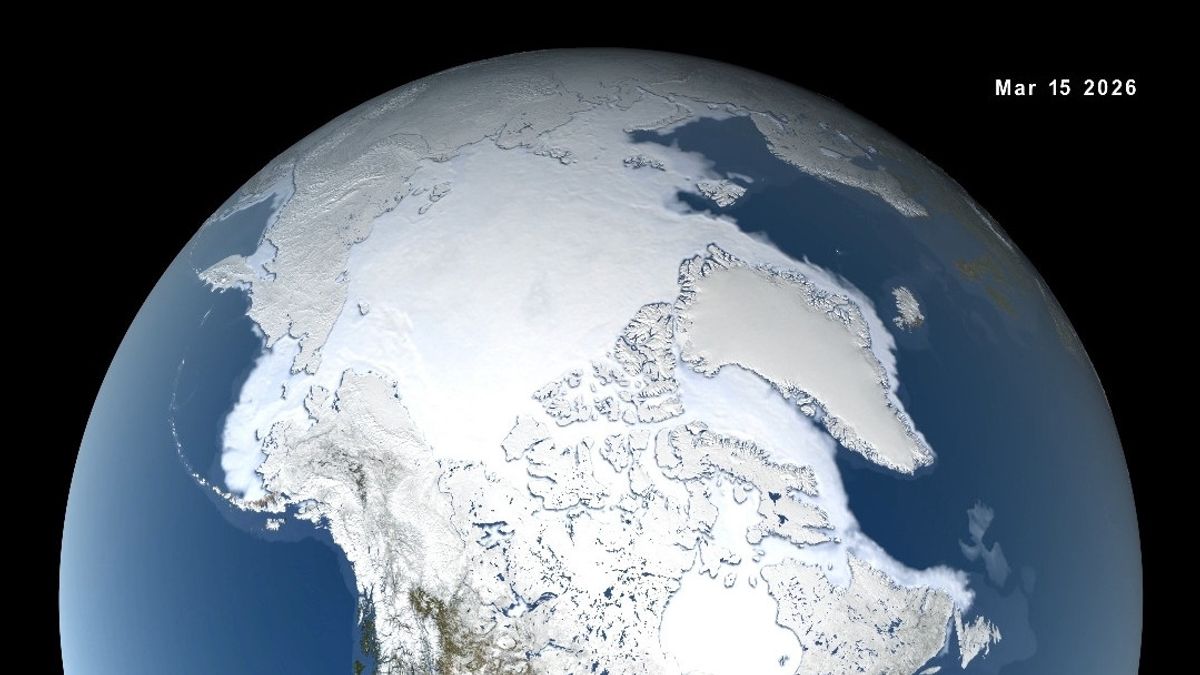


JAKARTA - The Arctic sea ice condition during the winter continues to reach its lowest point. In two consecutive years, the results of NASA-monitored satellite observations show that the ice area continues to shrink.
On March 15, 2026, the ice area only covered 14.29 million square kilometers, almost matching the record low that occurred the previous year, namely 14.31 million square kilometers. This situation is considered to strengthen the trend of ice decline monitored since 1979.
Scientists from NASA and the National Snow and Ice Data Center (NSIDC) are also concerned about changes in ice thickness. Data from NASA's ICESat-2 satellite shows that most of the northeastern region of Greenland now has a much more fragile ice sheet.
The Okhotsk Sea, which borders Japan and Russia, also experienced significant thinning of ice in winter. Although the region has natural variability, the current conditions are still considered worrying by cryosphere experts.
Satellite data revealed that this year's peak ice cover was about 1.3 million square kilometers below the 1981-2010 average. This proves that new ice formation at the North Pole continues to shrink from year to year.
"One or two years with a little bit of ice may not mean much when looked at in isolation," said NSIDC ice scientist Walt Meier. However, he stressed that the consistent decline since 1979 provides a real picture of global climate change.
Unlike the Arctic, sea ice in Antarctica actually showed a slight increase compared to the lowest point in 2023. Although still below the historical average, the ice area in the south pole reached 2.58 million square kilometers at the end of February.
To monitor this condition in real-time, researchers now rely on advanced sensors from the Japan Aerospace Exploration Agency (JAXA). The data will be compared with Nimbus-7 satellite recordings to ensure the accuracy of climate change.
The English, Chinese, Japanese, Arabic, and French versions are automatically generated by the AI. So there may still be inaccuracies in translating, please always see Indonesian as our main language. (system supported by DigitalSiber.id)
Popular


