
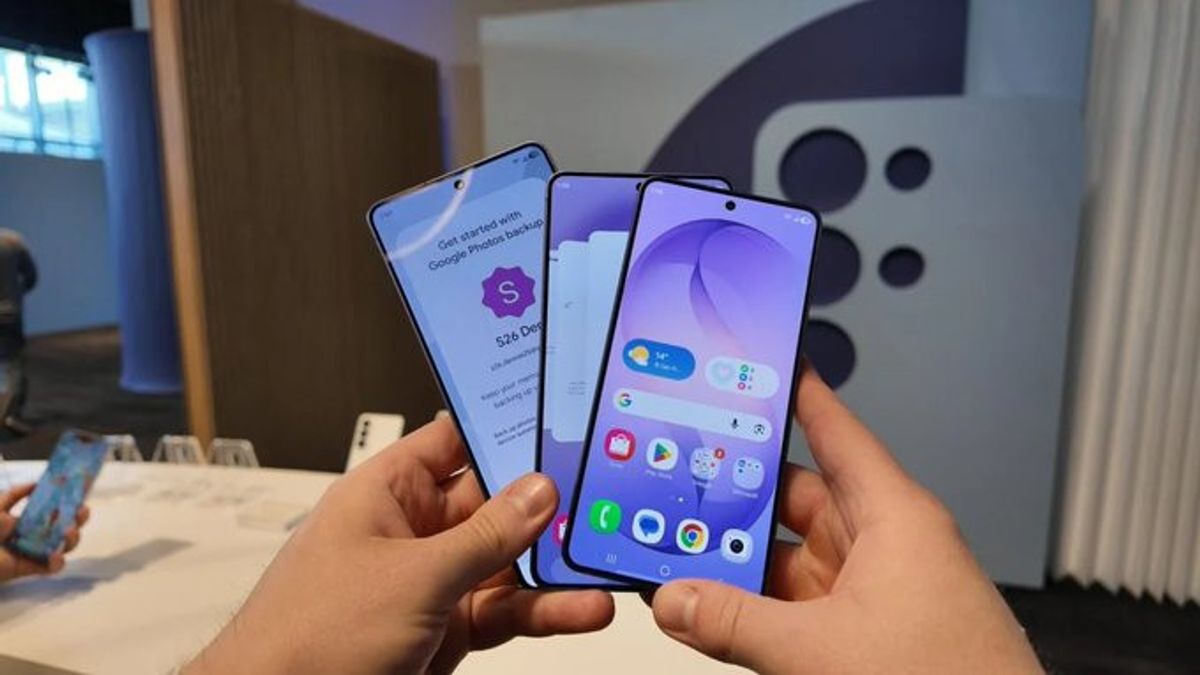


JAKARTA - Bad news came for the gods class screen specification hunters. Samsung confirmed that it pinned an 8-bit panel on the entire Galaxy S26 line, although it had previously mentioned 10-bit in a press briefing session last month.
This confirmation comes after a report from SamMobile which said Samsung had clarified the information. Initially, in the product presentation, the company indicated that the Samsung Galaxy S26 Ultra came with a 10-bit screen. However, Samsung later explained that the information was inaccurate and that not only the Ultra variant, but also the Samsung Galaxy S26 and Samsung Galaxy S26 Plus use an 8-bit panel.
Technically, the difference between 8-bit and 10-bit is not just a marketing figure. An 8-bit screen is capable of displaying about 16.7 million colors, while 10-bit reaches 1.07 billion colors.
The difference sounds like a cosmic leap. The 10-bit screen also helps reduce color banding, which is a broken or layered color gradation, and improves color accuracy, something that is important for content creators and users who are sensitive to visual details.
But in everyday practice, most users are unlikely to notice the difference. Many consumers prioritize improving the camera, chipset performance, or battery life over the color depth of the panel. This is where the reality of the market speaks: high specifications are tempting, but the actual experience is often more complex than the numbers on paper.
Interestingly, SamMobile also noted conflicting information regarding this detail, although so far official clarifications have led to the use of an 8-bit panel. If this is true, then the previous mention of 10-bit could be a pure communication error in an internal session or early material.
Even so, overall the Galaxy S26 still comes with various improvements compared to the previous generation. The design is said to be slimmer and more modern, and other improvements in the performance and photography sectors are still the main attraction.
This case shows one thing: in an era where consumers are increasingly tech-savvy, small details like color depth can trigger big discussions. Specifications are not just numbers, but expectations. And when expectations are not in line with reality, the internet moves fast.
In the world of premium smartphones, every bit does matter. But in the end, the question is simple: do human eyes really capture that 1 billion color difference in a daily TikTok scroll? That's where perception science meets marketing strategy.
The English, Chinese, Japanese, Arabic, and French versions are automatically generated by the AI. So there may still be inaccuracies in translating, please always see Indonesian as our main language. (system supported by DigitalSiber.id)


