
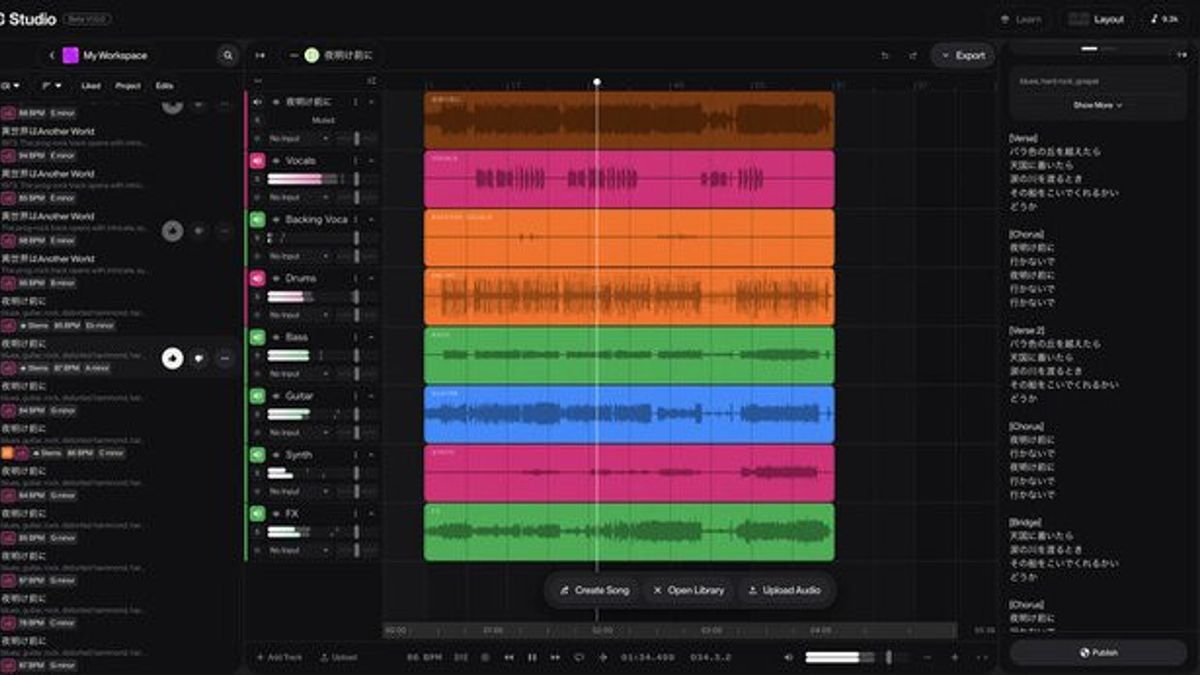


JAKARTA - The main music industry accuses AI platforms such as Suno and Udio of gross copyright theft by training their systems using millions of songs without permission. With the increasing number of lawsuits, the fight between the music industry and AI companies has the potential to change the way copyright protection is in the digital era.
If you've never written a single tone in your life, AI can change that. There are many AI tools that help users compose songs with just a few text commands. While this sounds like a good opportunity for prospective songwriters, it's actually a big problem for music publishers. In fact, several large music groups now accuse AI of stealing copyrighted material.
The world's largest technology companies, including special AI companies such as OpenAI, Suno, Udio, Mistral, and others, are involved in the biggest copyright infringement ever, said John Phelan, director-general of the International Confederation of Music Publishers (ICMP), quoted by VOI from AFP.
SEE ALSO:
-
 | TEKNOLOGI
Hadir di Semarang, AXIS Esports Labs Bawa Turnamen Esports hingga Edukasi Karier
28 September 2025, 16:20 -
 | TEKNOLOGI
Komdigi Resmikan Garuda Spark Innovation Hub di Bandung, Dorong Transformasi Digital
28 September 2025, 14:45 -
 | TEKNOLOGI
Realme GT 8 Pro akan Dirilis November 2025, Ditenagai Chipset Snapdragon 8 Elite Gen 5
28 September 2025, 14:03


This allegation is not just an empty threat. ICMP states that AI companies have "dosted the entire world music catalog" and committed "commercial-scale copyright violations intentionally."
Big record labels such as Universal Music Group, Sony Music, and Warner Music Group have filed a lawsuit against AI music generators such as Suno and Udio. They accuse these platforms of building their services by copying millions of unlicensed songs.
Music AI platforms like Suno and Udio allow users to compose songs only based on command text, so they can produce music that is very similar to famous artists such as Chuck Berry and Mariah Carey.
Is this just because music organizations want to protect their profits? Apparently, this is indeed a serious problem. Suno already has more than 10 million users who create music files, with some works even getting more than 2 million streams.
Meanwhile, AI-generated music reaches 28 percent of the content uploaded daily in Deezer. Imagine if millions of people took samples from songs, used them without paying royalties, then made money from other people's works. That's what's going on right now.
The music industry is not alone in fighting AI-related theft. photographers and artists have also started voicing their objections. Many photographers found that image generators of AI use their works as model training materials, thus producing images that are very similar to original works, with little change. In fact, earlier this year Getty Images sued AI Stabilities for similar problems.
In addition, publishers and media such as the New York Times have also filed a lawsuit against AI companies such as OpenAI regarding the use of their written works.
The English, Chinese, Japanese, Arabic, and French versions are automatically generated by the AI. So there may still be inaccuracies in translating, please always see Indonesian as our main language. (system supported by DigitalSiber.id)
Most Popular Tags
#Prabowo Subianto #donald trump #Febrie Adriansyah #8791 #giias 2026Popular


