

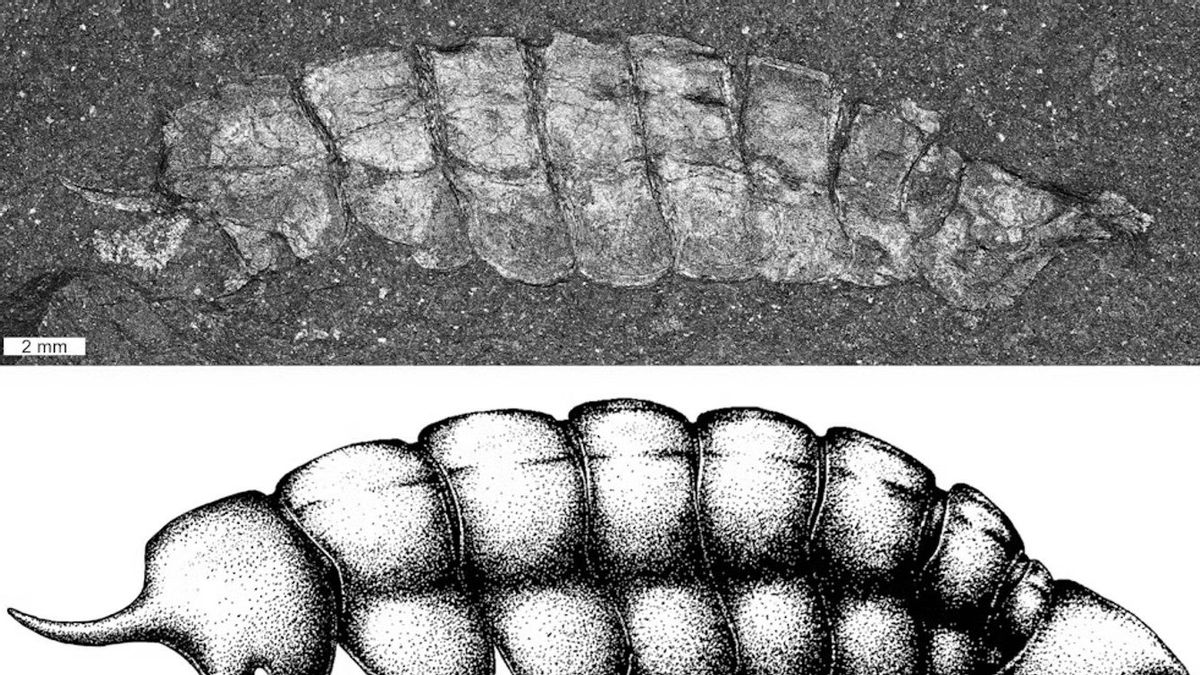


JAKARTA - A fossil that has been stored in a museum drawer for decades has led scientists to reconsider one of the great puzzles in the history of life on Earth. The fossil, which is about 500 million years old, suggests that the "Furongian Gap" may not have been the time when life declined sharply.
According to a report by The Independent, quoted on Saturday, May 30, this finding comes from a new study published in the journal BMC Biology. So far, paleontologists have referred to the vague period in the Cambrian fossil record as the "Furongian Gap".
Paleontologists are scientists who study ancient life through fossils. The Cambrian Period is a very old period in Earth's history, when many early life forms began to appear.
The Furongian gap is considered strange because the fossil record shows a burst of biodiversity just before and after that period. Therefore, some scientists suspect that a biological crisis has occurred, for example due to environmental changes, marine chemistry, climate cooling, or lack of oxygen in the ancient sea.
But this new study offers another possibility: The Furongian gap could be more related to the location of fossil searches and the types of rocks that have been studied, rather than evidence of the collapse of biodiversity.
The fossil studied is from Quebec, Canada. The animal was named Magnicornaspis garwoodi and belongs to the arthropods, a group of animals with an exoskeleton such as insects, crabs, spiders, and scorpions.
Magnicornaspis garwoodi belongs to the corcoraniid group, a very rare ancient arthropod. Its body features include a wide head shield, a large body, and defensive spines.
This specimen is special because it has two large spines that protrude forward from the head. The spines distinguish it from known relatives and show that defensive abilities in this group may have emerged earlier than previously thought.
The fossil is actually not a new find in the field. The specimen was collected in 1962 during geological mapping near Sainte-Anne-de-la-Pocatière, Quebec. The fossil comes from the mudstone of the Rivière-du-Loup Formation, which was formed in a deep marine slope environment in the late Cambrian.
Such rocks come from relatively calm offshore conditions, when fine mud slowly settles. Until now, this type of rock has not received much attention from paleontologists.
The Independent reported that the fossil had long been stored in the collection of the Smithsonian National Museum of Natural History in Washington DC. For decades, its value was almost unnoticed.
This case shows that important discoveries in paleontology do not always come from new fieldwork. Long-stored museum collections can also unlock big information when re-examined with modern techniques.
The findings from Quebec reinforce evidence that the late Cambrian world was not entirely devoid of life. Previous studies from China and Sweden have also found well-preserved fossils from around 497 million to 485 million years ago.
The researchers assessed the findings showed that the ecosystem at that time may still be diverse and complex.
The Quebec fossil also expands the map of the soft-bodied fossil preservation area. Its location is on the edge of ancient Appalachia in eastern Laurentia, an ancient continent that once covered most of North America and today's Greenland.
With this finding, "Furongian Gap" could be a proof of the collapse of life, but a mirror of the limitations of human search. In scientific terms, this is called an anthropogenic bias, that is, a picture that changes because humans only examine certain places, rocks, or collections.
Researchers say there are still many groups of organisms, perhaps even entire ecosystems, that have not been discovered. Some of them could be in rock formations that are rarely studied or in museum collections that were collected decades ago.
The English, Chinese, Japanese, Arabic, and French versions are automatically generated by the AI. So there may still be inaccuracies in translating, please always see Indonesian as our main language. (system supported by DigitalSiber.id)
Most Popular Tags
#Prabowo Subianto #donald trump #firearm #8791 #giias 2026Popular


