

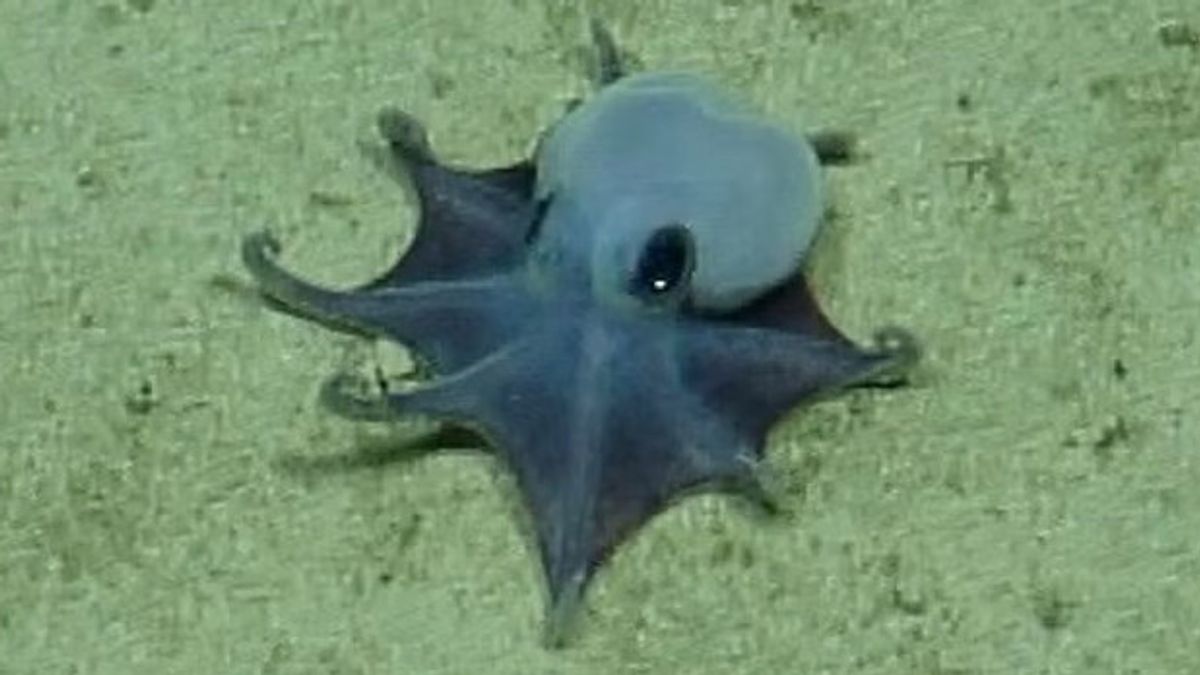


JAKARTA - A small blue octopus from the deep sea near the Galapagos Islands has been confirmed as a new species. The golf ball-sized animal was first spotted in 2015, but has only now been identified through scientific study.
Quoted from The Independent, Tuesday, May 26, the octopus was named Microeledone galapagensis. The animal was found on an underwater expedition using the EV Nautilus research vessel.
At the time, the crew lowered a remotely operated underwater robot to explore the sea floor near Darwin Island, at the northern end of the Galapagos Islands. The robot's camera captured the blue octopus near an underwater mountain at a depth of about 5,800 feet or 1,768 meters.
The expedition team took one octopus and recorded two other octopuses that looked similar. Of the several specimens collected, the little blue octopus was the most interesting.
The specimen was then preserved in alcohol and formalin, then sent to the Field Museum in Chicago for research.
The Independent reported that the study on the octopus was published in the scientific journal Zootaxa.
"From the very beginning, I knew this was something very special. I've never seen anything like it," said Janet Voight, one of the study's authors.
However, researchers face a problem. They only have one main specimen. In fact, to establish a new octopus species, scientists must examine many parts of the body, including the mouth, beak, and teeth.
"To see those parts, the specimen must be split. We only have one specimen, so I don't want to dismantle it," said Voight.
In order not to damage the rare specimen, researchers used CT scans. These scans work like layered X-rays that can show the inside of the body and help create a three-dimensional model.
Stephanie Smith, another author of the study, said CT scans are important because they don't damage specimens.
"People often bring in specimens that are very rare and beautiful, and I get the chance to virtually open them up," Smith said.
The scan revealed details of the octopus' internal organs, including the mouth. The data helped confirm that the animal was a truly new species for science.
"This is a small octopus that lives in the deep sea and has almost never been seen by anyone on Earth. I feel lucky to be able to study it," said Voight.
He said the ocean still holds a large space that is not known to humans.
"If all the land on Earth were put together, its size would still not cover the Pacific Ocean. The ocean is so vast and there is still so much to explore," he said.
This discovery shows how little of the deep sea around the Galapagos is understood. Each new species provides clues to hidden ecosystems that have been virtually untouched.
"Each new species helps us better understand this hidden ecosystem, and why protecting it is important," said Salome Buglass, a marine scientist from the University of California Los Angeles.
The English, Chinese, Japanese, Arabic, and French versions are automatically generated by the AI. So there may still be inaccuracies in translating, please always see Indonesian as our main language. (system supported by DigitalSiber.id)
Most Popular Tags
#Prabowo Subianto #donald trump #Febrie Adriansyah #8791 #giias 2026Popular


