

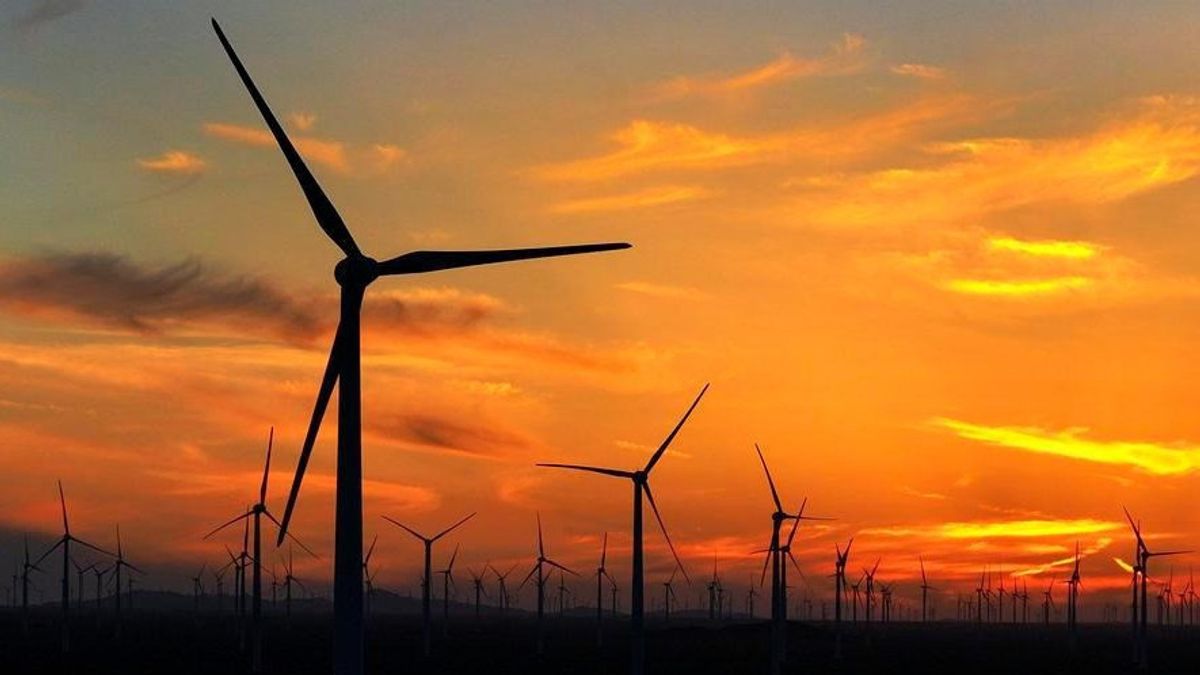


JAKARTA - Chinese researchers are using artificial intelligence or AI to map solar and wind energy infrastructure across the country. The result: 319,972 solar energy facilities and 91,609 wind turbines were identified from satellite images.
According to a Xinhua report quoted on Friday, May 22, the study was carried out by researchers from Peking University and Alibaba Group's DAMO Academy. The results of the research have been published in the journal Nature.
The research team analyzed more than 7.56 terabytes of high-resolution satellite imagery. From there, they mapped renewable energy facilities in 1,915 counties in China in 2022.
Liu Yu, a professor at the School of Earth and Space Sciences, Peking University, said the detailed data provided "a bird's-eye view of the national renewable energy landscape".
The important finding of this study is not only the number of facilities. Researchers also looked at how solar and wind power can offset each other's weaknesses.
Solar power usually reaches its peak production during the day. Wind power often produces more electricity at night. If managed across regions, these two energy sources can make the electricity supply more stable.
The study tested four energy integration strategies, from the provincial level to full national coordination. The results, interprovincial national coordination is the most effective way.
In a system with 80 percent of the supply being adjustable, the national strategy can increase the effective penetration of renewable energy by 99.88 terawatt-hours or TWh.
TWh is a unit to measure electricity in very large quantities. In this study, an additional 99.88 TWh is equivalent to 9.1 percent of the total solar and wind electricity production calculated by the researchers.
The amount is also said to be enough to supply China's national average electricity load for about 120 hours.
Interestingly, the additional electricity does not require a new plant. The energy comes from clean electricity that was previously potentially wasted due to production restrictions or was not absorbed by the network.
The study highlights that the integration of renewable energy does not only depend on the addition of solar panels and wind turbines, but also on the regulation of the network, region, and time of supply.
With the database from AI, researchers assess that China has a clearer path to integrate renewable energy more efficiently and pursue its carbon neutrality target.
The English, Chinese, Japanese, Arabic, and French versions are automatically generated by the AI. So there may still be inaccuracies in translating, please always see Indonesian as our main language. (system supported by DigitalSiber.id)


