



JAKARTA - Chinese scientists have successfully tested a system that can send electricity wirelessly to multiple moving targets at once. This technology is a first step towards the use of solar energy from space.
China Daily, quoted Tuesday, May 19, reported that the trial was conducted by the "Sun Chasing Project" team led by Duan Baoyan, a member of the Chinese Academy of Engineering and a professor at Xidian University in Shaanxi Province.
In ground-based testing, the system was able to deliver 1,180 watts of power over 100 meters to multiple moving targets. The team said this "one-to-many" transmission success brought the technology closer to the implementation of more tangible techniques.
Duan likened the space solar power plant to a wireless charging pole placed in a certain orbit.
In orbit, solar panels can capture sunlight continuously. The system is not disturbed by the atmosphere or the alternation of day and night as on Earth.
However, electricity from space is not possible to be sent by cable. Therefore, scientists use microwaves. Electricity is converted into microwaves, emitted to the target, then converted back into direct current electricity that can be used.
This technology is important for small satellites in low Earth orbit. Currently, many satellites can only generate electricity for about 60 minutes in one orbit during a 96-minute orbit. The rest, the satellite is in the shadow of the Earth and depends on the battery.
According to Duan, charging networks in space can reduce the dependence of satellites on their respective solar panels. Satellites can charge directly in orbit.
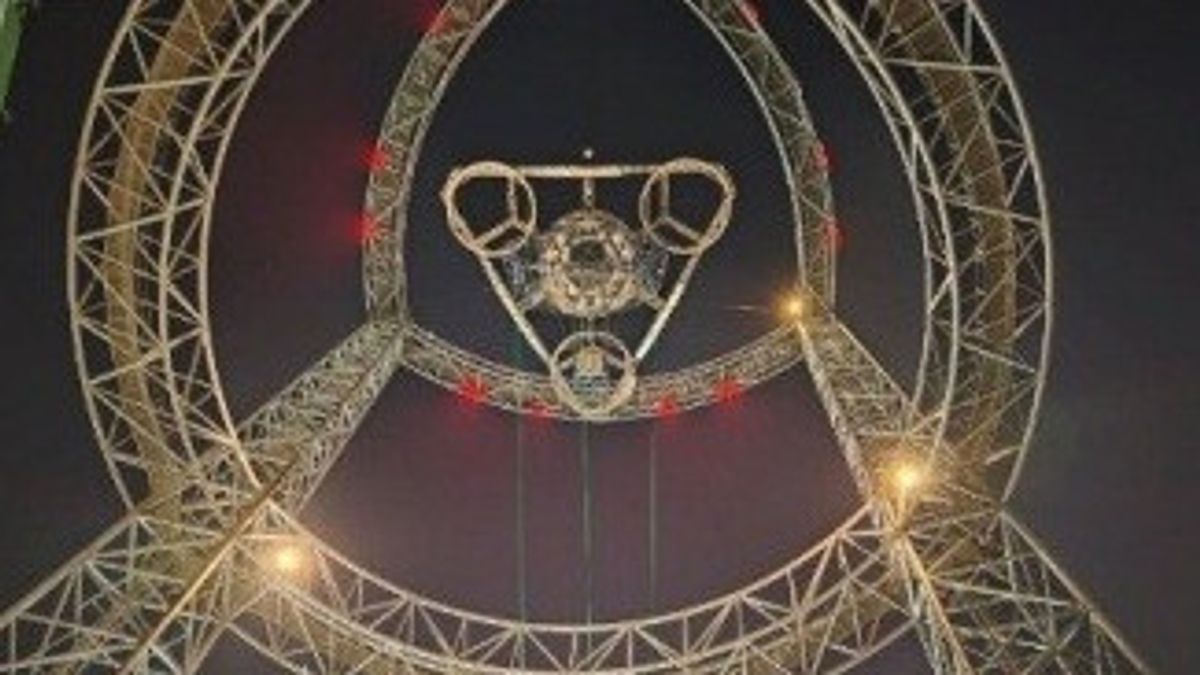
Duan's team has been developing the OMEGA design since 2014. The system uses the principle of a ball to focus sunlight. In June 2022, they built the world's first full-chain ground validation system.
The test covers the entire process, from capturing sunlight, converting it into electricity, converting electricity into microwaves, emitting it, then converting it back into electricity on land.
The latest version of the system is called Distributed OMEGA. The design is modular. This means that its components can be assembled or replaced in orbit like a stack of blocks. This approach is used to address the challenges of building and maintaining large electrical networks in space.
The latest test data shows an increase compared to 2022. At a distance of more than 100 meters, the efficiency of the transmission of direct current to direct current reaches 20.8 percent. In 2022, the figure was 15.05 percent.
The efficiency of the collection of the wave beam reaches 88 percent. This means that the energy of the microwave beam is still directed to the target.
The team also tested the ability to track moving objects. In the simulation, a drone flying 30 kilometers per hour managed to receive a stable 143 watt power supply from a distance of 30 meters. This ability is important because satellites and orbit stations keep moving relative to each other.
An expert panel from the Shaanxi Provincial Technology Transfer Center judged the results of this project to have reached the world's leading level and have broad opportunities for engineering and industrial applications.
China places the utilization of space resources as one of the focuses in the 15th Five-Year Plan period 2026-2030. In the long-term roadmap, this team plans to test technology in low Earth orbit during that period.
The next target is a trial in a megawatt-scale orbit around 2030. China Daily said the ultimate goal is to build a commercial gigawatt-scale space solar power plant by 2050 to send clean energy directly to Earth.
The English, Chinese, Japanese, Arabic, and French versions are automatically generated by the AI. So there may still be inaccuracies in translating, please always see Indonesian as our main language. (system supported by DigitalSiber.id)


