

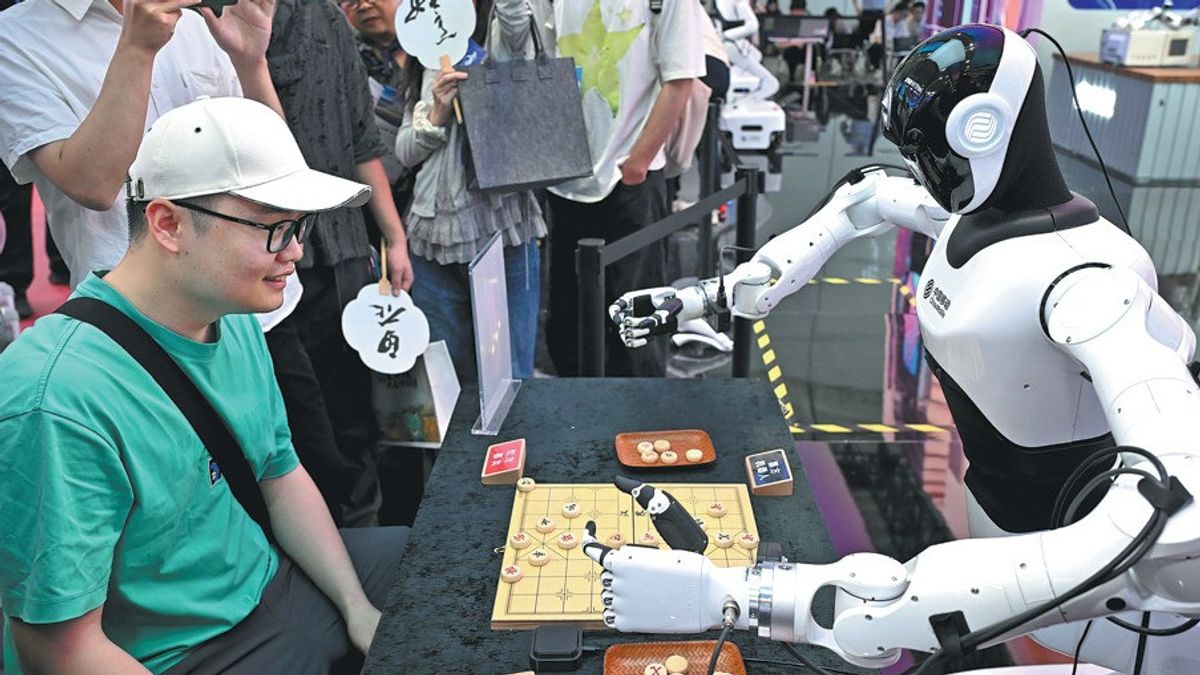


JAKARTA - The race for artificial intelligence fuel is now getting closer to Indonesia. According to a report by China Daily, Thursday, April 30, the AI company from Fujian, Joyful Embodied, has begun to establish partnerships with a number of companies in Indonesia and is targeting the Southeast Asian market.
The partnership comes as daily use of AI tokens in China has skyrocketed. Tokens are small units that AI systems use to read and process user text, images, or commands. The greater the number of tokens, the greater the AI activity running.
In China, daily use of AI tokens rose from just over 1 trillion in early 2025 to 100 trillion by the end of the year. In March this year, the figure had reached 140 trillion.
The data was delivered by Liu Liehong, Head of the China National Data Administration, at the opening of the 9th China Digital Summit in Fuzhou, Fujian Province, Wednesday.
Liu called the surge an exponential growth. He said data is no longer just "fuel" to train AI models. Data has become a production factor that drives the application of technology in the real world.
In 2025, China generated 52.26 zettabytes of data, up 27.28 percent from the previous year. Of that amount, AI and system software accounted for 26.92 zettabytes. For the first time, the contribution of this sector surpassed the data from the internet of everything or IoT sensors.
This pattern shows that China's AI industry is no longer relying solely on data from devices and sensors. New data is now born from the wider use of AI.
The most striking change is seen in the inference data. From 199.48 exabytes of data used for AI training and inference in 2025, inference data reached 101.34 exabytes. This is the first time that the data that appears when an AI model is used exceeds the data to train the model.
In other words, China's AI has been widely used in the field. Not just tested in the laboratory. The technology is entering health services, finance, manufacturing, and city governance.
China Daily also reported the emergence of new infrastructure behind the data explosion. Joyful Embodied built a large-scale robotic data collection facility in Fujian. This facility is designed to work around the clock to record high-precision industrial data.
The robots at the facility mimic and record complex physical work. Cameras and sensors capture the movements, then turn them into a structured data set to train embodied AI, that is, AI that works through physical devices such as robots.
President of Joyful Embodied, Chen Yishi, said the company's automated system was able to achieve data collection efficiency of up to 95 percent. The system combines perception, computation, and execution.
The competition of AI is not only about chips and algorithms. High-quality data is starting to be coveted, especially for robotics and AI that must work in the real world.
In that regard, Joyful Embodied's partnership with companies in Indonesia is important. Chinese AI companies are now not only bringing technology to new markets. They also bring data infrastructure, the most expensive part of the AI economic war.
The English, Chinese, Japanese, Arabic, and French versions are automatically generated by the AI. So there may still be inaccuracies in translating, please always see Indonesian as our main language. (system supported by DigitalSiber.id)
Most Popular Tags
#Prabowo Subianto #donald trump #Febrie Adriansyah #8791 #giias 2026Popular


