

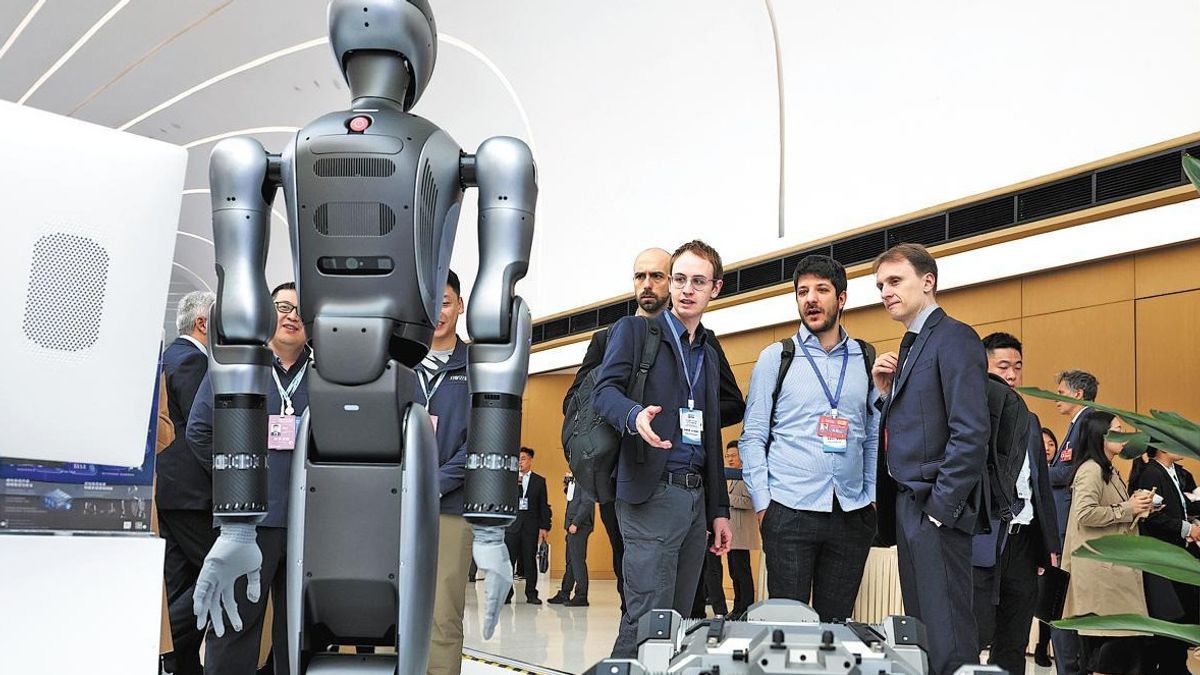


China has begun opening up some of its major science projects and research facilities to global researchers amid increasingly tight technology competition. China Daily quoted Thursday, March 26, reported that Beijing used this step to encourage open science cooperation and build a more open and inclusive "global technology community".
The policy was announced at the opening of the Zhongguancun Forum in Beijing, Wednesday, March 25. Deputy Prime Minister Ding Xuexiang said China is ready to expand technological cooperation, strengthen basic research and cutting-edge research, and promote the use of new technologies to support the economic and social development of various countries.
At the same time, Ding also highlighted the other side that is not light. He asked countries to deal with potential regulatory clashes, social risks, and ethical challenges that arise from technological developments so that technology governance runs more fairly and responsibly.
On the opening day of the forum, China released a plan of action for international cooperation in open science. In it, Beijing will open access for researchers around the world to 10 major projects and facilities, including space monitoring systems, particle observatories, and fusion devices. One of them is the China Meridian Project, a national facility for monitoring the space environment that is said to have built the world's largest ground network and so far serves 267 organizations from 18 countries, including Germany and Brazil.
This year's Zhongguancun Forum was attended by thousands of participants from more than 100 countries and regions. At the forum, China also confirmed its steps in the field of artificial intelligence. According to the report, Beijing not only expanded the use of AI, but also helped promote how AI models are built, shared, and applied in the industrial sector.
Moonshot AI founder Yang Zhilin said Chinese companies are increasingly positioning themselves as drivers of change in the AI ecosystem. He assessed China's openness in sharing major models and technological breakthroughs could accelerate global innovation while giving an edge in technological competition.
"China's willingness to openly share large-scale models and technological breakthroughs can accelerate global innovation while giving it an edge over other countries' closed technology ecosystems," Yang said, as quoted by China Daily.
He also touched on the importance of "token factories", which are a combination of data centers, chips, and AI systems designed to process huge amounts of data. This infrastructure is the main support for the development of large-scale AI. According to Yang, in the new stage of AI development, energy costs and computing infrastructure will be the determining factor. "In the long run, the barrier may no longer be the ability of the model, but how quickly one can build a large-scale 'token factory'," he said.
OpenRouter data shows that China's AI model has surpassed the US AI model in global usage for three consecutive weeks. Last week, the Chinese model recorded 7.359 trillion tokens, up 56.9 percent from the previous week. The US AI model recorded 3.536 trillion tokens.
WIPO Deputy Director General Wang Binying said China became the first country to surpass 5 million granted domestic invention patents. China also contributed more than 40 percent of global generative AI patent filings.
The English, Chinese, Japanese, Arabic, and French versions are automatically generated by the AI. So there may still be inaccuracies in translating, please always see Indonesian as our main language. (system supported by DigitalSiber.id)


