
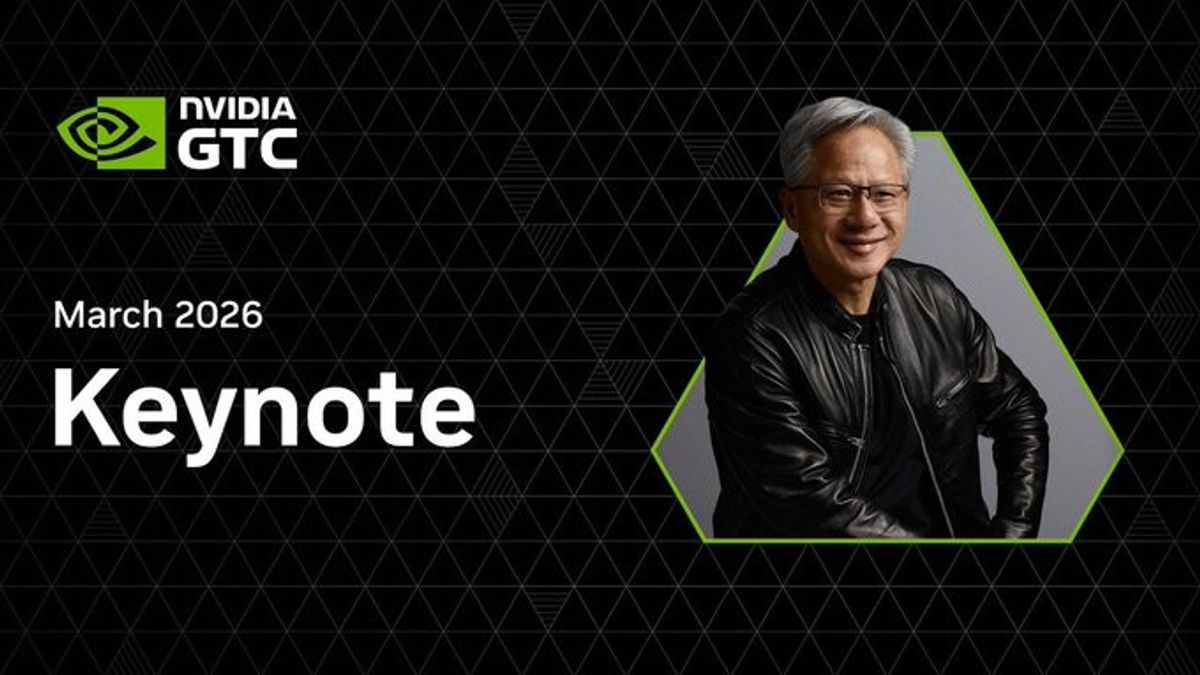


JAKARTA - Nvidia CEO Jensen Huang is scheduled to unveil the company's latest roadmap in the development of artificial intelligence at Nvidia's annual developer conference GTC held in San Jose, California, Monday, March 16.
In a keynote speech at the hockey arena with a capacity of more than 18,000 people, Huang is expected to outline the company's strategy for dealing with rapid changes in the global AI industry landscape, including plans to develop the latest generation of chips and software that support the artificial intelligence ecosystem.
Semiconductor giant Nvidia, which is currently the world's most valuable public company with a market capitalization of more than 4.3 trillion US dollars, is expected to introduce the next generation of AI chips called Feynman. The name of the chip is taken from the American physicist, Richard Feynman, a science figure known for his contributions to quantum mechanics and quantum electrodynamics.
In addition to the announcement of the new chip, Huang is also expected to discuss the development of AI-based data centers, Nvidia's CUDA programming platform, as well as the evolution of digital assistant technology, which is now evolving into "AI agents". This technology allows artificial intelligence systems not only to answer questions, but also to carry out tasks automatically.
The conference is also expected to highlight the concept of "physical AI", which is the integration of artificial intelligence into physical machines such as industrial robots and service robots that can operate autonomously.
Another focus is Nvidia's collaboration with chip startup Groq. In December, Nvidia licensed the company's technology in a deal worth about $17 billion.
Groq is known for developing processors optimized for "inference" computing, which is the process when an AI model uses the knowledge it has learned to generate answers or predictions in real-time. This segment is becoming increasingly important as technology companies are now moving from the stage of training AI models to providing AI services to hundreds of millions of users.
In recent years, companies such as OpenAI, Anthropic, and Facebook owner Meta Platforms have spent hundreds of billions of dollars training large-scale AI models.
However, the industry's focus is now shifting to the next phase, namely running the model to serve users on a massive scale. This change makes competition in the inference chip market more intense than the chip market for AI training, which has been dominated by Nvidia.
Despite facing increased competition - including from some of its major customers who are starting to design their own chips - Nvidia still holds a central position in the global AI ecosystem.
A number of countries, including Saudi Arabia, are even building national artificial intelligence systems using Nvidia chips to serve the needs of their populations.
In addition, Nvidia is also one of the major American technology companies that are still actively releasing open-source AI software, an area that is now a strategic competition ground between the United States and China in the development of artificial intelligence technology.
The English, Chinese, Japanese, Arabic, and French versions are automatically generated by the AI. So there may still be inaccuracies in translating, please always see Indonesian as our main language. (system supported by DigitalSiber.id)
Most Popular Tags
#Prabowo Subianto #donald trump #firearm #8791 #giias 2026Popular


