

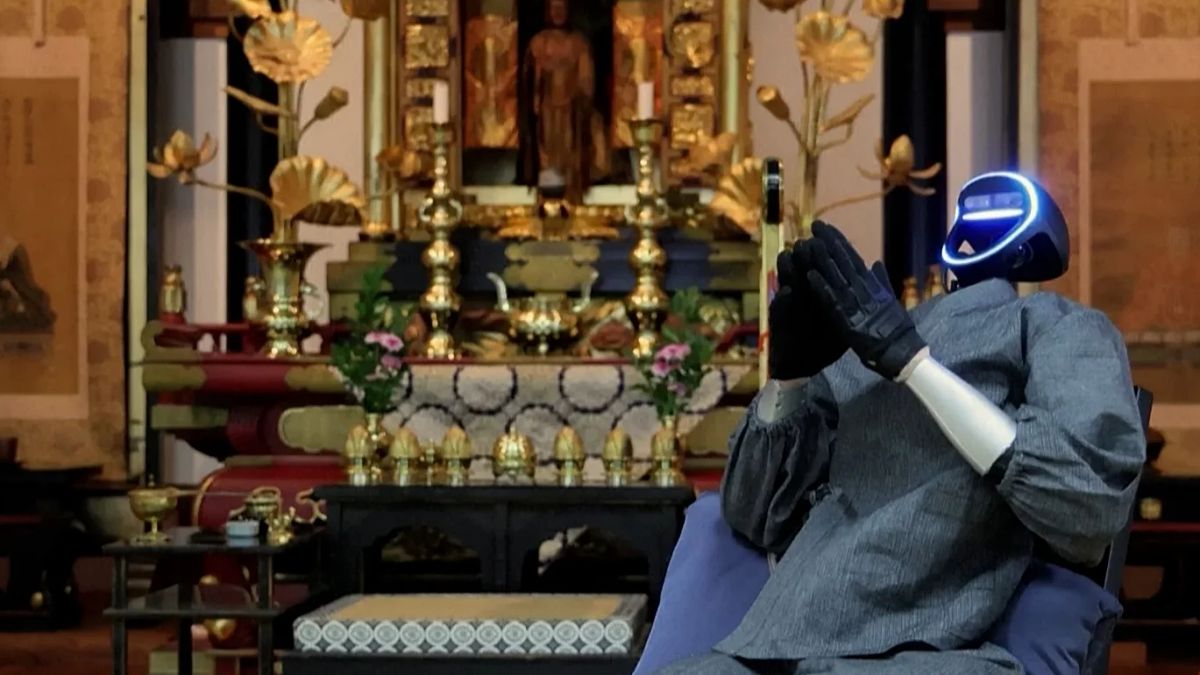


JAKARTA - Amid the challenges of population decline and labor crises, a leading university in Japan has launched an innovation that combines spiritual traditions with cutting-edge technology. Kyoto University officially introduced an artificial intelligence (AI) powered "monk robot" named Buddharoid.
Launched in February, Buddharoid is designed to alleviate the impact of the shortage of Buddhist monks in the Sakura State. This robot is not just a machine; it has been trained with the most complex Buddhist scriptures, so it is able to provide answers to sensitive questions that are often difficult for humans to ask their peers.
This project is the latest work of Seiji Kumagai, a professor at the Institute for the Future of Human Society Research, Kyoto University. Kumagai integrates a sophisticated AI model called "BuddhaBotPlus" into the Chinese-made Unittree G1 humanoid robot framework.
In a demonstration in front of the media crew, the robot showed fine motor skills by bringing its two hands together in a praying position and walking calmly. Apart from the physical aspect, its main advantage lies in its counseling ability.
A young female reporter once asked for advice because she felt too anxious and had a lot of thoughts (overthinking). The robot gave a soothing answer.
"Buddhism teaches that it is important not to blindly or hastily follow one's own thoughts in doing something," the robot told an NHK reporter.
"One approach is to calm the mind and let go of the thoughts themselves," the robot said.
Not only personal issues, Buddharoid is also able to respond to questions about social relationships. When Professor Kumagai asked about personal relationships, the robot suggested that a person reassess the level of attachment and maintain inner balance.
Although the use of AI in the religious realm is popular, this step still raises controversy in various major religious circles in the world. Kyoto University realizes that in-depth discussions on the ethics of using digital tools in religious practices are essential.
On the other hand, "robot monks" are seen as a practical solution to maintain a sense of togetherness in places of worship. Japan is currently facing an extreme phenomenon of population aging, which has an impact on the emptiness of important positions in traditional temples.
"In the future, robot monks may help or replace some religious ceremonies traditionally performed by human monks," said the Kyoto University.
This move is predicted to create a significant shift in modern religious culture, where technology becomes a bridge for traditions that are beginning to fade.
The English, Chinese, Japanese, Arabic, and French versions are automatically generated by the AI. So there may still be inaccuracies in translating, please always see Indonesian as our main language. (system supported by DigitalSiber.id)
Most Popular Tags
#Prabowo Subianto #donald trump #firearm #8791 #giias 2026Popular


