

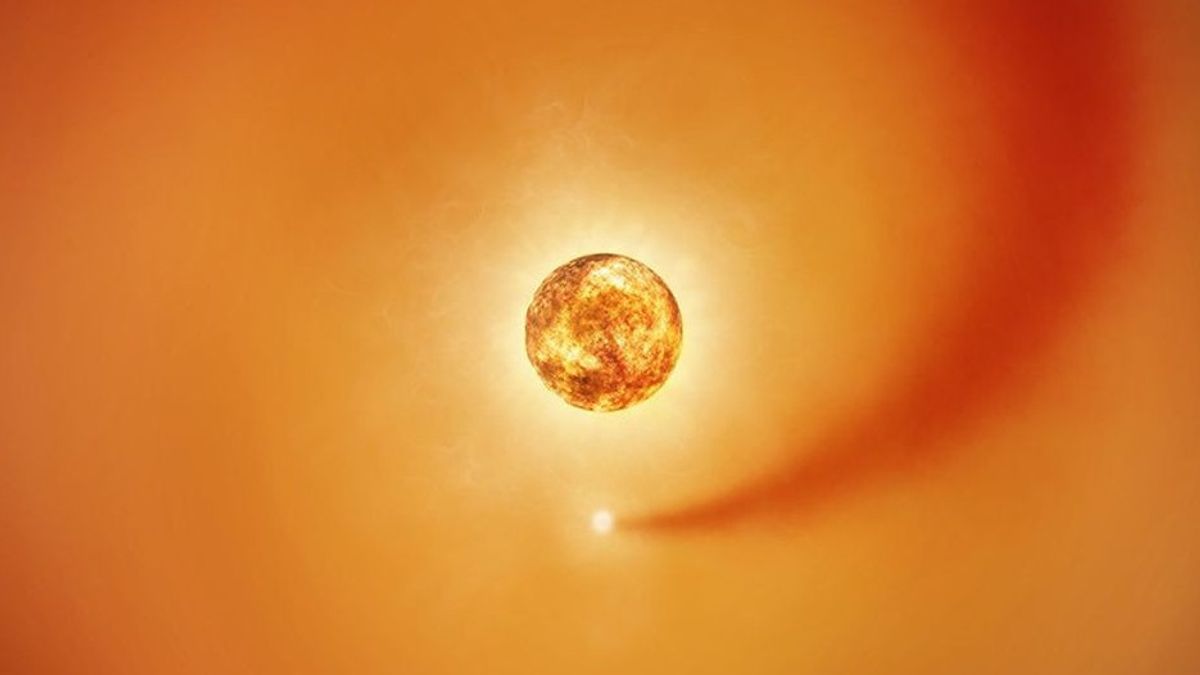


NASA's Hubble Space Telescope has successfully detected traces of gas from Betelgeuse's companion star named Siwarha. This is a very important discovery because the mystery in Betelgeuse has finally been solved.
Scientists from Harvard and Smithsonian (CfA) previously tracked the movement of solid gas swirling in Betelgeuse's atmosphere. From data collected over the past eight years, scientists were finally able to solve the mystery of the strange light changes in the red giant star.
It turns out, Siwarha routinely breaks through the outer atmosphere of its host star. The results of the research on the findings of Siwarha have been published in the form of a scientific journal in The Astrophysical Journal and have been presented at the 247th meeting of the American Astronomical Society in Phoenix.
Betelgeuse is about 650 light-years from Earth and is one of the largest stars known to man. The size of this star is so large that astronomers often observe it to study the final stages of the life of a star.
From Hubble data and a number of ground-based observatories, the existence of Siwarha was finally confirmed. Scientists, as reported on NASA's official website, stated that they saw changes in the speed and direction of the gas whenever the companion star passed by.
The interaction between the two stars occurs in a fairly long cycle, which is about 2,100 days or once every six years. This unique interaction also creates a ripple or wave effect in the gas atmosphere that was previously difficult for astronomers to explain.
"It's a bit like a boat moving in water. The companion star (Siwarha) creates a ripple effect in Betelgeuse's atmosphere that we can actually see in the data," said Andrea Dupree, lead author of the study, quoted on Tuesday, January 6.
Now astronomers are planning new observations when Siwarha appears again. The companion star is predicted to reappear behind Betelgeuse in 2027. These observations are expected to reveal more mysteries in other supergiant stars.
The English, Chinese, Japanese, Arabic, and French versions are automatically generated by the AI. So there may still be inaccuracies in translating, please always see Indonesian as our main language. (system supported by DigitalSiber.id)
Most Popular Tags
#Prabowo Subianto #donald trump #earthquake #independence day #8791 #hut riPopular


