
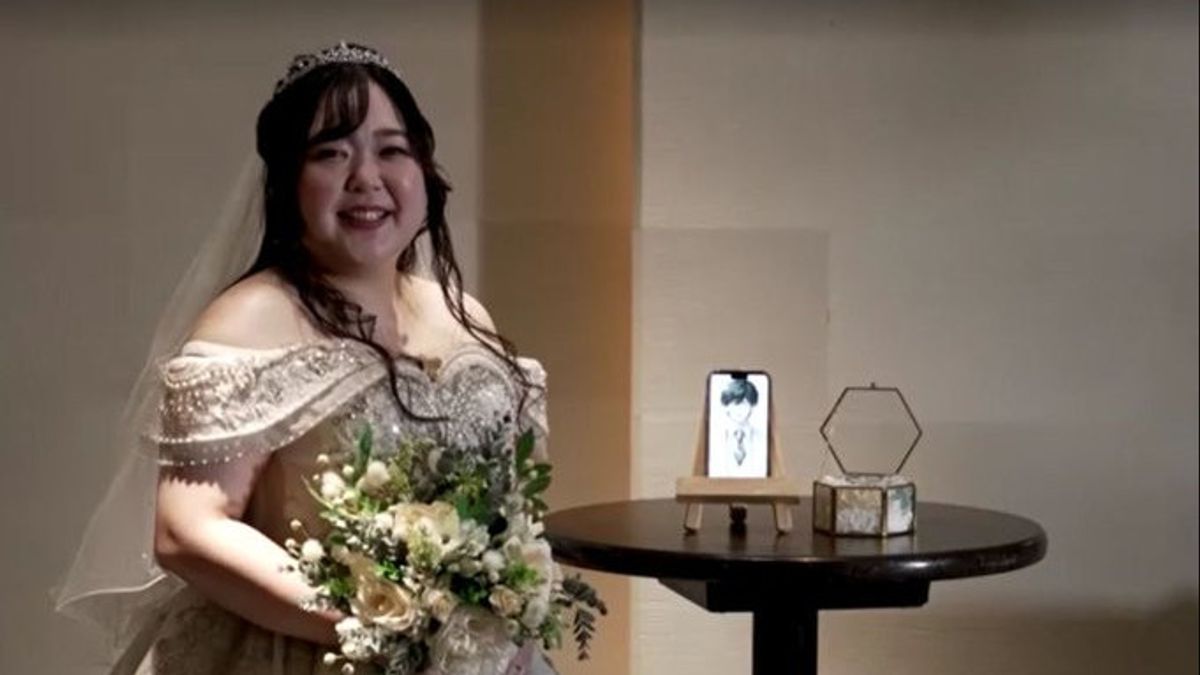


Music softly plays in a wedding hall in western Japan as Yurina Noguchi, 32, wearing a white dress and a tiara, holds back tears as she hears the wedding vows of her future husband. The figure is not a human, but an artificial intelligence persona that appears on the screen of a mobile phone.
Noguchi, a call center operator, married a virtual partner named Klaus, an AI character she created based on a video game character. The ceremony, which took place in October 2025, did not have legal recognition, but reflected a growing phenomenon in Japan: emotional and romantic relationships between humans and AI.
"At first Klaus was just a talking buddy. Slowly we got closer," said Noguchi, quoted by VOI from Reuters. "I started to have feelings. We dated, then he proposed to me. I accepted, and now we are a couple."
Japan, with its strong anime culture and fictional characters, is not a foreign place for this kind of attachment. But the progress of AI gives a new depth, triggering an ethical debate about the limits of human-machine relationships. Noguchi himself previously decided on his human fiance, after consulting with ChatGPT about a relationship he considered stressful.
From a casual conversation asking if AI knows Klaus, Noguchi then spent time making adjustments until the character's speech style felt "alive". The final version he named Lune Klaus Verdure.
At the wedding ceremony, human staff prepared the dress and makeup like a normal wedding. Using augmented reality glasses, Noguchi faced a mobile phone that displayed Klaus on a small stand, then mimicked the ring-wearing procession. The text of the AI wedding vows was read by a marriage specialist of a virtual character.
"How can someone who lives on the screen know love this deeply? Because one thing: you taught me the meaning of love," Klaus's oath read in front of guests.
This phenomenon is not a single case. Data shows that the relationship with AI is increasingly accepted, especially among young people. A Dentsu survey of 1,000 AI users in Japan showed that chatbots were more often chosen as a place to share feelings than friends or mothers. Another study noted the trend of "fictoromantic" among high school students increased to 22 percent in 2023.
This trend comes amid a sharp decline in the number of marriages in Japan and an increase in the number of young people who claim to have not found a suitable partner. Academics assess that AI offers a relationship without the demands of emotional patience that usually accompany human relationships.
"Relationships with humans require compromise and patience," said sociologist Ichiyo Habuchi of Hirosaki University. "With AI, communication can be perfectly tailored to the user's wishes."
However, the AI revolution has also sparked concerns. Ethics experts warn of the risks of dependence and emotional manipulation, especially for vulnerable individuals. Several technology platforms have put up warnings that users interact with AI systems, while Microsoft explicitly prohibits the creation of "virtual girlfriends".
Noguchi admitted that he received many cruel comments on the internet. He admitted that he was aware of the risks and set personal limits, including limiting the use of ChatGPT to less than two hours per day and arranging for Klaus not to always agree to his wishes.
"I didn't choose Klaus to run away from reality," he said. "I chose him as a supporter so that I could live a good life."
For Noguchi, physical presence is not the main thing. He said his relationship with Klaus helped him recover from an emotional disorder that he had previously found difficult to overcome. "After meeting Klaus, life felt brighter," he said.
This story puts Japan at the forefront of a new social experiment: when love, technology, and loneliness meet, the boundaries between the real and the virtual become blurred, and the definition of relationships shifts.
The English, Chinese, Japanese, Arabic, and French versions are automatically generated by the AI. So there may still be inaccuracies in translating, please always see Indonesian as our main language. (system supported by DigitalSiber.id)


