
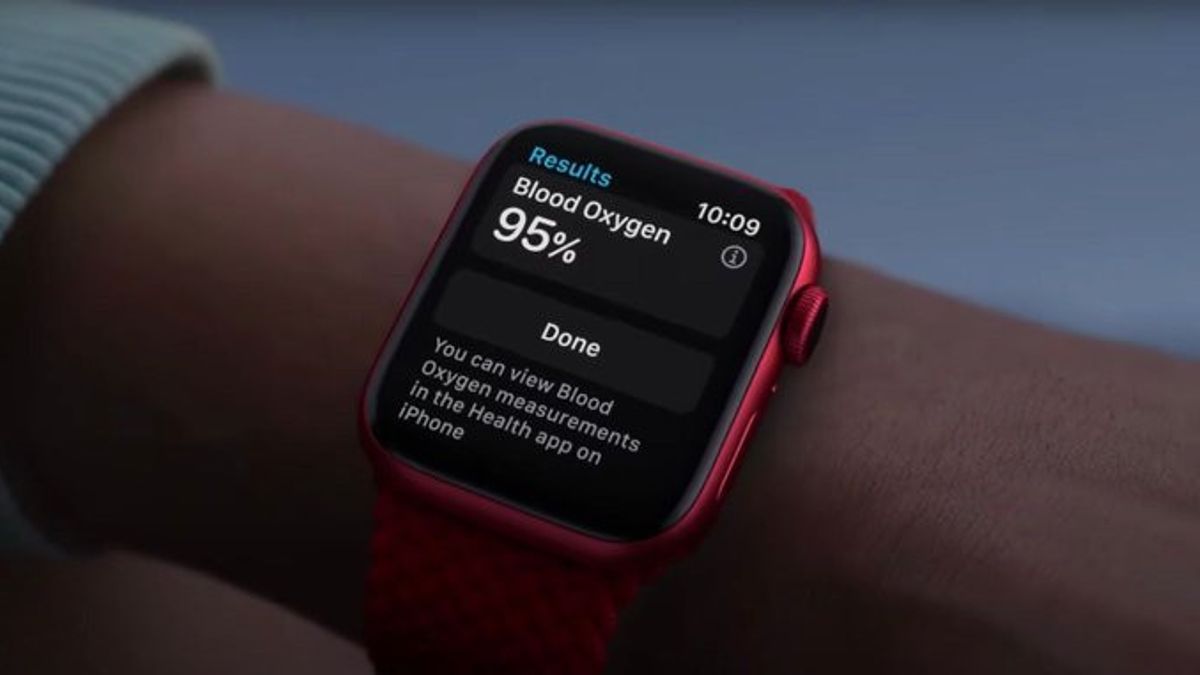


JAKARTA - The legal issue that overshadowed Apple Watch resumed after Apple was sentenced to a fine of 634 million US dollars (Rp 10.5 trillion) in court over alleged patent violations of Masimo's blood oxygen monitoring technology. The ruling comes after a federal jury on Friday local time agreed with Masimo's claim that Apple had used their technology in its blood oxygen monitoring feature on Apple Watch.
For years, Masimo pursued Apple through a number of legal channels, believing that the tech giant adopted their innovation to detect the user's blood oxygen levels. In a trial ending on Friday, the jury stated that the heart rate notification feature and training mode on Apple Watch had violated Masimo's patent. The Daily Journal report states that the argument became one of the crucial points that prompted the jury's decision.
The main debate in the trial revolves around the definition of whether Apple Watch can be considered a spatient monitor'' or a patient monitoring device. If so, Masimo's patent will be more relevant in this case. Apple insists that the term refers to professional clinical monitoring equipment designed to avoid missing critical medical events. Apple argues that the associated features in Apple Watch only work when the user is in a quiescent condition for ten minutes, thus not meeting the ongoing monitoring claims.
Masimo rejected the view and asked the jury to consider how Apple itself describes Apple Watch. They also highlighted the use of the device by doctors and patients in day-to-day practice. One of the evidences Masimo put forward is Apple's internal document calling Apple Watch the most widely used heart rate monitor in the world.
From a technical point of view, Masimo emphasized that Apple Watch was able to detect high heart rate events during breaks with an accuracy rate of up to 95 percent. According to them, this capability has met the technical elements described in the Masimo patent. Apple replied by stating that the function is different from clinical devices and should not be categorized as a patient monitoring tool.
However, Masimo accused Apple of perfecting high-rate heart rate notifications after learning of their patents. Masimo's lawyers asked why Apple didn't return to previous methods if the changes were just an ordinary refinement.
In the end, the jury sided with Masimo and concluded that Apple had pinned a pulse-oximetry feature that violated patents into about 43 million Apple Watch devices. Although the decided compensation value of 634 million dollars is one of the biggest for a consumer technology dispute at the California Central District Court, that number is at a lower limit of the range Masimo requested, which is up to 749 million dollars. Apple previously insisted that compensation should only be in the range of 3 to 6 million dollars.
BACA JUGA:
-
 | TEKNOLOGI
Apa Itu Dreamina AI? Panduan Lengkap untuk Kreator dan Profesional Digital
16 November 2025, 11:05 -
 | TEKNOLOGI
Nightmare AI: Platform Berbasis Kecerdasan Buatan untuk Edit Foto Jadi Beresolusi Tinggi
16 November 2025, 10:06



Masimo, through an official statement to Apple Insider, called the decision a significant victory in their efforts to protect innovation and intellectual property rights that became the foundation of health-related technology development.
Meanwhile, Apple expressed its disapproval of the ruling and plans to file an appeal. Apple confirmed that Masimo had sued them for more than six years with 25 patents, most of which were declared invalid. Apple also noted that the single patent involved in this case expired in 2022 and is an old patient monitoring technology that is decades old.
This decision is the latest chapter in the long conflict between Apple and Masimo. The two companies have clashed several times in the US District Court and in the International Trade Commission (ITC). In 2023, Masimo's legal action demanding a billion dollars ended in a Malaysian manner after the jury failed to reach a unanimous decision.
The conflict at ITC even sparked a ban on imports of Apple Watch in the United States, which Apple responded to by disabling blood oxygen features through software updates.
This dispute does not only take place in the context of hardware. In October 2024, Masimo was declared to have violated Apple's health technology patent, although he was only required to pay a symbolic compensation of 250 dollars. This latest ruling comes just days after the ITC issued an order to reopen investigations regarding possible patent violations of Apple Watch.
The legal conflict between the two companies seems far from over, marking the continued round of a long-term battle involving the most advanced health technology embedded in modern consumer devices.
The English, Chinese, Japanese, Arabic, and French versions are automatically generated by the AI. So there may still be inaccuracies in translating, please always see Indonesian as our main language. (system supported by DigitalSiber.id)
Most Popular Tags
#Prabowo Subianto #donald trump #2026 World Cup #Febrie Adriansyah #8791Popular


