

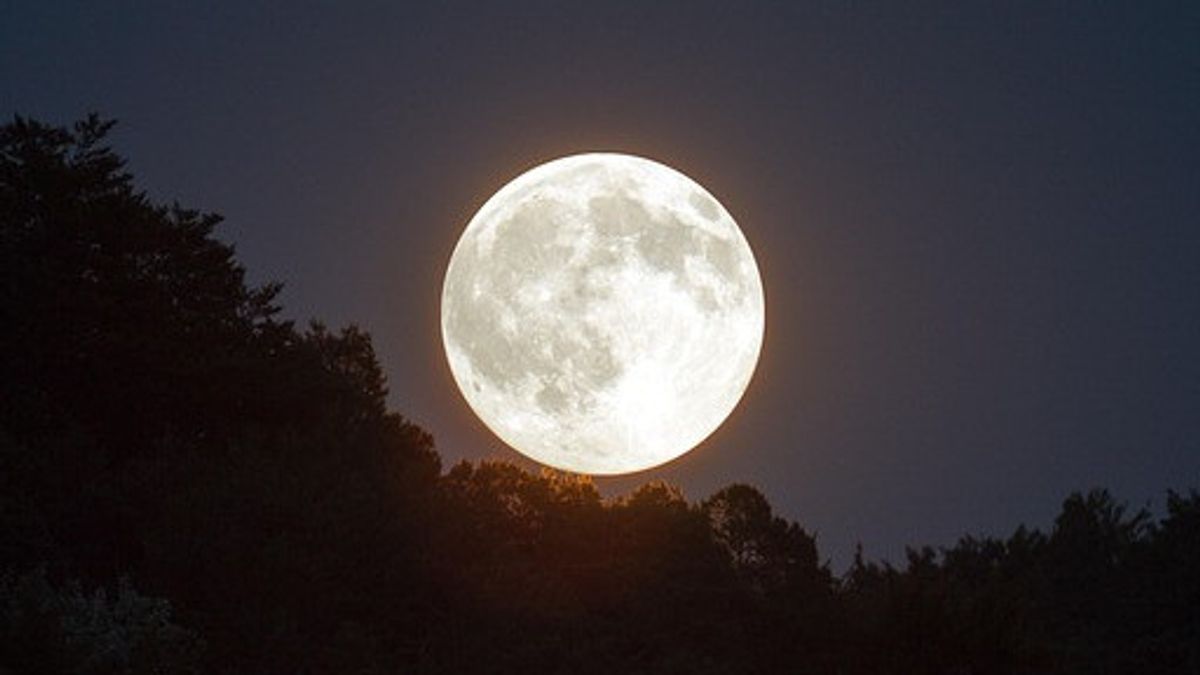


JAKARTA - The phenomenon of the sky is again pampering observers of stars around the world. On November 5, 2025, the night sky will feature the largest and brightest supermoon of the year.
That night, the position of the moon was very close to Earth, so it looked bigger and shine stronger than the usual full moon.
Quoted from Earth Sky, the supermoon on November 5, 2025 is the largest and brightest throughout the year. On that date, the moon will be about 357,000 kilometers from Earth, closer than the average lunar distance of 384,000 kilometers.
This phenomenon is also part of a supermoon parade that occurred sequentially in October, November, and December 2025. However, the November 5 supermoon is the culmination of the entire series because it is closest to Earth.
Sky observers in Indonesia can enjoy this moment after sunset until dawn, especially if the sky is clear without clouds. When it rises in the eastern horizon, the moon will appear very large due to the optical illusion effect near the horizon, making it the best time to observe or take a photo.
Although it looks extraordinary, supermoon does not have a major impact on life on Earth. The most obvious effect is only the tide which is slightly higher than usual. However, this increase is relatively reasonable and harmless.
There is no scientific evidence to suggest a supermoon could trigger an earthquake or natural disaster. This phenomenon is entirely natural and safe to enjoy by anyone.
This supermoon phenomenon is expected to be witnessed throughout Indonesia, of course if the weather is favorable and the sky is bright enough.
What's Supermoon?
The term supermoon is used to describe events when the full moon occurs simultaneously with the position of the moon at its closest point to Earth, called perigee.
Because the distance is closer, the moon looks about 14% bigger and up to 30% brighter than the usual full moon. The moon's orbit surrounds Earth in an elliptical shape, not a perfect circle.
This means that the distance between the Earth and the moon continues to change, sometimes closer (perigee), sometimes further (apogee). When the full moon coincides with perigee, a supermoon occurs.
Although this difference in size is difficult to see with the naked eye, the brighter light and the softer light of the moon often create stunning views of the sky.
SEE ALSO:
-
 | BERITA
PDIP Tolak Soeharto Jadi Pahlawan Nasional, Hasto Bongkar Pesan Megawati!
02 November 2025, 06:08 -
 | MUSIK
Hujan Bukan Penghalang, Tampil Penuh Magis: BLACKPINK Sihir Ribuan Penonton di GBK Jakarta
02 November 2025, 07:15

Supermoon is the result of a combination of lunar orbital movement and the influence of Earth's and the Sun's gravity. In one orbital cycle for 27 days, the moon experiences two important points:
The English, Chinese, Japanese, Arabic, and French versions are automatically generated by the AI. So there may still be inaccuracies in translating, please always see Indonesian as our main language. (system supported by DigitalSiber.id)
Most Popular Tags
#Prabowo Subianto #donald trump #firearm #8791 #giias 2026Popular


