
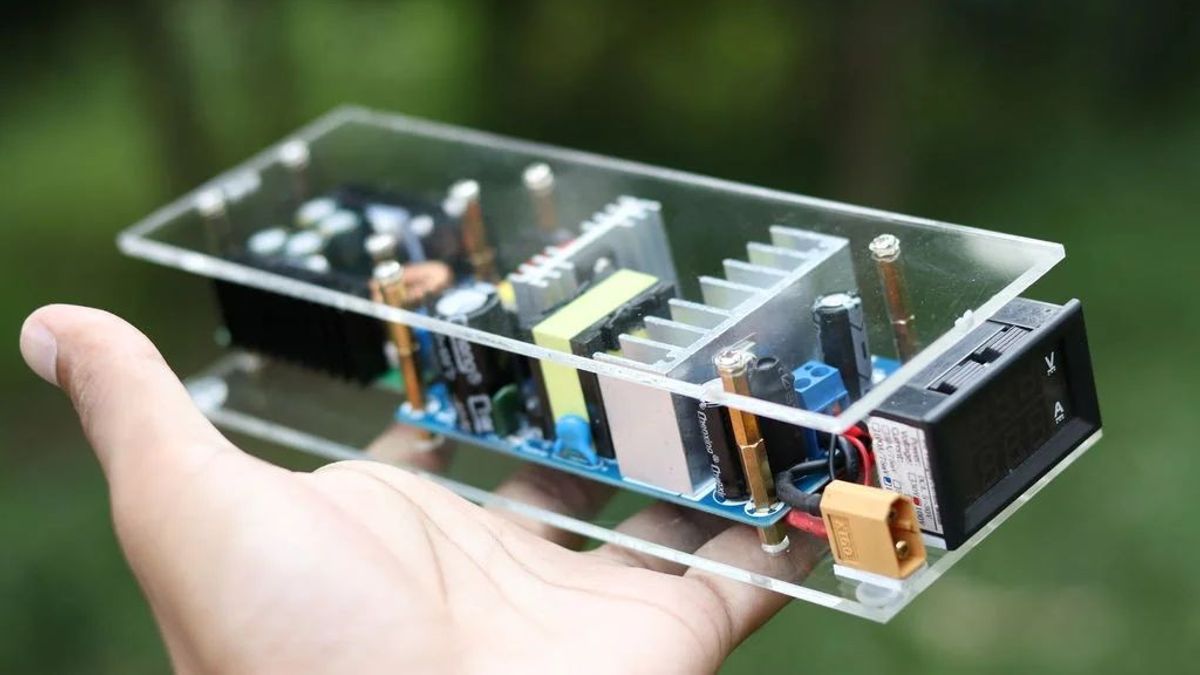


YOGYAKARTA - The power supply series is a basic component in electronics that functions to provide energy to one or more series. Without power supply, devices such as cell phones, laptops, or computers cannot operate because they do not receive stable electric power.
Through an understanding of power supply series, we can understand how electrical energy is transformed into a safe and appropriate form for various electronic devices. The following will be discussed in types, components, and how to design a power supply series.
Without realizing it, we often interact with a power supply series in everyday life. For example, a cellphone charger used to recharge a battery or a computer CPU unit that requires a power supply so that all components are active.
SEE ALSO:
-
 | TEKNOLOGI
Alibaba Luncurkan Layanan Chatbot AI Baru untuk Dorong Bisnis Konsumer
24 Oktober 2025, 03:05 -
 | TEKNOLOGI
Google Uji Fitur Edit Gambar Langsung di Overlay Gemini dengan Nano Banana
24 Oktober 2025, 07:05 -
 | TEKNOLOGI
Snapchat Luncurkan Fitur Imagine Lens Gratis untuk Buat Gambar dengan AI
23 Oktober 2025, 21:05
Based on the work system, there are several types of power supply series that are commonly used on electronic devices. One of them is a power supply switching series that uses switching regulatory technology. This type is known as SMPS (Switched Power Supply Mode) and has a high efficiency of up to 83%, so it is widely used on modern devices.
The advantage of power supply switching lies in a smaller size and its ability to conserve energy. Its switching frequency is above 20 kilohertz, making it invisible to human ears. Although more expensive than conventional types, the efficiency and stability of the power generated makes it the main choice in today's electronics industry.
Another type is a conventional power supply series, which uses a large transformer stepdown. This transformer functions to lower electrical voltage from AC sources to lower levels for use on electronic devices. However, this process generates heat and reduces power efficiency, so that this technology slowly begins to be replaced by switching systems.
The creation of a power supply series requires an understanding of the principle of work so that the results are safe and efficient. The first step is to determine the needs of the output and current voltage needed by the device. After that, select the appropriate transformer to lower the input voltage to the desired level.
Next, use a series of directors (rectifiers) to turn the back and forth current (AC) into a directional current (DC). After that, install filter capacitors to smooth DC voltage to stabilize. Use voltage regulators to keep the output constant despite changes in load.
The last step is to create a schemetic diagram and test the circuitboard using a circuit board or PCB. Trial is very important to ensure all components function properly. An example of a simple series commonly created is a power supply of 5V DC or 12V 3A, which is widely used on basic electronic projects.
In order to function optimally, a power supply series requires various main components. Transformators (trafos) function to convert AC signals from power sources to appropriate voltages for electronic circuits. Diodes are used to convert the AC current into DC.
The capacitor acts as a filter that maintains the stability of DC voltage, while the resistor is used to limit electricity from exceeding the safe limit. The voltage regulator ensures that the output remains stable despite changes in the electricity load. In addition, transistors are often used as switches to control current flow in the series.
Several series also use variable resistors to regulate the magnitude of the output voltage as needed. Basic electronic knowledge is needed in order to read the circuit scheme and calculate the value of the components exactly. With a good and standard design, power supply series can be used with stable and secure performance.
The English, Chinese, Japanese, Arabic, and French versions are automatically generated by the AI. So there may still be inaccuracies in translating, please always see Indonesian as our main language. (system supported by DigitalSiber.id)
Popular


