

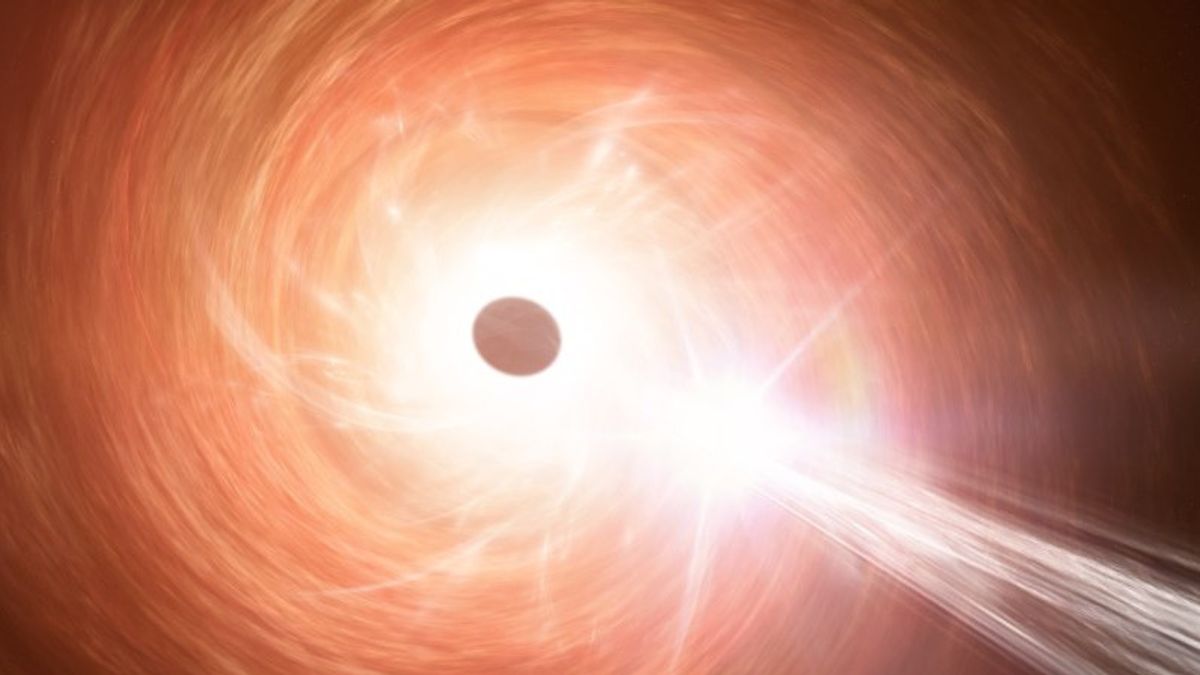


JAKARTA A group of astronomers has managed to find a black hole that is growing at the fastest rate. This discovery is supported by NASA's X-ray Chandra Observatory data.
This giant black hole has a mass of about one billion times the mass of the Sun and is located 12.8 billion light years from Earth. From this data, it can be estimated that astronomers have only seen the presence of a black hole about 920 million years after the Big Bang.
These black holes emit more X-rays than any other black hole seen in the first billion years of the universe. These black holes power a very bright quasar, an object whose light extends the entire galaxy.
The source of this quasar force is a large amount of material flowing into the black hole. This process produces intense radiation that scientists can observe. This quasar is known as RACS J0320-35.
Actually, the team found this black hole two years ago, but at that time Chandra's observations only focused on the uniqueness of its object. X-ray data finally reveals that the object grows at a rate that exceeds the normal limit.
According to scientists, black hole growth has a maximum limit called the Eddington limit. This limit is reached when radiation pressure from incident matter balances black hole gravity. However, this object does not seem to comply with these limits.
SEE ALSO:
-
 | TEKNOLOGI
Meta Perkenalkan Oakley Meta Vanguard, Kacamata AI untuk Olahraga Ekstrem
18 September 2025, 15:30 -
 | TEKNOLOGI
Pembaruan PS5 Bawa Mode Penghemat Daya dan Fitur Multi-Perangkat untuk DualSense
18 September 2025, 17:05


This black hole is estimated to grow up to 2.4 times the Eddington limit. If this growth is appropriate and has been done for a long time, this black hole may grow from a more conventional way.
The initial mass may have been less than a hundred suns, which came from massive stellar implosion. This initial mass estimate was obtained after scientists learned how big the black hole is today.
"It's shocking to see this black hole grow rapidly," said Luca Ignana, lead researcher from Harvard andaturation Astrophysics Center. He added that this discovery could help explain how black holes hit giant masses in the shortest time after the Big Bang.
The English, Chinese, Japanese, Arabic, and French versions are automatically generated by the AI. So there may still be inaccuracies in translating, please always see Indonesian as our main language. (system supported by DigitalSiber.id)


