
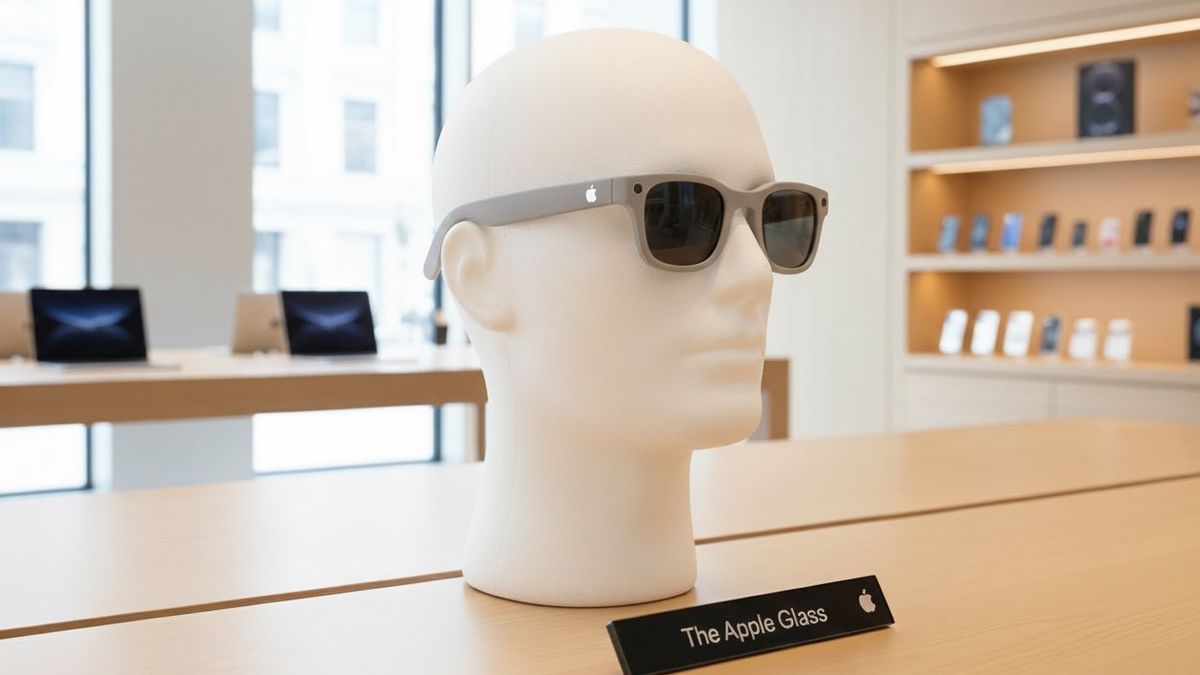


JAKARTA - Apple's smart glasses will be launched at the end of 2026 or early 2027 according to a report. However, Apple Glass' initial release will be more rival to Ray-Bans Meta instead of being the full augmented reality (AR) experience.
Apple Glass has long been believed to be Apple's next major step in computing worn on the head. Although its ambition is to introduce glasses with augmented reality elements, the first really circulating version will be much simpler and not too long away.
In the Sunday edition of the "Power On" bulletin for Bloomberg, Mark Gurman discussed Apple's efforts to create smart glasses. He believes that Apple will enter the market in the next 12 to 16 months, which will be in line with or after the 2026 fall release schedule.
SEE ALSO:
-
 | TEKNOLOGI
Bitcoin Terkoreksi, NanoByte Jadi Primadona dengan Potensi Lonjakan Tiga Kali Lipat
15 September 2025, 18:00 -
 | TEKNOLOGI
Gelar AI Forum 2025, Samsung Fokus pada Transformasi AI Secara Global
15 September 2025, 17:35 -
 | TEKNOLOGI
Sempat Hilang Kontak, NASA Berhasil Terhubung Dengan Satelit TRACERS
15 September 2025, 17:05 -
 | TEKNOLOGI
Prompt Gemini AI Ala Foto Studio yang Bisa Dicoba, Hasilnya Keren!
15 September 2025, 16:35

Gurman added that the smart glasses that will appear for the first time will be in the form of a screenless version to compete with Ray-Bans Meta. That means smart glasses with cameras for video recording, a kind of audio system for playback and recording, as well as connections to iPhone for processing.
The full experience of smart glasses, which will involve the ability to view data through lens glasses, is estimated to be a few years away from being a reality. Much of this is related to the miniaturization and weight reduction process, because the expectation is that Apple must approach a pair of lightweight glasses, not heavy equipment like the Apple Vision Pro.
Gurman is quite well known for his reporting accuracy on rumors and is usually right about future products. However, this timeline has actually appeared in previous rumors.
The release time in 2026 or 2027 has been appointed by other parties, such as Ming-Chi Kuo, but Gurman himself is arguably the main supporter of this idea. He repeatedly reported the possibility of a 2026 release or delay until 2027.
The Benefits of the Ecosystem
One thing Gurman raised in this Sunday's bulletin is that Apple has a natural advantage in this area. The brand means that existing iPhone users will be automatically interested in their smart glasses.
There is also Apple's ability to integrate its hardware deeply into its ecosystem. While Meta and others have more difficulty making its glasses work with the iPhone, Apple can do much deeper integration, as it has done with other products.
It is also debatable that this overall integration and ecosystem capability could be Apple's advantage for future models. Or even provide options such as smart glasses without real glasses.
Apple is said to be working on a pair of AirPods with a built-in camera. The theory is that cameras with IR sensors can be used to detect the user's environment, send videos to iPhone and Apple Intelligence for computer vision purposes.
Given that AirPods have audio capabilities, adding cameras to it can provide current generation smart glasses capabilities to these personal audio devices.
You can also bring this concept further by allowing AirPods with cameras to work with smart glasses. With more angles and camera views, there will be more data for a more quality Apple Intelligence, as well as possible audio and microphone drivers.
The English, Chinese, Japanese, Arabic, and French versions are automatically generated by the AI. So there may still be inaccuracies in translating, please always see Indonesian as our main language. (system supported by DigitalSiber.id)
Most Popular Tags
#Prabowo Subianto #donald trump #Febrie Adriansyah #8791 #giias 2026Popular


