
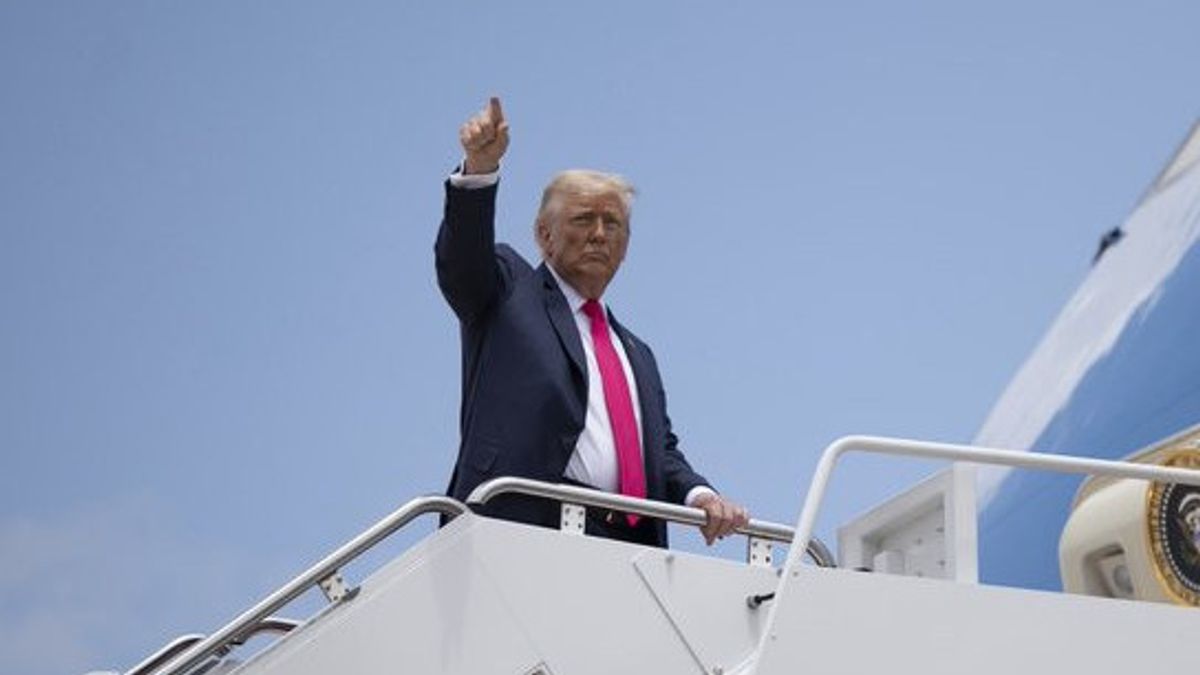


JAKARTA - The President of the United States, Donald Trump, on Tuesday night, July 15, intervened directly to broker an agreement among Republican lawmakers after a deadlock that threatened the long-awaited fate of crypto legislation. This legislation is considered a major step for the digital asset sector.
Earlier on the same day, procedural voting at the US House of Representatives (DPR) failed, prompting a drop in shares of a number of crypto companies. But Trump later announced that he had met with 11 of the 12 important Congressmen at the Oval Office, which was needed to pass the voting rules.
"After a brief discussion, they all agreed to vote in favor of tomorrow morning," Trump wrote on his social media platform.
This week was dubbed "Crypto Week" by the Republican Party, which has ambitions to pass a number of draft laws related to digital assets to provide clarity on regulations and formal recognition of the crypto industry.
But on Tuesday, several conservative Republicans joined Democrats to block the procedural vote, in a dispute over how the bill should be drafted and considered.
US House Speaker Mike Johnson told reporters he would continue to discuss with the members and hoped the vote could be held again in the near future.
Shares of crypto companies such as Circle Internet and Coinbase Global fell due to the news, although they began to recover.
The House of Representatives is working on ratifying several crypto bills, including the most important: a bill that will establish a regulatory framework for stablecoins of cryptocurrencies designed to maintain a fixed value, generally equivalent to one US dollar. Stablecoins have grown rapidly and are seen as an efficient means of making instant payments.
SEE ALSO:
-
 | TEKNOLOGI
Komdigi Tegaskan Pentingnya Digitalisasi untuk Kesuksesan Program MBG
16 Juli 2025, 18:35




Another bill under consideration is a rule that will establish when a crypto token is classified as a commodity, as well as a bill that will ban the issuance of a central bank digital currency (CBDC) by the US government.
Republicans assess that the issuance of CBDC has the potential to provide excessive control to the government over residents' personal finances.
However, the Senate has not considered the CBDC ban bill, and so far the Federal Reserve has not shown interest in developing the central bank's digital currency.
Meanwhile, the US Supreme Court on Monday, July 14, gave the Trump administration the green light to continue dismantling the Department of Education, marking another controversial move from the current government.
The English, Chinese, Japanese, Arabic, and French versions are automatically generated by the AI. So there may still be inaccuracies in translating, please always see Indonesian as our main language. (system supported by DigitalSiber.id)
Popular


