

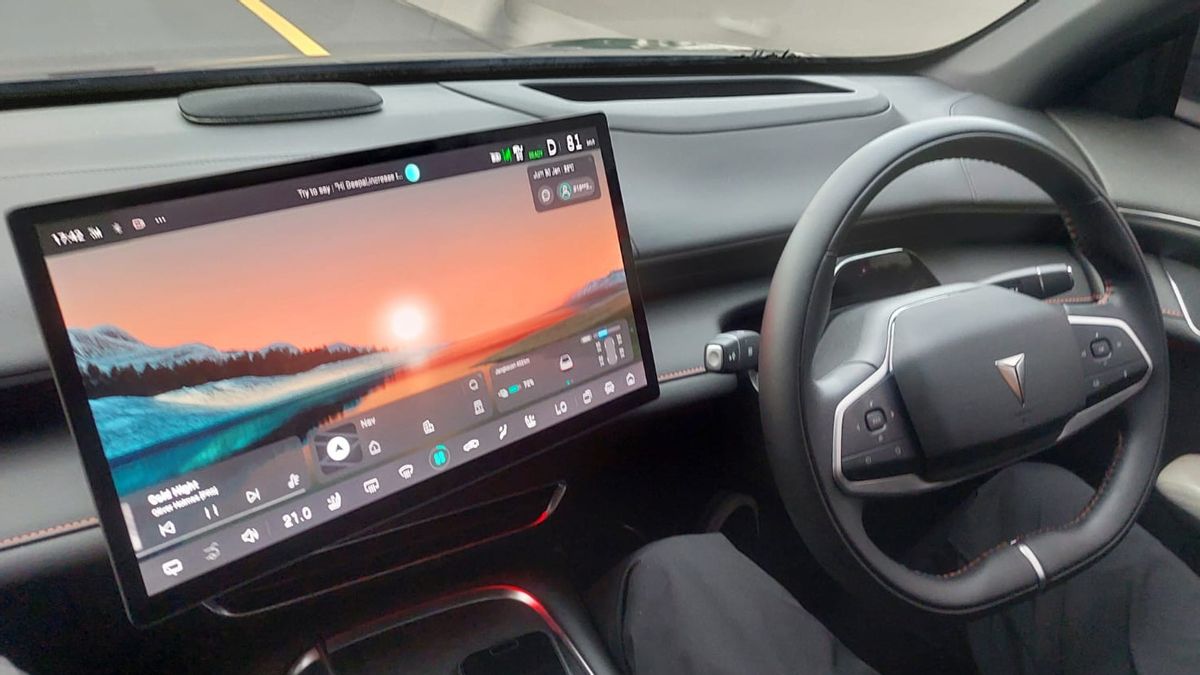


JAKARTA - The Ministry of Industry and Information Technology of China plans to require the presence of a physical control mechanism on a number of important vehicle functions, such as turn signals, electric windows, to the activation of advanced driving assistance systems. This policy is targeted to apply to new vehicles produced starting July 1, 2027.
In recent years, the new energy vehicle industry in China has been synonymous with minimalist cockpit designs. Many manufacturers have cut physical buttons and moved almost all vehicle functions to a large touchscreen in the center console, often adding a special entertainment screen for passengers.
Launching from Carnewschina, Wednesday, February 18, the trend had been criticized by industry players. Geely's Vice President, for example, described it as a condition when the Chinese automotive industry was hit by a trend of blindly following trends.
This policy plan is part of the revision of the national standard GB4094-2016 on the marking of automotive control components, indicators, and signal devices. In the update, the government added new types and technical requirements for physical controls.
The goal is to ensure that the main components of the vehicle are easily accessible, usable, and most can be operated without looking at the car, thus reducing dependence on visual input and minimizing distraction from the screen.
The revision process for this standard has begun since 2023 by involving a number of major automotive manufacturers and testing institutions, such as the China Automotive Research and Technology Center, Geely, FAW-Volkswagen, BYD, to Great Wall Motor. The draft rules for public consultation are said to have been completed and will be released soon.
The rules include physical control obligations for lighting functions such as hazard warning lights, hazard warning lights, and horns, to P/R/N/D gearboxes that can no longer fully rely on the activation button screen of the driver assistance system, as well as safety and emergency features such as wipers, defrosters, electric windows, child or accident emergency call (AECS) systems, to the electric vehicle power cut-off switch.
In addition, this regulation also regulates the technical details of physical control, ranging from the minimum dimensions of the effective operating area which is set at least 10 mm x 10 mm, ease of use with a fixed position and can be operated without looking, to the presence of haptic or auditory feedback. Reliability aspects are also emphasized, with the provision that basic functions must remain available even if the vehicle system experiences interference or loss of power.
The English, Chinese, Japanese, Arabic, and French versions are automatically generated by the AI. So there may still be inaccuracies in translating, please always see Indonesian as our main language. (system supported by DigitalSiber.id)
Most Popular Tags
#Prabowo Subianto #donald trump #2026 World Cup #Febrie Adriansyah #8791Popular


