

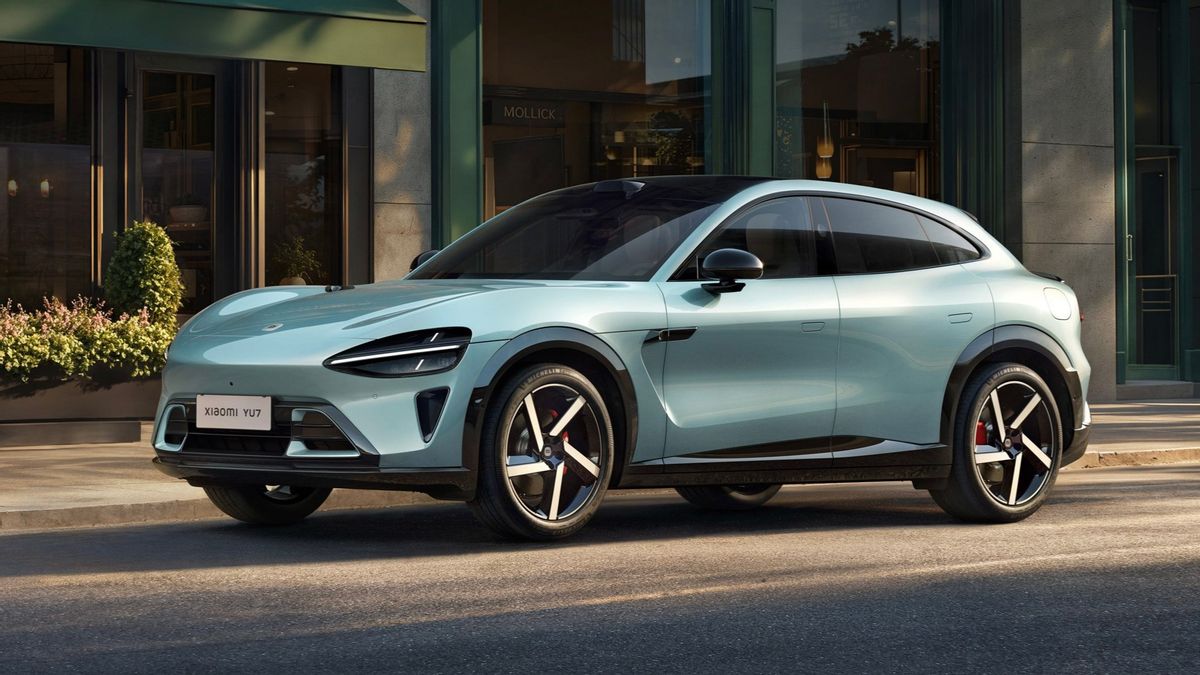


JAKARTA - Xiaomi founder and CEO Lei Jun, chose an unusual way to respond to the criticism that flooded his company's electric vehicle line. He held a live broadcast lasting almost five hours by presenting Xiaomi Automobile engineers.
As reported by Carnewschina, Monday, January 5, in the broadcast, Xiaomi's latest electric car was dismantled directly in front of the camera. This action is in response to various online discussions and viral criticism that highlighted Xiaomi Automobile, especially related to YU7.
Lei Jun openly discussed one issue after another, ranging from mileage claims, video cuts of braking tests, to accusations of marketing manipulation. "I want everyone to see where our responsibility lies in making cars," said Lei Jun.
He emphasized that this session was not just a performance, but an effort for technical transparency. One of the most popular criticisms was the claim that YU7 is able to travel up to 1,300 kilometers on a single charge.
Lei Jun clarified that his initial statement referred to a combination of a single full charge and a medium charge, which was later misinterpreted on social media. He also responded to a viral video about instant braking from 200 km/h, which was said to come from Xiaomi's factory test.
According to him, the footage was selectively cut so as to create a false perception. Another content that is also widely discussed is the collision video which shows the wheel of YU7 coming off.
Lei Jun stated that it was not a material defect, but rather part of the safety design. The wheel release mechanism is designed to divert the impact force and reduce the pressure to the passenger cabin.
Lei Jun also responded to allegations that Xiaomi prohibited farmers from selling its products. He called the issue a misinterpretation of complaints about malicious accounts on online platforms, not trade restrictions.
Responding to criticism about the quality of design and construction, Lei emphasized that the YU7 is a mid-segment electric SUV. Therefore, comparing it with high-end vehicles priced at one to two million yuan is considered irrelevant.
In the broadcast, Lei Jun also mentioned the use of high-strength steel of 2,200 MPa on YU7. Which is the result of joint development by the research team of Wang Guodong, which is claimed to be the strongest material used in mass-produced vehicles.
He also admitted the practice of denying small letters in promotional materials, including on the 17 Pro poster. In which, potentially causing misinterpretation, and promises to improve the marketing approach so as not to seem excessive.
Initially, the live broadcast comment column was closed to prevent coordinated trolling. However, as the event progressed, the column was opened and Lei Jun actively encouraged the audience to ask questions.
Xiaomi, according to him, is very open to fair and fact-based criticism. On the same occasion, Lei Jun revealed Xiaomi Automobile's delivery performance throughout 2025 which reached 410,000 units and set a target of 550,000 units in 2026.
The English, Chinese, Japanese, Arabic, and French versions are automatically generated by the AI. So there may still be inaccuracies in translating, please always see Indonesian as our main language. (system supported by DigitalSiber.id)
Most Popular Tags
#Prabowo Subianto #donald trump #Febrie Adriansyah #8791 #giias 2026Popular


