


JAKARTA - Mercedes-Benz are moving forward to conquer one of the biggest obstacles in mass adoption of electric cars: charging duration.
This luxury German manufacturer has ambitions to make the process of refilling power as quickly and comfortably refueling at the Public Fuel Filling Station (SPBU). To achieve this ambitious goal, they launched a state-of-the-art walking laboratory called Experimental-Lade-Fahrzeug (ELF), a V-Class-based van equipped with five different charging ports.
According to the Head of Mercedes Charging Development Malte Sievers, the challenge of travel distance (range) is almost resolved, with their latest model such as CLA EQ Saloon now approaching 800 kilometers (500 miles) on a single charge or the equivalent of a diesel car.
"The next fight is about comfort," said Sievers, quoted by Autocar, Thursday, October 9.
The ELF is designed as a mobile research center aimed at exploring extreme limits of charging technology, ranging from extreme electrical energy transfers, battery cooling, to bidirectional energy flows.
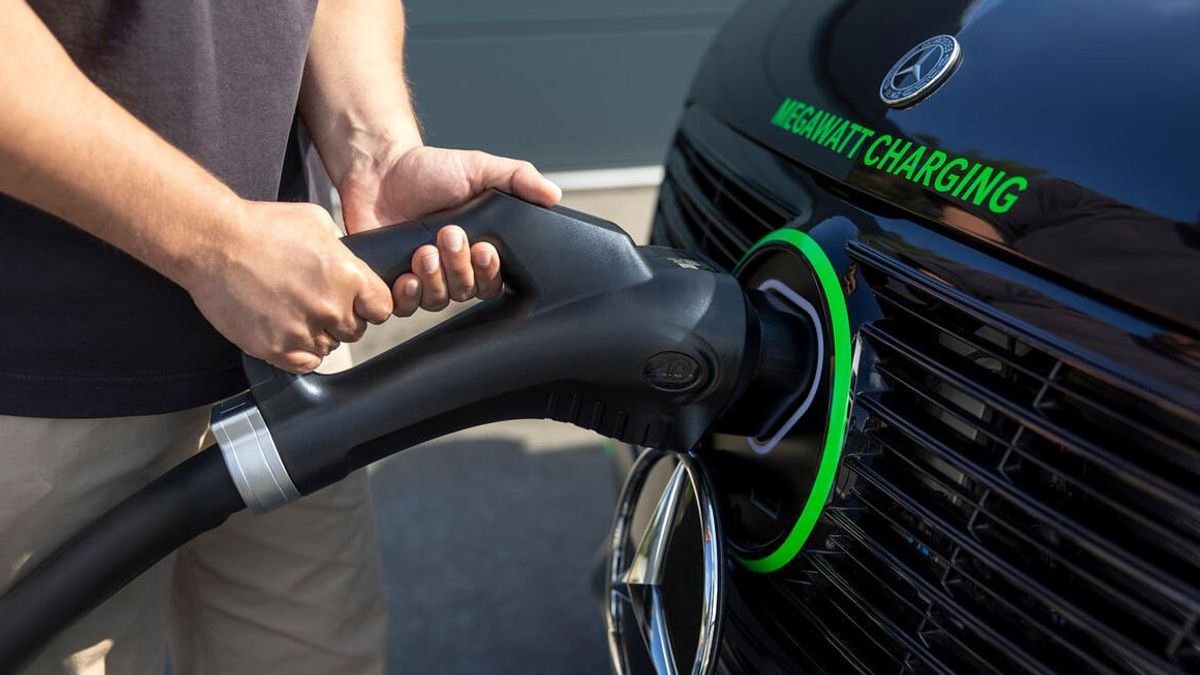
ELF's main focus is on charging speed. The vehicle is equipped with Double Combined Charging System (CCS) and Megawatt Charging System (MCS) systems of heavy task. Through the CCS system, the ELF is capable of reaching up to 900kW of power, enough to add 100kWh of energy in just about 10 minutes. Meanwhile, the MCS system, which is adapted from electric truck technology and connected behind the three-star logo on the grILL, drives further testing, injects power above 1000kW to test the battery's thermal resistance under a very heavy charging load.
SEE ALSO:
Direct Influence On Future Production Cars
The development tested on the ELF has had a direct influence on the Mercedes production plan. Research from its CCS/MCS dual system directly forms a charging architecture on the Mercedes-AMG GT XX concept, which records the peak charging power of 1041kW during a robustness trial on the Nard total track. To achieve this record, Mercedes is working with Italian charging specialist, Alpitronic, to modify the commercial truck charger who is the forerunner of the upcoming generation ultra-high capacity charger to be introduced by manufacturers.
In addition to speed, ELF is also a center for two-way (bidirectional) charging development. This technology allows EVs to power back to home (vehicle-to-home) or to thevehicle-to-grid). Starting in 2026, Mercedes will offer MB Charge Home services, allowing owners to use their EV batteries as home power storage. Their long-term ambition even includes a "virtual energy account" that allows customers to gain energy credit by supplying power back to the network, which can later be used for charging cost discounts.
Five Minutes Vision Equivalent To Gasoline Content
The ELF also tested other futuristic charging methods, such as inductive charging (wireless) for snack charging' (short charge) and robotic autoconductive charging. However, all these developments lead to one main goal. According to Sievers, the lessons learned from the ELF project make the idea of charging for five minutes to gain a distance of 500 miles, as a realistic prospect for EV production before the end of the decade. Mercedes is strongly determined to change the perception that charging is a process that takes a long time.
The English, Chinese, Japanese, Arabic, and French versions are automatically generated by the AI. So there may still be inaccuracies in translating, please always see Indonesian as our main language. (system supported by DigitalSiber.id)
Most Popular Tags
#Prabowo Subianto #donald trump #2026 World Cup #venezuela #Bhayangkara hut #konflik timur tengahPopular


