

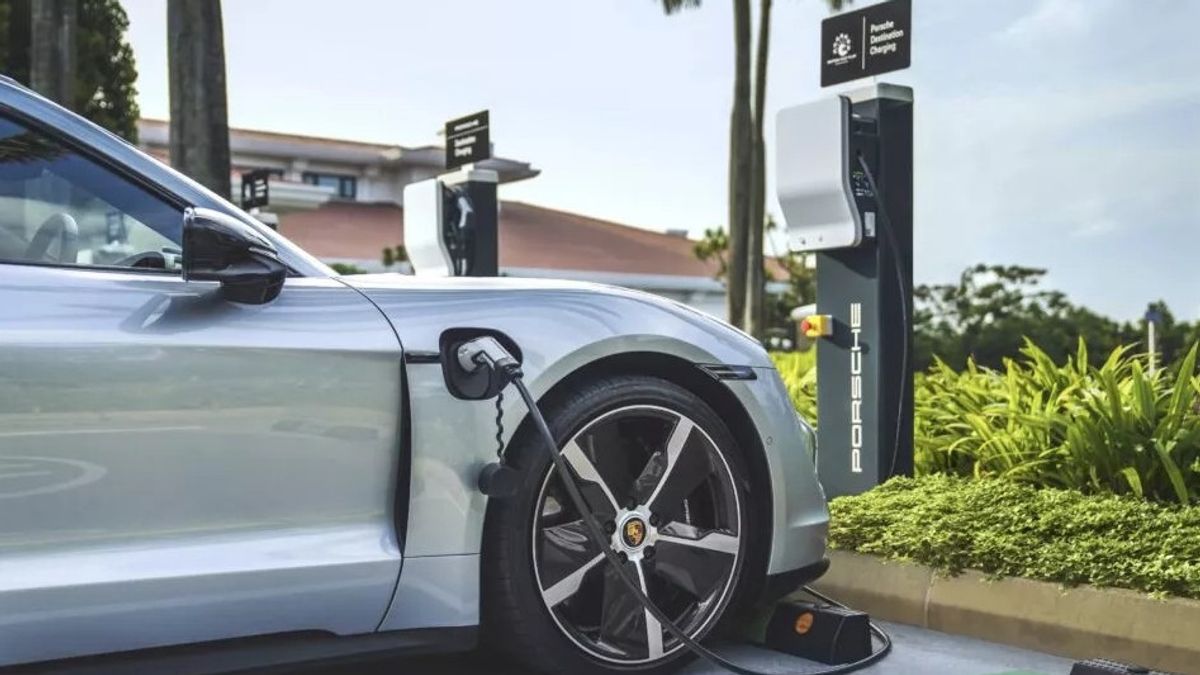


JAKARTA A number of Porsche electric car (EV) owners in the United States sued the German manufacturer not because of problems with his car, but on the house charging device which was deemed not working according to the promise.
Reporting from Carscoops, Thursday, October 9, the class action lawsuit was filed on September 26, 2025 at the Georgia North District Court, Atlanta, with a case called Herdtner, et al. v. Porsche Cars North America, Inc.
In the lawsuit, the owners accused Porsche of secretly lowering the capabilities of two charging devices, namely the Porsche Mobile Charger Plus (PMC+) and the Porsche Mobile Charger Connect (PMCC). Initially, these two devices were able to charge fully in about 9.5 to 10.5 hours.
However, after the software update, the charging time swelled to 20 hours. This step is said to have been carried out by Porsche after finding an overheating potential that could pose a risk of fire.
As a solution, Porsche lowered the maximum charging power from 40 amperes to 20 ampere. However, the plaintiff considered the move unfair because it reduced product performance without proper notification or compensation.
SEE ALSO:
In court documents, the plaintiff said that Porsche sold PMC+ and PMCC devices at high prices and advertised them as fast charging solutions at home.
"The inability to charge quickly at home greatly hinders owners or tenants from using cars as promised," they wrote in the lawsuit.
One of the main plaintiffs is Paul Herdtner, owner of the 2020 Porsche Taycan 4S, admitted that he was disappointed because the charging performance had dropped drastically. He was accompanied by John Holby, owner of the 2021 Taycan Turbo, who also filed a similar lawsuit.
Both demanded that Porsche return the charging function according to the initial specifications, or return the device purchase fee. In addition, the plaintiffs also demanded compensation in the form of compensation in the form of compensation for real losses (actual damages), penalties, and additional compensation (exemplary damages).
They assess that Porsche's power restrictions have undermined consumer confidence and reduced the value of their electric vehicles. Porsche itself has not yet provided an official response to the lawsuit.
If the court grants the demands, the Stuttgart manufacturer has the potential to be required to repair or replace charging devices, and pay financial compensation to affected consumers.
The English, Chinese, Japanese, Arabic, and French versions are automatically generated by the AI. So there may still be inaccuracies in translating, please always see Indonesian as our main language. (system supported by DigitalSiber.id)


