
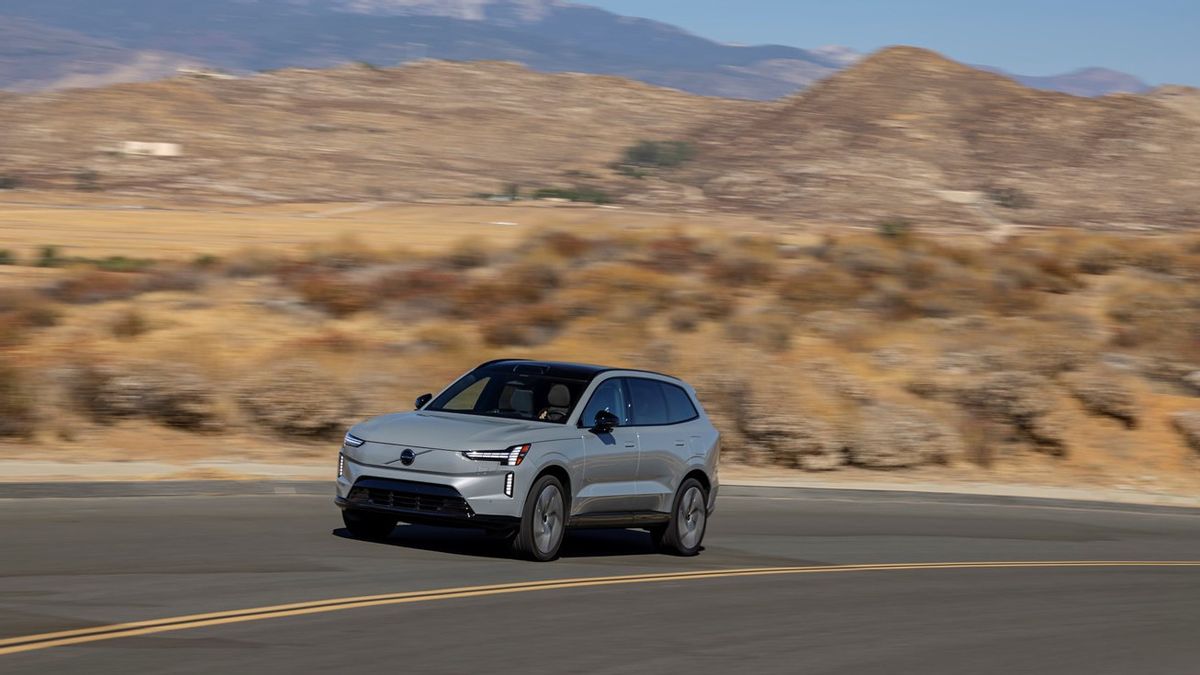


JAKARTA - In the past, even today, Volvo cars have been very well known and have a very strong reputation in terms of the safety and resilience of the hit test. This reputation is not just a marketing claim, but is supported by various innovations and design philosophy that they have applied for decades.
Now in the era of the rise of electric vehicles, well-known Swedish car manufacturers have to adjust their approach in designing cars along with technological changes. This situation forces Volvo to rethink how to protect drivers and passengers, as well as people outside the car.
According to the Head of the Volvo Cars Safety Center, Haglun, the era of electric vehicles presents a significant new challenge. One of the main challenges is the heavier vehicle mass. Electric cars can be 30 percent heavier than gasoline-powered cars, as seen in the Volvo EX90 which is 25 percent heavier than the XC90 SUV.
"The challenge for us is to make whatever car we make safe. Electric vehicles present new challenges," said Haglun, quoted from Road & Track, Monday, September 22.
SEE ALSO:
This extra weight, especially from the batteries placed on the floor of the vehicle, must be taken into account in the collision structure. Haglun explained that the battery is now integrated into the car's "safety suspect" to protect passengers.
Another challenge that is no less important is the front of the vehicle. In conventional cars, large metal engines on the front function to absorb impact energy. Without this engine, the stiffness of the front of the electric car must be strengthened to withstand collisions.
Haglund added that their goal is to engineer cars to be able to deal with various types of collisions, not only those tested in government test standards. This is to ensure the car structure is able to respond to various objects that may be hit.
However, Haglund admits that there is one thing that is made easier by electric cars, namely the absence of gasoline tanks. This means that concerns about fuel leakage when an accident occurs are no longer a problem.
The English, Chinese, Japanese, Arabic, and French versions are automatically generated by the AI. So there may still be inaccuracies in translating, please always see Indonesian as our main language. (system supported by DigitalSiber.id)


