
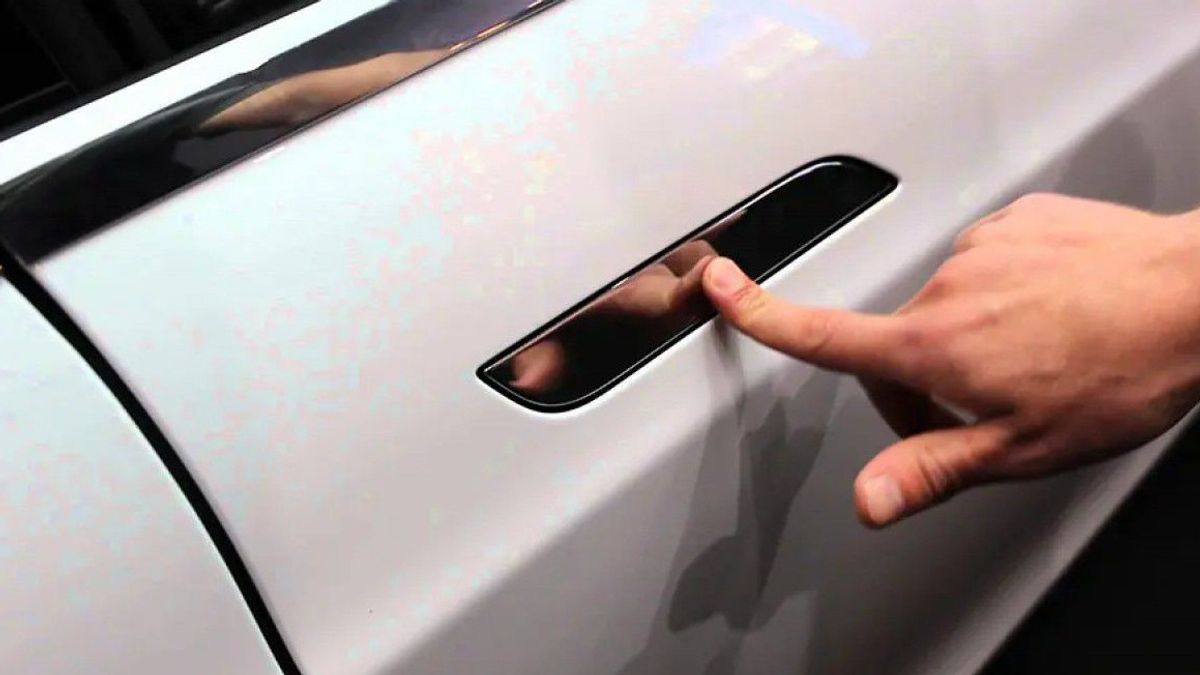


JAKARTA The design of a door handle evenly with a body aka a flush door handle has become a trend in many modern electric cars. At first glance, the appearance is indeed futuristic and is claimed to increase vehicle aerodynamics. However, behind this sophisticated impression, there are a number of problems that are considered greater than the benefits.
Automotive regulators in China are even preparing to take decisive steps to end this trend.
Citing the ArenaEV report, Monday, September 8, Chinese authorities are reportedly close to finalizing a new mandatory standard that will directly prohibit the use of a fully withdrawn door handle. This rule is expected to be published this month, with a transition period of one year, before it officially takes effect in July 2027. After the rules were enforced, new cars sold in China were no longer allowed to use the design of a hidden door handle.
Even so, regulators still allow the use of semi-attracting handles and conventional models, as long as they are equipped with a mechanical backup system that can still function when the vehicle's electricity goes out.
Lack Of Benefits, A Myriad Problem
Car manufacturers have so far reasoned that the design of hidden handles can increase aerodynamic efficiency by lowering barrier coefficients by about 0.03 Cd. However, independent research actually shows much smaller results, only 0.005 Cd equivalent to energy savings of 0.6 kWh per 100 km, a figure that is barely felt for daily drivers.
On the other hand, this modern door handle carries many negative consequences. The driving force mechanism can increase the weight of the car up to 8 kg, is known to be prone to damage, and the cost of production is three times that of the conventional handle. Worse yet, the failure rate is eight times higher.
Local data shows, in one of the popular EV brands, damage to the door handle accounts for 12 percent of the entire vehicle repair case.
SEE ALSO:
-
 | MOTOR
Sempat Bangkrut, Produsen Motor Listrik Italia Energica Siap Bangkit Dari Kegelapan?
07 September 2025, 16:09 -
 | MOBIL
BYD Boyong Sedan Seal 6 DM-i ke Eropa, Tawarkan Jarak Tempuh 1.500 Km
07 September 2025, 14:56 -
 | OTOINFO
Hatchback Baleno Hilang Dari Web Resmi Suzuki, Bakal Disuntik Mati?
07 September 2025, 14:11
Real Dangers To Safety
The most worrying thing is safety. In the side impact test conducted by the China Insurance Automotive Safety Index (C-IASI), only 67 percent of doors with an electronic handle could open. This figure is far behind the traditional mechanical handle which was 98 percent successful.
Cases in the real world also emphasize the dangers.
In winter 2024 on Changchun, several EV passengers were trapped because the motorbike on the handle of the door was frozen.
Still in the same year, heavy rains in Guangdong caused an electrical short circuit, making the door unable to open so passengers had to break the glass to save themselves.
A report from the National Accident In-Depth Investigation System (NAIS) noted an increase in 47 percent of accidents due to the failure of the door handle throughout 2024, with 82 percent of which involved hidden designs.
It didn't stop there, consumer associations also recorded a 132 percent spike in complaints regarding children's fingers which were pinched by an automatic mechanism. Several cases even ended in fractures.
The Sophisticated Trends That Become Boomerang
With a series of problems ranging from high costs, broken vulnerabilities, to safety threats, it's no wonder that Chinese regulators are now preparing to ban it. The innovation, which was originally meant to beautify the design and slightly increase energy efficiency, turned backfired that endangered its users.
The English, Chinese, Japanese, Arabic, and French versions are automatically generated by the AI. So there may still be inaccuracies in translating, please always see Indonesian as our main language. (system supported by DigitalSiber.id)


