
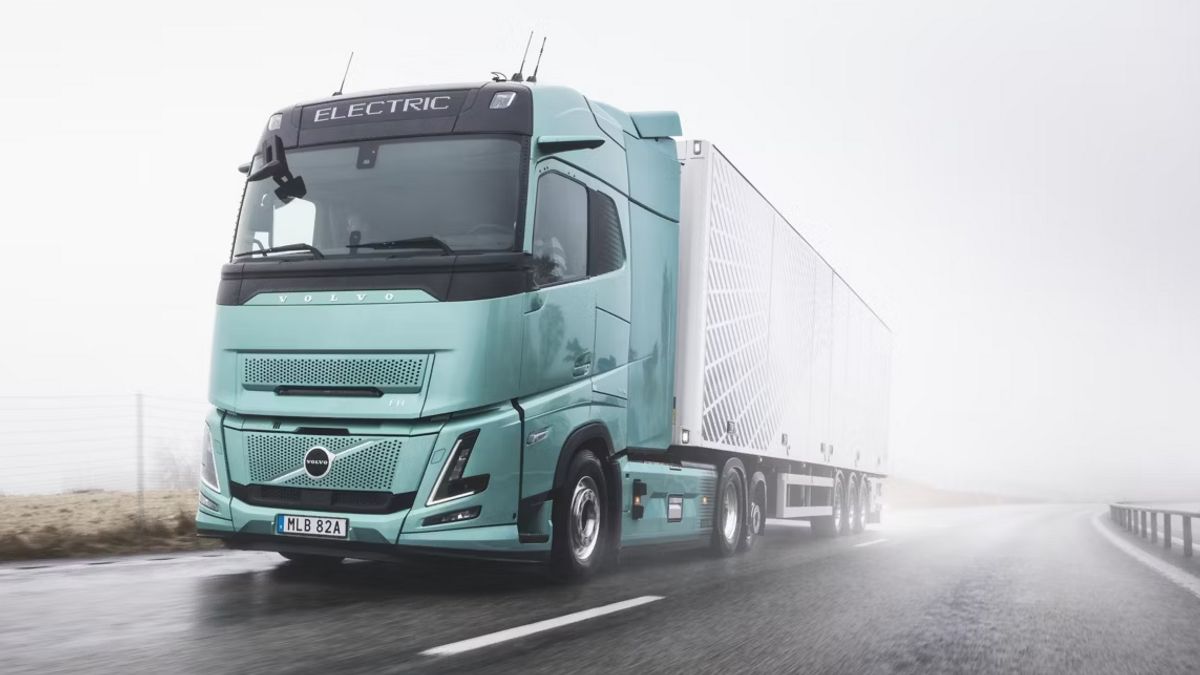


JAKARTA Competition between global producers in developing long-range electric trucks is heating up. As the need for sustainable transportation increases, various large manufacturers are competing to offer solutions for heavy electric-powered vehicles that are able to travel between cities or even across countries. In this arena, Volvo Trucks recently managed to steal attention through the launch of FH Aero Electric, a semi-long-range electric truck that is now one of the leaders in terms of range.
The latest model from Volvo is capable of traveling a distance of up to 600 kilometers in one charge, ahead of its main competitor, Mercedes-Benz eActros 600, which launches in 2023 with a range of 500 kilometers. This increase is not just a number; it marks real progress in efforts to make electric trucks the backbone of future logistics.
Volvo FH Aero Electric is powered by eight battery packages with a total capacity of 780 kWh, and adopts a more compact driveline e-axle technology, enabling extra space for batteries. The truck has also been designed to be compatible with the upcoming super fast charging system Megawatt Charging System (MCS). With this system, the battery can be charged from 20 to 80 percent in just 40 minutes.
"This is a big leap towards zero-emissions transportation. Now, transportation companies can operate long-distance electric trucks without having to compromise on productivity. Super-fast charging and high-charge capacity make this solution very competitive," said Volvo Trucks President Roger Alm, as quoted from the manufacturer's official website, Wednesday, June 4.
The truck will be available in a variety of configurations, including versions with standard cabins, and become an important part of Volvo's growing electric truck line. The Swedish company also offers complete service, ranging from evaluating electrification routes, charging on depots and highways, to monitoring fleet performance in a sustainable manner.
According to the late, Volvo's advantage is not only in its product technology, but also in their experience on the ground.
We have accompanied thousands of customers, both large and small, for more than five years in the transition process to electric vehicles. We have the most comprehensive transportation solutions in the industry," he added.
SEE ALSO:
-
 | MOBIL
30 Tahun Kemenangan Le Mans, McLaren Luncurkan 50 Unit 750S Edisi Spesial
03 Juni 2025, 19:23
However, technological advances have not fully answered the biggest challenge in the adoption of long-distance electric trucks: charging infrastructure. Although the technology promises, the deployment of fast charging stations is still not evenly distributed. Currently, most of the new advances are seen at several points in Europe and North America, after years of simply stopping at the planned stage.
This condition shows that, for the time being, large-scale logistics companies with planned routes and broad networks are still the party that benefits the most from the presence of electric trucks. Daily operation between warehouses without staying overnight is the ideal scenario at this time.
But to achieve an even adoption scale across the industry, it takes longer, perhaps a decade or more. Until MCS charging infrastructure is widely available and transportation-specific electricity rates become more competitive, electric trucks will still depend on their own charging solutions.
Even so, competitions between producers ranging from Volvo Trucks, Mercedes-Benz (Daimler Truck), Scania, to Tesla show a strong industry commitment towards a cleaner logistics future. If passenger electric cars take years to enjoy the convenience across countries, then the road to the electric truck ecosystem may be longer, but no less important.
The English, Chinese, Japanese, Arabic, and French versions are automatically generated by the AI. So there may still be inaccuracies in translating, please always see Indonesian as our main language. (system supported by DigitalSiber.id)
Most Popular Tags
#Prabowo Subianto #donald trump #Febrie Adriansyah #8791 #giias 2026Popular


