
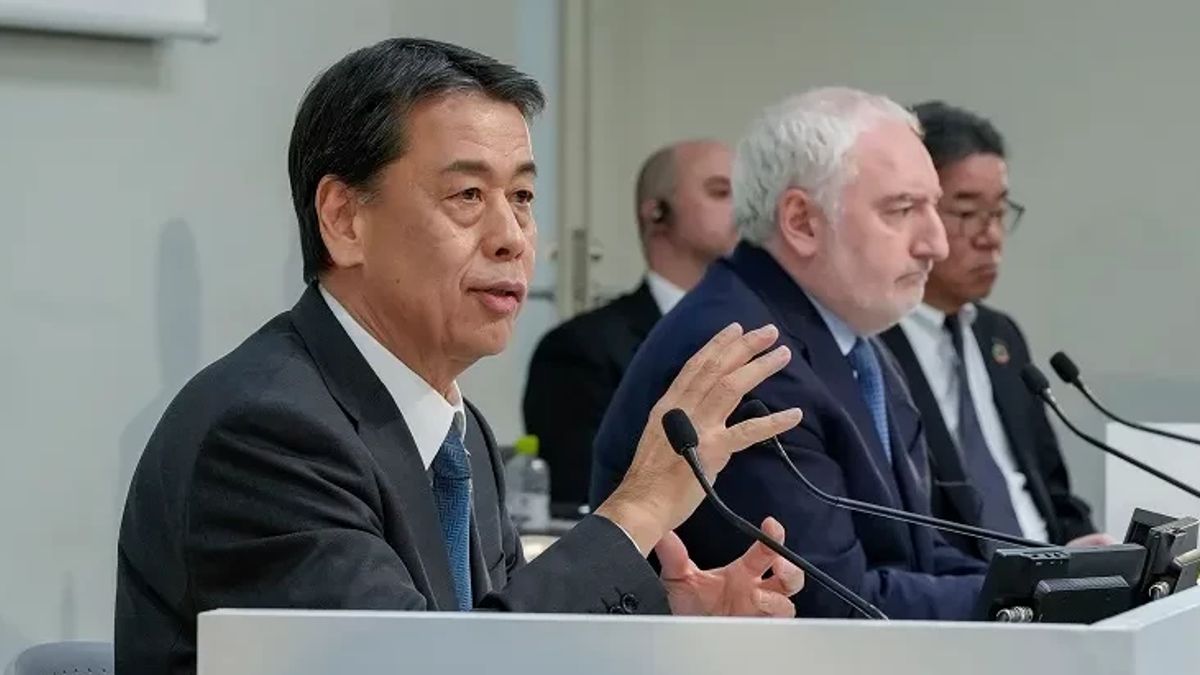


JAKARTA The shocking news has again rocked the Japanese automotive industry. Nissan, the third largest auto giant in Sakura Country, is rumored to be holding a board of directors meeting on March 11.
According to a source quoted from Reuters, March 7, the main agenda for the meeting was to discuss the potential replacement for Nissan CEO Makoto Uchida, whose position was considered increasingly shaky due to the company's declining performance.
No wonder, names like Chief Financial Officer Jeremie Papin, Chief Planning Officer Ivan Espinosa, and Chief Performance Officer Guillaume Cartier, emerged as replacement candidates. However, there is no certainty who will be elected, considering they are all closely related to Uchida's threatened leadership.
The speculation of Uchida's replacement is getting stronger after the failure to negotiate a merger with Honda last month. The plan to form a company worth 60 billion US dollars ran aground in the middle of the road due to differences of opinion, especially regarding the balance of power between the two automotive giants. Honda's proposal to make Nissan a subsidiary a crucial point that eventually canceled the agreement.
As previously reported by VOI, amid this uncertainty, rumors about the potential of the Nissan alliance with Taiwan's electronics company, Foxconn, have surfaced. Foxconn, which has an electric vehicle (EV) division that is currently developing under the leadership of former Nissan executive Jun Seki, is considered to be a strategic partner. Seki's name was once mentioned as a candidate to replace Uchida if the merger with Honda succeeds, or if Nissan establishes a four-way alliance with Honda, Foxconn, and Mitsubishi Motors.
SEE ALSO:
-
 | MOBIL
Genesis Luncurkan G90 Long Wheel Base Black di Korea, Ini yang Istimewa
07 Maret 2025, 21:12


Endless Storm: China's Ghosn Heritage And EV Challenges
The leadership crisis in Nissan is a new chapter in the long drama that began with the overthrow of former Chairman Carlos Ghosn in late 2018. This will mark the fourth CEO's turn in less than six years.
Nissan faces deeper structural challenges compared to its competitors. The legacy of the post-Ghosn crisis, focusing on volume rather than value that damages brand image, failures to take advantage of EV's pioneering with the Leaf, and a hybrid demand prediction error in the US, are a heavy burden to bear.
At the same time, traditional automotive manufacturers are facing serious threats from Chinese EV manufacturers offering advanced cars at competitive prices. Nissan, who is also facing vehicle import rates from Mexico to the US, is now at a crucial crossroads.
Nissan's board of directors meeting on March 11 is in the main spotlight. Who will be chosen as a replacement for Uchida? Will Nissan set up a new alliance with Foxconn? How will Nissan overcome the structural challenges and stiff competition of Chinese EV manufacturers? The answers to these questions will determine the future direction of Nissan in the midst of a global automotive industry storm.
The English, Chinese, Japanese, Arabic, and French versions are automatically generated by the AI. So there may still be inaccuracies in translating, please always see Indonesian as our main language. (system supported by DigitalSiber.id)


